A new report indicates Samsung may debut a full high definition display suitable for smartphones during CES 2013. Could it be destined for the Galaxy S3's successor, or a new device entirely?
Samsung could be preparing to debut its own smartphone-sized 1080p display during CES 2013, hot on the heels of HTC’s Droid DNA. Full high definition displays are all set to be next year’s must-have new smartphone feature, although their size will see them used on hardware that tips over into smartphone/tablet hybrid territory.
A Korean newspaper claims Samsung has developed a 4.99-inch touchscreen with a 1080p resolution and a pixel density of 441ppi. While the resolution is the same as the Droid DNA’s, the pixel density beats it by one point.
It’s unlikely we’ll see the hardware related to Samsung’s new screen at the show though, as it’s not expected to go into production until later in the first quarter of 2013, which means Samsung could follow LG’s example and only show off the panel itself.
There are two logical, future homes for Samsung’s Full HD screen: The successors to the Galaxy S3 and Galaxy Note 2. The slightly odd 4.99-inch screen size could mean it’s destined for the Galaxy S4, as by keeping it under 5-inches — even if it is by a ridiculous 0.01 of an inch — it could still (just) be classed as a true smartphone.
There’s also a chance Samsung could introduce a new device which neatly fits in-between the 4.8-inch Galaxy S3 and the 5.5-inch Galaxy Note 2. An earlier rumor put the Galaxy S4’s announcement for sometime in March, which seemed a little too soon into the S3’s life, however maybe Samsung is planning an event for that time, but it’s for our mystery 1080p phone and not for the S4.
We won’t find out until closer to the time, but provided the talk of a Samsung 1080p screen is correct, we should get to see it in action during CES 2013, which begins on January 8.
In an era of increasingly sophisticated mobile technology, it's tempting to assume that smartphones and tablets provide users with a wealth of content wherever they want it.
But achieving a great multimedia viewing experience in bright light, particularly in sunlight, has been an ongoing problem for the consumer electronics industry.
As anyone who has ever tried to play an immersive game or watch a movie on a phone in bright sunlight knows, the subsequent glare and lack of highlight and shadow makes for a fairly dismal viewing experience.
But all this could be about to change. At IFA 2013 in Berlin, London-based company Apical unveiled an intelligent digital processing technology called Assertive Display, which offers radically improved resolution in bright light, and a dramatically reduced power consumption.
The technology has already been rolled out in Japan, where it features in devices such as Sharp's new smartphone, the Aquos SH-01D. According to Apical CEO Michael Tusch, Assertive Display will transform the mobile viewing experience of gamers and movie viewers alike.
"The whole point of these mobile devices is that we should be able to use them wherever we are," he says. "But unless you're in a dark room, your experience is heavily compromised. If you were a first person shooter game addict, for example, nobody would play that on anything other than a bright screen in a fairly dark room.
"It's the same story with movies. Ideally, you need the 5000-to-1 contrast ratio of a TV to show a movie. An iPad can do 1000-to-1, but if you went outside that would diminish severely, to 20-to1.
"And it's not just in sunlight, it's the same if you're just sitting in a room with windows or with bright lighting. Your multimedia experience is being degraded, and we can avoid that."
YouTube : http://youtu.be/caEPq4KvTTA?t=35m8s
How it works
Most mobile device manufacturers rely on adjusting screen brightness to improve viewing experience. But this is ineffective and the biggest drain on battery power.
Instead, Assertive Display works by adapting the contrast ratio, adjusting each pixel of the video stream in real-time, with very short latency so that you don't notice.
The technology is based on a model of how the human eye works, tuning the pixels so that you can view a movie or play an immersive game in bright light without killing the battery.
Assertive Display off Assertive Display on
The result is a radically improved viewing experience with dramatically reduced power consumption (up to 50%) due to the fact that you no longer require maximum brightness of the backlight to view content.
"The thing to remember is we're not changing the brightness or the power of this display at all," stresses Tusch, "we're just tuning the pixels to adjust the contrast ratio."
Of course, mobile device manufacturers have tried to solve this problem themselves, spending colossal amounts of money on achieving strong blacks on displays, putting anti-reflection coatings on screens, making them brighter and more power efficient.
Assertive Display off Assertive Display on
"But actually, that's pretty much working in the margins," says Tusch. "What we're simulating here is a display that has 100 times higher contrast than we really have. And we're doing it via video processing, as opposed to controlling the display power.
The whole aim of Assertive Display is to adjust the contrast ratio without you ever noticing. Viewing conditions are monitored via the tiny light sensors on mobile devices and the pixels are tuned accordingly.
There is no slider or button to control Assertive Display. It's always on, continuously reading the viewing conditions and controlling the contrast ratio automatically.
Smartphones and tablets featuring Assertive Display technology will be available in the UK by autumn 2013, according to Tusch. While he refuses to divulge which manufacturers will ship products with this technology, it seems clear that it will encompass Apple and Android devices.
One of the major challenges for Apical is overcoming the slow cycle from the design stage through to market. This is due to the complexities of having numerous parties licensing their technologies on the same 'real estate' of the processing chip.
To overcome this hurdle, Apical is seeking to run Assertive Display as software, so that each successive generation of the technology can be delivered as a firmware update or a software upgrade.
Assertive Display off Assertive Display on
To help achieve this, Apical recently joined the HSA Foundation, an increasingly powerful alliance of manufacturers whose membership includes Samsung.
The industry response to Assertive Display so far has been unanimously positive, says Michael Tusch. Most of the major smartphone and tablet makers have seen the technology.
"Just about every company that has seen it has liked it and wanted it," he says. "It's had that real 'wow factor'."
This is not that surprising, considering that Apical appears to be the first company in the world to have cracked the problem of viewing multimedia content in bright light on mobile devices.
This was a point highlighted at the conclusion of Tusch's IFA presentation in Berlin, by Phil Rogers, president of the HSA Foundation.
"I know you're a fairly modest chap," he told Tusch on the keynote stage. "But I just hope people realise that for any colour display today to be viewable in bright light, it has Apical technology. And no one else has solved this have they?"
"Well it's a problem that can't be solved by display alone," replied Tusch. "We've got a solution and it works. So yes, I think you're right."
Huawei has announced the Android-based Honor 2, which comes with some major hardware improvements over its predecessor.
The Honor 2 has a 4.5-inch, 1280 x 720 resolution display with a pixel density of 326ppi. Inside, there is Huawei's K3V2 1.4GHz quad-core processor with 2GB of RAM. The Honor 2 also has 8GB internal memory with a microSD card slot. On the back is an 8 megapixel camera with 1080p video recording.
The Huawei Honor 2 will be releasing in China later this week for 1,888 yuan ($302).
This teardown may give you a tear down your face (credit: iFixit)
The first teardown of the 13-inch MacBook Pro Retina display indicates that the new, super-slim computer from Apple is slightly more repairable than its 15-inch counterpart.
That's definitely a step in the right direction. In its 15-inch MacBook Pro Retina display review, TechRadar said that the computer was "arguably the least upgradeable or repairable notebook around."
In keeping with that, the 15-inch version scored a repairability rating out 1 out of 10 (10 being the easiest to repair) from iFixit four months ago.
The same teardown team gave the 13-inch Retina a 2 out of 10, which is still a long way from making any computer marked "Retina" user-repairable.
Why the 13-inch is easier to repair
Pulling apart the just-released computer and taking photos in the process, iFixit illustrated why the 13-inch Retina model deserved an extra repairability point.
"[Removal of the battery] took us roughly 15 minutes to complete, without the use of a heat gun," iFixit explained, making it sound easy. "All we needed was a Torx screwdriver and three spudgers."
"In contrast, it took us three attempts to successfully remove the 15-inch Retina's battery without puncturing it, and the third attempt took over half an hour to perform."
Replacement of the trackpad was also less intense.
"We are so excited to see the trackpad come out. Just five screws keep the trackpad in place. You can actually replace it if it breaks, which is pretty much impossible on the 15" model - it's covered by the battery."
In no way easy
Of course, iFixit still discovered five major problems in its teardown process.
The battery, while replaceable in 15 minutes, is still glued into the laptop's top case. This makes replacing a bum battery much more difficult compared to past no-adhesive MacBook Pros.
Fans also require more work. They can't be removed without going through the heatsink, so breaking out some thermal paste is a must, said iFixit.
Repairers who want to go beyond the "Do Not Remove" sticker will also need to deal with the proprietary pentalobe screws, which return from the 15-inch Retina model.
From not easy to impossible
Impossible to upgrade is the RAM, which is soldered to the logic board. As iFixit put it: "It will forever have 8GB of RAM."
Finally, and most depressing of all if you don't have AppleCare, it's impossible to separate the display from the glass since they're fused together.
"The display assembly is almost impossible to take apart," noted iFixit. "If anything ever fails inside the display, you'll need to replace the display as a whole."
This is unlike the iPhone 5 display assembly, which iFixit recently found to be more repairable than the previous two iPhone models.
Sony's flagship handset for 2013 is rumoured to pack a 5-inch display and new reports suggest it will also sport WhiteMagic technology.
We heard about a super-sized screen earlier this month after Japanese display manufacturer JDI revealed it was producing 5-inch, 1080p screens with an impressive 443ppi pixel density.
The screen has been linked with the Sony Odin, which is expected to be the Japanese firm's flagship handset for 2013, and new reports suggest it could be packing some seriously clever tech.
It's a kind of magic
Earlier this year Sony explained to TechRadar that the WhiteMagic tech was stuck at 4-inches, which pours a certain amount of cold water on the possibility of this rumour coming true.
According to a recent press release from JDI, the firm is readying prototypes of a 5-inch WhiteMagic display which boasts a 438ppi pixel density – slightly lower than the initial reports we saw from the firm, but never the less still very impressive.
One of the big selling points of the WhiteMagic screen is that it conserves power much more effectively and JDI claims it will have "low power consumption that is approximately 50% less by utilizing an RGBW pixel structure".
This will be a massive bonus for smartphone manufactures, as bigger screens and more powerful innards currently drain batteries quicker than you can say "where's my charger?"
As well as saving battery, the WhiteMagic technology also has another trick up its sleeve: instead of keeping you going for longer, it can be switched to double the brightness of the display, ensuring that your face is illuminated like a Christmas tree.
We can't be sure if the 5-inch, WhiteMagic display will make it into Sony's flagship smartphone next year, but we wouldn't be surprised if it did.
The Sony Yuga had its display and quad-core Krait internals leaked in the not so distant past, and now its camera draws our attention thanks to a leaked Picasa sample photo.
The EXIF data of the photo hints that Sony will be using a 13MP Exmor RS CMOS sensor with f/2.4 aperture. Also, the Android firmware is 10.1.A.0.270, which is said to represent Android 4.1.1 Jelly Bean.
Other than that, the photo doesn't tell us much about Sony's future flagship Android device. The Yuga and Odin are expected to be Sony's flagship models for 2013 and might be unveiled at the Mobile World Congress in Barcelona at the end of February 2013.
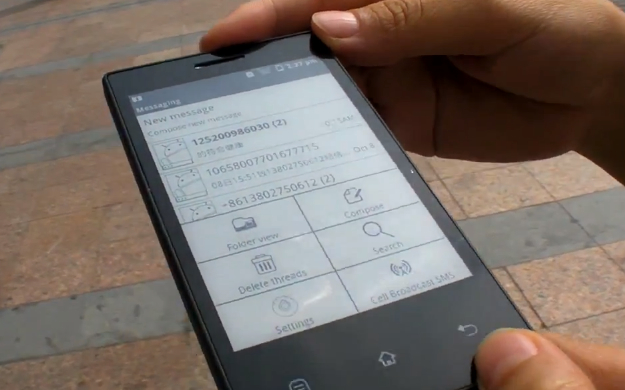
Onyx International, a company known for its range of e-readers, has shown off a prototype Android smartphone with an E Ink display. While the outdoor legibility and battery life are both excellent, the screen does let it down in other areas.
As every owner knows only too well, smartphone screens are difficult to view in direct sunlight, and while pushing the brightness up to maximum can help, it doesn’t do wonders for the battery life.
Here’s an interesting solution to the problem from a company named Onyx International, a smartphone with an E Ink screen. Onyx has plenty of experience in the world of E Ink screens, as it produces the Boox series of e-readers. The handset is only a prototype at the moment, but you can see a working version in the video below, where its screen is compared to a Galaxy Nexus.
The result is spectacular, as the Nexus device just looks like it’s turned off the entire time, while the Onyx phone’s display is crisp and sharp, despite being viewed outdoors. This probably won’t come as a surprise to anyone who has used an e-reader over the past few years, and the superior performance of an E Ink screen in sunlight formed the basis of a recent Amazon Kindle ad campaign.
Surprisingly, the Onyx phone runs Google Android, which has been extensively modified to run on a monochrome screen, but as you can see, the core functionality is still there. Because E Ink screens only take little sips of battery power, the standby time on the prototype is a week. Try that on any other smartphone.
There are, however, one or two little drawbacks. E Ink displays aren’t known for their speed, and sure enough the refresh rate is terribly slow, meaning any multimedia or gaming would be impossible. Viewing text webpages is good though.
While it’s an impressive technical feat and the use of an E Ink screen on a phone certainly has its benefits, the thought of enduring those long refresh times and not being able to do the things that almost all other smartphones can do, would probably make ownership too frustrating. After all, If I wanted a long standby time, a monochrome screen and little else, I’d buy a basic feature phone.
Take a look at the video showing the phone in action and see what you think.
Floats like a Butterfly, stings like a mildly agitated caterpillar
The slightly oddly named HTC J Butterfly has been announced in Japan, sporting a deliciously high-res 5-inch display.
The original HTC J launched in Japan earlier this year, sporting a 4.3-inch qHD display, and the J Butterfly builds on this substantially, boasting an impressive Super LCD 3, 5-inch display with a staggering 1080 x 1920 resolution.
That display, with its 440ppi density, puts the Retina Display on the iPhone 5 to shame, as it can only muster 640 x 1136 at 326ppi, while its big screened rival, the Samsung Galaxy Note 2, may want to go into hiding with its 5.5-inch display at 720 x 1280.
Power
It's not all about the big screen though, the HTC J Butterfly also has impressive specs under the hood, with a 1.5GHz quad-core processor backed up by 2GB of RAM, which will make mincemeat of the Android 4.1 Jelly Bean OS which has been slapped onto the phone.
Round the back there's an 8MP camera capable of recording 1080p video, while the front facing snapper offers up a 2.1MP sensor, and Wi-Fi, Bluetooth 4.0, 4G support and a microSD slot will keep you connected.
The real issue with the J Butterfly is bound to be battery life. HTC has plonked a 2,200mAh juice pack into the handset, which is larger than most of its rivals, but we can still see that huge screen eating through it before the day is out.
The UK and US HTC J Butterfly release date and price are currently unknown, as the Taiwanese firm hasn't mentioned which regions it will be shipping the flagship handset to, other than Japan.
We've contacted HTC about the J Butterfly and possible other territory releases, and we'll update this article once we hear back.
We have been hearing rumors of an HTC phone with a large 1080p display for a while now and it has finally come true. HTC has unveiled the HTC J butterfly in Japan and it is the first production smartphone to have a 1080p display.
The display in question is a 5.0-inch, Super LCD3 with a resolution of 1920 x 1080, which gives it a pixel density of the astonishing 440 ppi. The display is quite big but at 143 x 71 x 9.1 mm, the J butterfly is only slightly bigger than the One X (134.4 x 69.9 x 8.9 mm) and at 140g weighs just 10g more.
Inside, the HTC J butterfly runs on a quad-core Qualcomm APQ8064 Snapdragon S4 processor clocked at 1.5GHz with 2GB of RAM. It has 16GB internal memory along with a microSD card slot.
On the back is an 8 megapixel camera with 1080p video recording and on the front is a 2 megapixel camera. The phone supports LTE and NFC and is dust and waterproof (IPX5). Strangely, for a phone with such specs, the battery is only 2,020mAh. Lastly, the J butterfly will ship with Android 4.1 Jelly Bean out of the box.
The HTC J butterfly is set to release in Japan on AU/KDDI in December. The phone will be sold in three colors: red, black and white. Unfortunately, this particular model will be exclusive to Japan but we are sure to see that glorious display on HTC's future models soon.
The Premiere is said to pack the same display size and resolution as the Galaxy Nexus (credit: unwiredview.com)
While the tech world is still reeling from Samsung's introduction of the Galaxy S3 Mini, reports surfaced on Friday claiming that yet another exciting new Galaxy phone is in the works at the Korean company.
Called the Galaxy Premier, the new device is rumored to lie somewhere between the Galaxy S3 and Samsung's Galaxy Nexus in tech and scope.
At the time, the unknown device was assumed to be Samsung's Galaxy Nexus 2, but the Galaxy Premiere is more than a simple Nexus successor.
Origins of a rumor
The rumor about the Samsung Galaxy Premiere first appeared on German site Mobile Geeks, which may have caught wind of the device at the same event at which the S3 Mini was unveiled.
The exact origin of the Galaxy Premier rumor is unclear, though, and TechRadar reached out to Samsung for clarification, though the company hasn't yet responded.
Either way, the information that's currently available suggests that the Galaxy Premier may only be planned for European markets at this time.
Samsung Galaxy Premiere specs
The Galaxy Premier carries specs that place it in the middle territory somewhere between the Galaxy S3 and Galaxy Nexus, with Android 4.1: Jelly Bean and a 1.5GHz dual core processor.
The Premier is said to pack the same display size and resolution as the Galaxy Nexus, with a 4.6-inch 1280x720 Super AMOLED screen.
According to the reports, the Premier also features a 8-megapixel camera, Bluetooth 4.0, NFC capabilities, and DLNA.
Hopefully, more concrete information about the Galaxy Premier appears soon.
We first heard about the Lumia 510 last month, in a leak that revealed that the low-end smartphone would sport a 4-inch display, have 4 GB of internal memory, and run on just 256 MB of RAM.
Those specs have just been confirmed by our own source, who also sent us the picture above and hinted that the initial price will be $150.
The Lumia 510 is aimed at targeting the entry-level smartphone market, and will likely start in China where smartphone ownership has nearly tripled since 2010.
The device will likely be available there in time for the holidays, and should hopefully see a global release in early 2013.
Sharp has announced it has started production of a 5-inch, 1080p display, which will be coming to a mobile device near you soon.
Many of the current top-of-the-range smartphones — iPhone 5 apart — have screens with a 1280 x 768 pixel resolution or similar, which is good enough to be labelled as HD. However, just as it did with flat screen TVs, 720p is about to be replaced by 1080p — as Sharp has announced that it has started production of its own 5-inch, full-HD smartphone displays.
The new panel boasts a resolution of 1920 x 1080 and a pixel density of 443ppi. As a comparison, the Samsung Galaxy S3’s 4.8-inch display has a resolution of 1280 x 720 and a pixel density of 306ppi, while the 4-inch iPhone 5 has 1136 x 640 pixels and 326ppi.
Sharp may say its 5-inch screen is headed for smartphones, but any device with a display that large usually gets put in the smartphone/tablet hybrid category, joining the likes of the Galaxy Note, Note 2 and the LG Optimus Vu.
The benefits of such a high resolution screen almost go without saying, but Sharp states that it’ll bring “crisp text, super clear maps and amazingly real HD images.” Sharp doesn’t mention on which devices its new super-screen will appear, but along with making its own smartphones, Sharp also supplies screens to other manufacturers too.
The mobile industry loves big numbers, as they help convince prospective buyers that one device is “better” than another, and a 1080p screen with 443ppi is about as impressive as screens can get. Questions will no doubt be raised concerning just how much difference a 1080p resolution and a 443ppi density will make on a screen this small, but answers will have to wait until the first device with such a screen goes on sale — and judging by the increase in activity from these companies, we shouldn’t have that long to wait.
Sharp’s press release notes that the screen will be displayed at the CEATEC show — a CES-style technology exhibition — in Japan, which starts on October 2 and will run to October 6.
Popular display analyzing company DisplayMate has decided to put the iPhone 5 through its various highly scientific tests and pit it against the Galaxy S III. The 4.8-inch Super AMOLED HD display of the Samsung flagship faces the 4-inch IPS LCD screen of the iPhone 5, as well as the 3.5-inch display of the iPhone 4 for good measure.
DisplayMate tested many characteristics of the displays, such as screen reflections, brightness and contrast, colors and intensities, viewing Angles and display power Consumption, running time on battery. So what's the verdict?
According to DisplayMate's lab measurements, the iPhone 5 has a "state-of-the-art-accurate" display, and is the best one they've ever seen, even if there's room for improvement in some areas. Compared to the iPhone 4, the IPS LCD display of the iPhone has lower screen reflections and much higher image contrast. The color gamut is also significantly improved and more accurate than before. But what about the Galaxy S III?
In a word - the OLED technology isn't able to produce the same kind of accuracy that the iPhone 5 IPS LCD does. That's because OLED is a relatively new technology that isn't yet as refined as LCDs are. As a result, it doesn't perform as well as the iPhone 5. However, DisplayMate promises a very bright future for OLEDs as they've been evolving and improving at a very rapid pace.
The display brightness of the Galaxy S III is about half of the iPhone 5 due to OLED's low power efficiency resulting in power constraints. The image contrast and screen readability of the Galaxy S III in high ambient lighting is also poorer than that of the iPhone 5.
As far as the color gamut is concerned, Apple has made a noticeable effort in making the colors as accurate as possible, while Samsung hasn't really done this in their OLED displays. As a result AMOLED displays have inaccurate color representation and over saturated colors.
There's one thing that you should keep in mind however - the DisplayMate tests only judge the screens based on its accuracy. In reality, many people prefer the extra punch offered by the over saturated colors on AMOLED screens, even if they are not as accurate.
Check the source link below to see the the full comparison table with included measurements and assessments.
Nokia has announced two new budget touchscreen phones called the Asha 308 and the Asha 309.
Both are 2G-enabled handsets with a 3.0-inch, WQVGA capacitive touchscreen display, 2 megapixel camera, multiple homescreens, stereo loudspeaker, FM radio and have up to 32GB microSD card support. The phones come with the usual social networking applications and YouTube as well as free 40 games from EA.
The difference between the two is that the Asha 308 is a dual SIM phone whereas the Asha 309 is a single SIM phone with built-in Wi-Fi.
No specific price has been mentioned but the phones are expected to cost around $99 and will start shipping some time in the fourth quarter of this year.
At a special event in South Korea, LG officially launched the most powerful Android phones do date, the Optimus G.
Built around a 4.7-inch True HD IPS Plus display with a resolution of 1280 x 768 (15:9 ratio), the Optimus G is powered by a Snapdragon S4 Pro chipset, featuring a 1.5GHz quad-core Krait processor and the whopping 2GB of RAM. Naturally, this powerhouse boasts LTE connectivity as well as NFC, Bluetooth 4.0, and Wi-Fi with DLNA.
At the back there's gonna be either 13MP or 8MP snapper, both teamed up with a LED flash and capable of shooting 1080p video. Below the back cover resides a 2,100 mAh battery rated for 15h of talk time and 335hours of standby.
Measuring 131.9 x 68.9 x 8.45mm, the Optimus G weighs 145 grams which is pretty good for a smartphone with such large screen and powerful internals. Internal storage is 32GB.
The LG Optimus G runs on Android 4.0 Ice Cream Sandwich, with LG's proprietary Optimus UI launcher on top. However, an update to Jelly Bean is scheduled to follow in the not so distant future. Speaking of the customization LG has put on the Optimus G, it has quite a few outstanding features.
One of the most useful is called QSlide Function and it allows you to split the screen in two and have different apps running in each half. Some of the other interesting ones are Application Link, which launches a pre-defined app once you turn off the alarm and Cheese Shutter for taking pictures with voice commands.
Pricing of the LG Opitmus G is not known yet, but will surface when the device goes on sale in Korea starting next week. Global availability will follow soon afterwards.
With Apple set to unveil its latest iPhone on Wednesday, new images appear to confirm that the Cupertino company is about to introduce a taller, slimmer device, with a widescreen display – imagine a kind of 'stretched' iPhone.
We’re just hours away from Apple’s much-anticipated media event in San Francisco where it’s expected to reveal the latest iteration of its iPhone – but of course, until Tim Cook actually holds up the new device on stage at the Yerba Buena Center for the Arts on Wednesday, the rumor mill will keep on turning.
Prior to the unveiling of a new iteration of a popular device, speculation understandably swirls around how its physical look might alter – will it be bigger, smaller, taller, shorter, thicker, thinner, heavier, lighter? Or, perhaps, pretty much the same?
With the iPhone 5 (or whatever Apple has decided to call it), the latest reports suggest the handset is about to undergo its most radical redesign since coming on the market five years ago.
More information is circulating pointing to a phone that will be both taller and slimmer. MacRumors reader Michael Rou posted a photo (below) on his site showing pre-production cases for Apple’s expected iPhone 5 and iPad Mini devices, made by case manufacturers based on leaked specifications from Foxconn factories in China, where the handset is being assembled. With the current iPhone placed inside the new case, it’s clear that the next version will be taller, though retaining its 2.31-inch width, giving the appearance of a ‘stretched’ iPhone with a widescreen display.
Different images from Know Your Mobile also show a set of cases that are markedly longer than what’s available for the existing iPhone. The photos (one shown below) were obtained from mobile accessories company Mobile Fun. “They’re genuine leather pouches – one of the images even shows the size difference compared to the iPhone 4,” Mobile Fun told KYM. “We’re highly confident that these cases show that the size of the iPhone 5 will be taller than the iPhone 4.”
With the iPhone’s 3.5-inch screen starting to look a little on the small side when compared to its competitors’ offerings, there’s little doubt the next version will sport a larger display – the main question has been whether Apple would opt to push the viewable screen to the edges of the current design, or introduce a taller model. Based on all these images, it appears to be the latter.
As for its thickness, iResQ (via tech2) used received parts to build the casing of the next phone, with one of its pictures (below) showing Apple’s next handset to be marginally slimmer than its predecessor, likely due to the incorporation of a new in-cell display, which is thinner than a conventional LCD touchscreen.
Soon the Apple rumor mill will once again rest. All will be revealed shortly. Deep breaths now, Apple fans, deep breaths….
The Nokia Lumia 920 is a marvelous piece of technology. Nokia has really put its back into making the smartphone standout in several respects such as the extraordinary display and the innovative camera.
Among the last pieces of info that we didn't know about it was its availability schedule. We heard Steve Ballmer saying we are going to see a lot more of Windows Phone 8 in the next month or two, but here's some insider info on the availability of the Lumia 920.
An anonymous source from an Eastern European carrier has whispered to Reuters that they will start selling the Lumia 920 in mid-November, while Western European countries should be getting it even sooner, in the first half of November. When you think about it, November 1 is only 8 weeks from now. Wow, this summer's end is really closing in fast. But we digress.
The release of the Lumia 920 cannot come fast enough. We can't wait to put it through its paces in our obstacle reviewing course.
We put Amazon's new Kindle Fire HD 8.9-inch up against Apple's third-generation iPad with Retina Display in this spec showdown.
Amazon announced today two versions of its new 8.9-inch Kindle Fire HD. The first is a $300 Wi-Fi only version that comes with either 16 GB or 32 GB of storage. The second version includes 4G LTE connectivity, and costs $500 plus $50 per year for 250MB/month of data usage, as well as 20GB of cloud storage. But the real selling point for the both versions of the 8.9-inch Kindle Fire HD is its high-resolution display, which has nearly the pixel density as the third-generation iPad with Retina Display. Another perk is the Kindle Fire HD’s MIMO (multi-input/output) functionality, which Amazon claims will give the Kindle Fire HD 40 percent faster Wi-Fi than the iPad. Below, we’ve put all the specs of the Kindle Fire HD 8.9 and the third-generation iPad head-to-head. Which one do you think is the better deal?
Amazon Kindle Fire HD 8.9-inch vs Apple iPad (Retina)
Kindle Fire HD (8.9-inch)
iPad (Retina)
Price
$300/$500
$500-$830
Thickness
8.8 mm
9.4 mm
Weight
567g
652g
OS
Android 4.0.3 (heavily modified)
iOS 5
System Chip
TI OMAP 4470 (with 1.5GHz ARM Cortex-9 (dual-core) CPU)
HTC One ST is a dual-SIM smartphone intended for the China Mobile network. It packs a 4.3-inch WVGA display and runs on a 1GHz dual-core processor.
The rest of the known specs include a 9.25mm thin profile and 115g of weight. Beats Audio enhancement is also on board.
HTC One ST
The One ST is supposed to run on Android 4.0 Ice Cream Sandwich skinned with HTC Sense 4.0 UI.
There is an NY HTC event coming up on September 19, but we guess this fella will be a topic of another announcement. But looking at all these official pictures, it shouldn't take long for it to break cover.
Amazon's new Kindle Paperwhite line boasts an illuminated screen, sharper display and better touchscreen, while the ,ost basic Kindle will now sell for $69 and gets a host of improvements as well.
The new Kindle hardware inarguably stole plenty of attention at today’s event. Amazon CEO Jeff Bezo’s waxed lovingly about the lineup as well as users’ love for it before introducing us to the Kindle Paperwhite, the latest addition to the Kindle family.
“We love to invent. We love to pioneer,” he said. “We even like going down alleys that turn out to be blind alleys.” Bezos also explained that while Amazon is a risk-taker, it’s also perfectly happy when it strikes gold – and that it certainly has with the Kindle.
The Kindle Paperwhite is a significant upgrade, and features plenty of what we all thought it would: It’s a frontlit, E-Ink reader, with much higher resolution and contrast. The screen now boasts 212 pixels per inch, which is 62 percent more resolution than the last version, and contrast has been increased 25 percent from current Kindles. What else? The Paperwhite also gets rid of the Kindle’s infrared touch technology in favor of capacitive touch, and includes patented light guide technology (which Bezos called highly adjustable). It’s a slim 9.1 mm and 7.5 ounces, with eight weeks of battery life (even with the light left on).
And those are just the hard specs. Amazon has done a lot of work on font display, and the Kindle Paperwhite is able to analyze your reading speed and tell you how much time it will take you to finish a chapter or book. Other new features include author bios, and as you’d expect you can switch between content saved to your Kindle, connect to the cloud, and use X-Ray content analysis for tracking characters and story development.
The Kindle Paperwhite Wi-Fi model will cost $119, and the 3G-enabled version $179. You can order both now, and they will ship in October. In addition to the new devices, Amazon also has an upgraded its entry-level Kindle and cut cost from $79 to $69. The new version has better contrast and resolution, crisper fonts with more text, and faster page turning. It will ship September 14.
Of course, this is only a sampling of what Amazon is announcing today. We’ll be at the event and bringing you more news throughout the day.