HTC and Verizon have sent out invitations to a press event on November 13, where it's rumored to be announcing the Droid DNA, the US version of Japan's J Butterfly smartphone that's equipped with a 5-inch, 1080p display.
Phone fans could be in for a treat next week, as HTC and Verizon have sent out invitations to a press event to be held in New York on November 13, where we could get the first 1080p smartphone/tablet hybrid launched outside Japan.
The invite doesn’t appear to contain any hidden messages, showing nothing more than a lens-flared light on a dark background, but a few leaked press pictures could give us a better idea what these long-time partners are preparing for us.
The images popped up on @evleaks’ Twitter account this week, and show a big-screen, Verizon-branded HTC smartphone that bears a striking resemblance to the HTC J Butterfly.
Quite how such a bizarrely named phone could slip you memory, we’re not sure; but just in case it has, here’s what it’s all about. Announced last month in Japan, the J Butterfly has a 5-inch display with a headline-grabbing 1080p resolution. It seemed inevitable that HTC would let the Butterfly spread its wings at some point, and the Verizon event seems like the ideal launchpad.
Five-inch, full HD touchscreens are set to be the next big thing in the world of the smartphone display, with Sharp’s 1080p IGZO screen making its debut this week, and LG confirming recently that it’s also working on a similar panel.
It’s highly unlikely the J Butterfly name will remain on the US version though, and instead it’s likely to be another “Droid” device, this time the Droid DNA. That name has appeared on both the FCC’s website and a leaked Verizon price list, and has superseded other possible names including the HTC DLX and the HTC X5. Neither of those names are dead though, and could be used for a GSM version of the phone.
If the 5-inch, 1080p screen isn’t enough to get your pulse racing, then should the Droid DNA share the J Butterfly’s other features, it will also have Qualcomm’s high performance, 1.5GHz, quad-core Snapdragon S4 Pro processor, plus Android 4.1 Jelly Bean as its operating system.
Previous leaks have suggested a December 6 release date for the phone, but we’ll have to wait for the November 13 event to confirm this, and all the other details concerning HTC and Verizon’s new device.
HTC has sent out invitations for an event in New York City, which will take place next Tuesday, November 13. The Taiwanese manufacturer will show off its “latest collaboration” with Verizon Wireless.
Given the recent string of leaks, we can all but confirm that the device scheduled to break cover is the HTC DROID DNA. The upcoming smartphone appears to be a close relative of the Japan exclusive HTC J butterfly. It is bound to pack an eye-catching 5” Super LCD3 display with 1080p resolution and pixel density of 440ppi. Quad-core Snapdragon S4 Pro silicon, 16GB of built-in memory, microSD card, and Sense-d Android 4.1 Jelly Bean are also part of the device’s projected specs.
We are going to be live from the HTC event next week, so we’ll tell you all about the company’s latest creation.
HTC today announced a new Android based dual-SIM smartphone in an event in Singapore. The Desire SV, as it is called, will go on sale in India this month and will sell for ₹22,590 ($420) unsubsidized.
The Desire SV has a 4.3-inch Super LCD2 with a resolution of 800 x 480, dual-core 1GHz Qualcomm Snapdragon S4 processor, 768MB RAM, 4GB internal memory with microSD card slot, 8 megapixel camera with LED flash, BSI sensor, f/2.2 aperture and 28mm lens, WVGA video recording, Bluetooth 4.0, GPS, Wi-Fi, Beats Audio and a 1,620mAh battery. The phone runs on an unspecified version of Android (we are hoping it's 4.1) with HTC's Sense UI on top.
The big Microsoft event came and went and there wasn’t even a word about Windows Phone 7.8. Joe Belfiore and co didn’t even announce a date when the update will be released, but it will probably be a while after WP8 hits the shelves (which is already happening).
Whoever is managing the Windows Phone Italia Facebook page was more talkative, however, and answered a question from a fan, revealing the new features that v7.8 will bring. The response has been deleted since.
The list includes the new homescreen (which we already knew), something called 'Club', which we guess is Rooms, Xbox Music and SmartGlass.
Facebook is hardly a reliable source of info, but the features listed seem quite probable - we already know about the homescreen, Rooms and SmartGlass are available for other OSes too, so it's unlikely they will be excluded from WP7.8 and Xbox Music will bring the existing user base to Microsoft's new music service.
In case you don't know yet, Windows Phone 7.8 will be released for 7 and 7.5 devices, as the old hardware won't get updated to WP8.
Update: We had more hands-on time and got to dive into the OS at the Windows Phone 8 event in San Francisco – here are some further thoughts from U.S. Associate Reviews Editor Alex Roth.
HTC has doubled down on Windows Phone 8, creating two colorful handsets, the compact HTC Windows Phone 8S and the more powerful HTC Windows Phone 8X. Both devices are available in four colors that help them stand out from the smartphone pack, although consumers might confuse them with the also splashy Nokia Lumia 920.
We've already reviewed the HTC Windows Phone 8X and found it to be a slightly mixed bag that's more good than not. Now, at the Windows Phone 8 launch event in San Francisco, we took a hands-on look at the 8S, just weeks ahead of its rumored November release date.
Showing its colors
Other than perhaps those distinctive Windows 8 Live Tiles, the first thing you'll notice about the HTC Windows Phone 8S are those bold colors it's available in. Gray, black, red and blue are the four primary colors on offer.
Unlike the 8X, which comes in a single solid color, the 8S has a two-tone look. The bottom of the phone's face and the rear cover each sport a lighter hue. Red is met by orange and blue by a lighter blue. Black has a white stripe, giving it an Oreo cookie look, and gray with lime green, which comes of a bit like a crossing guard's vest.
Premium plastic
Holding the 8S, we were struck by its feel in more ways than one. Its polycarbonate construction has a distinctly rubbery feel. It's grippy and honestly fun to hold. There's an unmistakably plastic feel, but not the flimsiness you'd find with a budget phone.
That rubbery quality is a nice touch, but did have us worrying that it might pick up lint in our pocket and make the 8S lose some of its trademark luster.
The phone's Gorilla Glass face, rounded backside and highly tapered edges give it a sleek appearance. This makes the feel of its easy-to-hold rubberized body all the more surprising.
On the inside
The Windows Phone 8S by HTC has good specs for what will likely be a moderately priced device. While we don't have a firm word on costs yet, it will undoubtedly go for less than the 8X, which is $560 as a full priced, no contract device.
In the processor department it has a very standard 1GHz dual-core Snapdragon processor. The display is a rather sharp 4-inch, 720p screen. For memory there's 1GB of RAM and 4GB of onboard storage, with room for an additional 32GB via microSD expansion. That actually puts it above the 8X, which is stuck at 16GB of space thanks to its lack of expandable memory support.
All the right buttons
As with the 8X, the Windows Phone 8S's lock button is found on top of the phone. Depending on what sort of device you've grown accustom to, this placement may take some getting used to.
There's a volume rocker on the right side with the standard issue Windows Phone 8 dedicated camera button below it.
Pop-off panel
That two-tone space on the rear is actually a pop-off panel, allowing you access to a microSD slot. Again, the 8X lacks such a feature, and the 8S is only a tiny bit thicker for having a more open design. It's 0.41-inches (10.3-mm) thick, as opposed to 0.40-inches (10.1-mm).
This small, removable panel is easy to slide off thanks to the phone's rubberized build. While the lack of removable battery will disappoint some consumers (the cell is only 1700 mAh, after all), the miniature hatch design is yet another distinct design decision for the Windows Phone 8S.
The HTC touch
In addition to what Windows Phone 8 offers, HTC has contributed some software of its own. Its Live Tile behaves like an Android widget, displaying a forecast, temperature and the time at a glance.
Jumping into the app gives further information on those subjects as well as stocks.
In settings you'll find Attentive Phone, which has a selection of intuitive ringer options. The Windows Phone 8S can be set to ring louder when tucked away in a pocket or purse, automatically quiet down or shut up altogether when you pick it up or turn it over.
Taking pics
Like all devices running Windows Phone 8, HTC's 8S has a dedicated camera button. Pushing it opens up the 5-megapixel camera, which can also shoot 720p video.
If you feel like slapping some Instagram-style post-production on your snaps, HTC has included its own Photo Enhancer app. It has a number of filters to choose from, including the all-popular vintage style.
Alas, this is not a phone for video chat fans as it lacks a front-facing camera.
Beats by Dre
The Windows Phone 8S has surprisingly good external speakers. We were able to crank pre-loaded tracks to a high a volume without getting distorted, crunchy sound. While any music aficionado would surely use headphones, a representative reminded us that these speakers benefit the speakerphone function as well.
As the familiar "B" logo suggests, there's Beats by Dre branding here, which likely plays into the strong audio output. However, the 8S does not boast the volume-boosting amplifiers of its big brother the 8X.
Early Verdict
If we had a to pick a favorite aspect of the Windows Phone 8S by HTC, it would have to been its overall look. Between the iPhone 5, Galaxy S3 and Droid Razr M, we live in a sea of polished aluminum. In the past, we've claimed to prefer its feel, but HTC's 8X and 8S have proven that a little aesthetic variety is indeed nice.
It's a compact phone that's still got reputable specs, and the option for microSD expansion is an unexpected plus, given the 8X's completely sealed design.
We do wonder what its battery life will be like with a 1700 mAh cell, and the lack of front-facing camera is rather strange. A special version of Skype has been one of Mictosoft's major bragging points with Windows Phone 8, and seems the 8S won't be able to enjoy all the benefits. This could be corner that was cut to make a highly affordable device, making us all the more eager to get firm pricing numbers, and equally eager to give the 8S a full-blown review.
Below is our original and early hands-on look at the Windows Phone 8S by HTC.
TechRadar got early access to the Windows Phone 8S by HTC, and while we admired it's aesthetic merits, it wasn't running a finished version of the OS – we will be updating this review soon as we get hands on with the finished product at HTC's event in New York.
The Windows Phone 8S by HTC, which is its proper title don't ya know, launched alongside the HTC 8X at a special HTC event in New York, where the Taiwanese firm unveiled its first Windows Phone 8 handsets.
Both, we're told, will go on sale in early November and the Windows Phone 8S will be available in a range of two-tone colour options; California Blue, Graphite Black, Flame Red and Limelight Yellow – the latter being the one we've laid our hands on.
The HTC Windows Phone 8S price is currently un-known, but as this is clearly a mid-range handset we expect it to rival the likes of the HTC One V and Sony Xperia U.
Design wise the 8S can be compared to the One V and Xperia U, with a separate chunk below the screen – although it stays flush with the device instead of curving forwards as on the V.
Like the Windows Phone 8X, the HTC 8S isn't the slimmest handset at 10.3mm, but the taped edges provide the illusion that it is thinner than it is, and the tidy 120.5 x 63mm frame gives a sleek finish to decent looking device.
The Windows Phone 8S sits comfortably in the hand and at 113g it's nicely weighted without feeling like a cheap toy.
The 4-inch, WVGA (800 x 480) display dominates the majority of a relatively minimalist front, which also features the Windows, back and search soft keys on the colour bar below and the matching earpiece above.
There's a power/lock key and 3.5mm headphone jack sitting on top of the 8S, while a volume rocker switch and camera button reside on the right hand side of the handset.
The buttons are easy to hit, and thanks to the small stature of the HTC 8S you don't need to stretch your fingers to far to reach any part of the handset.
A microUSB port is found on the base of the Windows Phone 8S, and you can slide the rear of the coloured section off to reveal a microSIM slot and a microSD slot – allowing you to build on the 4GB of internal memory.
There's no access to the 1,700mAh battery though, which may annoy some of you who like to stick bigger power packs in your phones, but it should keep you going for a whole day with a decent level of usage.
We'd expect the 1GHz dual-core S4 processor and 512MB RAM to run Windows Phone 8 without too much of a fuss, however as we were only able to access the lock and home screens on the HTC 8S, you'll have to wait for our updated hands on review to find out how it gets on.
That said, the display was still clear, and although not as pin-sharp or vibrant as on its bigger brother the Windows Phone 8X, it's still a perfectible acceptable for what we expect to be an affordable smartphone.
Round the back there's a 5MP camera, with single LED flash and 720p video recording, and HTC has ensured it comes with a f/2.8 aperture and 35mm lens for improved picture quality.
It's good to see the dedicated physical shutter button on the side of the 8S, allowing you to launch the camera app and snap photos easily – something we find easier than trying to tap the onscreen alternative.
As we mentioned at the start, we'll update this review later today with our findings from the fully working version of the Windows Phone 8S by HTC, after we've spent some time with it at the event.
Early verdict
It's obviously difficult to give a proper early verdict at this point, but once we've had a play with the final device today, we'll update this with a more informed outlook.
Design wise we reckon the Taiwanese firm is on to a winner with the HTC Windows Phone 8S, but we'll reserve proper judgement until we've spent some time with the fully working device in New York.
Hurricane Sandy may have forced Google to cancel the New York event, but even the storm can't stop LG from announcing the Nexus 4. The phone leaked extensively, so there's little about it that's unknown (it's based on the LG Optimus G), but let's go over the specs one last time.
The LG Nexus 4 has a 4.7" True HD IPS Plus screen with WXGA resolution (768 x 1280, 15:9 aspect ratio). It's powered by a Snapdragon S4 Pro chipset with four Krait cores at 1.5GHz, 2GB RAM and Adreno 320 GPU.
The phone is running Android 4.2 Jelly Bean (so no Key Lime Pie) and you get a choice between 8GB and 16GB storage options (there's no microSD card).
The camera on the back has an 8MP sensor and it has a cool feature called Photo Sphere. It's like a panorama, but you can snap photos in every direction you like - sideways, upside-down, wherever.
The Nexus 4 measures 133.9 x 68.7 x 9.1mm and weighs 139g. It has a 2,100mAh battery, which has enough juice for 15.3 hours of talk time or 390 hours of standby. The phone supports wireless charging.
As far as connectivity goes, the LG-made Google Nexus 4 will have GSM/HSPA+ and NFC (unlike the Optimus G, there's no LTE). We suspect there will be a CDMA version later on, but there's no info on that just yet.
The first LG Nexus 4 phones will be available from the Play Store in US, UK, Canada, Germany, France, Spain and Australia starting November 13. If you prefer brick and mortar stores, the you'll have to wait until the end of November when the Nexus will hit Europe, Central/South Americas, Asia, CIS and the Middle East.
The 8GB version (unlocked) is priced at $299, while the 16GB version is $349. T-Mobile USA will carry the 16GB LG Nexus 4, though with a price of $199 and a 2-year contract, it doesn't sound like much of a deal.
Google's October 29 event has reportedly been cancelled after a state of emergency has been issued in the US due to the imminent arrival of Hurricane Sandy, which will be passing through New York City, Google's venue for the event.
Although Google did not announce the specific purpose of the event, other than calling it an 'Android event', it was generally assumed that the company was going to announce the LG manufactured Nexus 4 smartphone and a 10-inch Samsung manufactured Nexus 10 tablet.
The event has likely been postponed to a later date although we are yet to hear when exactly it will be taking place. Meanwhile, Microsoft's Windows Phone 8 event in San Francisco is still on track, so we still have something to look forward to.
It's the Friday before a big tech event, so that only means three things: leaks, reports and rumors.
Among the whispers are a few rumblings suggesting a new Android keyboard could make an appearance at Google's shindig in NYC Monday, perhaps as part of an Android 4.2 update.
The new keyboard is rumored to have Swype-like functionality, where users trace their finger over letters as an alternate typing method.
Rather, it is more fitting of Google's style to update its official keyboard while Swype remains an alternative for users to choose in the Google Play store.
Nexus Keyboard not the default?
Despite the report, changing the default Android keyboard may be too large of a shift for Google, as well as for some users. Google's new keyboard may also take the form of a separate Nexus Keyboard app.
As a separate app, the rumored Nexus Keyboard would match Google's pattern of offering alternatives to its own default Android services.
Google Maps, Google Mail and most recently Google Calendar have all broken off as independent apps to offer additional features compared to Google's default counterparts.
Perhaps more importantly to note, HTC and Sony have both begun preloading Android smartphones produced by the companies with native Swype-like keyboard.
A Nexus Keyboard app would step on far fewer OEM toes than a fundamental change to the default keyboard.
The rumored Nexus Keyboard could make its debut with the frequently leaked LG Nexus 4 handset, which is expected to be one of the featured devices at the event.
A Swype-like keyboard is on TechRadar's Android 5.0 Key Lime Pie wishlist, but Google could still surprise us with a Nexus Keyboard update before the new OS surfaces.
Tim Cook took the opportunity to spice up a generally boring earnings call event by talking some smack. Setting his aims on seven-inch tablets and Microsoft, Cook made his opinion known on his company's competition while still managing to brag about Apple's future.
Tim Cook is starting to really embrace his role as Apple’s CEO. He’s had the position for over a year now but he finally seems to be getting the hang of filling in for Steve Jobs. The past few days have shown his biggest marks of progress as he’s spewed out several almost unjustifiably cocky statements about Apple’s creations while simultaneously attacking his competition. Jobs was the master of this art and managed to set the bar rather high for his successor. One of his more famous remarks was about his well-known distain for seven-inch tablets, and today we learned that Tim Cook agrees.
Always up for a challenge, Cook decided today’s Apple earnings call would be a good place to start dropping gems of wisdom and All reports seem to point to Cook putting on quite the show for his company. Between reciting numbers about growth and doing some masterful spinning on some of the tough situations like iPhone 5 rollouts, he also managed to make time to pat himself and Apple on the back with one hand while driving a knife into the hopes of Microsoft and others. Here’s a quick round up of some of our favorite quotes from Cook’s instant classic of an earnings call.
iPad Mini Pricing
When asked about the pricing philosophy that Apple uses when deciding the cost for one of its products, specifically the iPad Mini, Cook did his best to explain how quality justifies the cost: ”One of the things we try to do is to create a product that people will love for months and years and continue using. That’s what iPad mini is designed to do.” The emphasis here should be on months if you’re an iPad owner. Everyone excited about that new Lightning connector?
It’s not seven inches
The iPad Mini has been a point of contention in Apple’s overall plan, mostly thanks to Steve Jobs’ instance in the pointlessness of that size. Presented with a question about the company’s about face on the smaller sized tablet, Cook took the opportunity to defend the product.
“We would not make one of the seven-inch tablets. We don’t think they’re good products, and we would never make one. Not just because it’s seven inches, but for many reasons. One of the reasons, however, is size. The difference in just the realistic size between 7.9, almost 8, versus 7 is 35 percent.” Feel free to fast forward to the next major Apple event where Cook brags about having the fastest selling 7.9 inch tablet on the market.
Not entirely satisfied with that answer, Cook continued to defend Apple’s little tablet. “When you look at the usable area, it is much greater than that. You know, it is from 50 percent to 67 percent. And also the iPad Mini has the same number of pixels as iPad 2 does.” If you think about it, saying the iPad Mini has the same display power as a product you essentially made obsolete in the same press conference might not be the best line of defense.
Surface tablet neither flys nor floats
Having talked enough about his own company for awhile, Cook moved to discussing Apple’s newest competitor, Microsoft. When asked about the launch of the Surface tablet and how that may change the market, Cook was quick to go on the attack. “I haven’t firstly played with the Surface yet, but what we are reading about it is that it’s a fairly compromised confusing product. …I suppose you could design a car that flies and floats, but I don’t think it would do all of those things very well.” T-Minus 5 minutes before the web blows up with rumors of an invitation to another Apple event announcing a car, and 10 minutes until rumors of an iCar Mini.
We’re not sure if this has been in Cook’s repertoire this entire time and he’s been holding back, but we hope it continues. It’s fun to see guys in Cook’s position speak with some passion and confidence is entertaining. Let’s put it this way, it takes a lot to make a call about earnings interesting to those that aren’t rolling in the profit announcements.
The General manager of HTC North Asia, Jack Tong announced at a press event that the Android 4.1.2 Jelly Bean update will start rolling out for the One X today. He also said that the One S will also be graced with the firmware update, but didn't specify a time frame.
The new firmware update will not only bring the One X to the latest Android release (not counting Monday's Google announcement, of course), as well as the latest Sense UI version.
Jack Tong also mentioned the One X+ and One S SE updated edition, which will hit shelves in Asia on October 30. No other markets were mentioned, but we recon they shouldn't be too far behind the schedule.
Everyone expected today’s Apple event to be all about the iPad mini, but it turned out that the Cupertino-based company had a surprise for us. Apple unveiled the fourth generation of its iPad iOS-running tablet.
The Apple iPad 4 comes with a new A6X chipset, which promises twice the CPU and GPU power of the A5X that the iPad 3 used. It also packs the new Lightning connector and its LTE version has now been updated to support the Sprint network in the US, among others.
Apple iPad 4th Gen
Other than those that the Apple iPad 4 is identical to its predecessor, which was announced at the start of the year. Sporting the same 10 hour battery life and 1536 x 2048 pixel display as the iPad 3, the iPad 4 base version will cost the same $499. The LTE-enabled units start at $629.
The iPad 2 will also stick around - it will retail, starting at $399 now. Shipping of the Apple iPad 4 Wi-Fi units starts on November 2, with the LTE-packing ones coming two weeks later.
Google always seems to have something up its sleeve, but at least some of its cards are already turned. The company's October 29 event looks like it will reveal a refresh to the Nexus 7, a 10-inch tablet, the LG Nexus 4, and a new installment of the Android OS.
The month of October appears to be “steal your competitor’s spotlight” month, with almost every major mobile company participating in press conference one-upmanship. Trying to get the last word in before the month closes is Google, with an unveil that is scheduled for the same day as Microsoft’s Windows Phone 8 event. Google is tagging its event with the phrase, “the playground is open,” and will likely have a lot of hands on available for attendees. October 29 will be a busy day, so here’s a cheat sheet of what to expect from the search engine turned major mobile player.
Nexus 7
As many expected, the Nexus 7 will be one of the stars of the show with a 32GB model. It appears that may not be the only change to the internals on seven inch tablet, as a 32GB with HSPA+ (3G) support is expected by some sources. This likely won’t be the Asus manufactured $100 model that was previously rumored, but the Nexus has been a leader in the budget-friendly tablet category.
10-inch Samsung-made Tablet
Hiding behind the internal alias of Codename Manta is a 10″ tablet manufactured by Samsung. This project has been the source of rumors for the past month, and it looks as though it may be confirmed at the October 29 event. According to sources reported on by The Next Web, the taller tablet will feature 300 pixels per inch spread across a 2560 x 1600 resolution display. The third generation iPad has 264ppi by comparison. The 10-inch device is also said to come running Android 4.2.
LG Nexus 4
While the handset has been cycling around the rumor mill for the Google event, it appears the LG Nexus 4 has RSVPed. The smartphone will be made by LG and will run with a quad-core 1.5GHz Snapdragon processor. That, along with 2GB RAM, will power the 4.7 inch device and its 1280×768 display. The device will also sport a 8-megapixel rear-facing and 1.3-megapixel front-facing camera and 16GB of on-board storage. The Nexus 4, like the 10-inch Samsung tablet, is believed to run Android 4.2.
Android 4.2
The operating system formally know as Key Lime Pie will likely retain the Jelly Bean title of Android 4.1. The OS appears as though it will go at iOS 6 head on by including a panoramic camera feature with support for both vertical and horizontal settings. It will also aim to surpass its competitor with a feature called “content in the center,” which will allow for Play Store access from a widget. Tablet Sharing will also be introduced, essentially creating profiles for tablets that are used by multiple people.
The Asus event, which brought us the new Padfone 2 smartphone/tablet was over all too quickly and some details almost slipped through. Among them were the Jelly Bean update schedule and the keyboard dock, which wasn’t presented.
According to an Asus representative, the company plans to have the Android 4.1 update ready by November. This means that even if you are among the very first to buy it, you will only have to wait a couple of weeks to get it.
As for the keyboard dock, that's still in development too. Asus says it's trying to create the best keyboard dock possible, but didn’t commit to a time frame. Of course, there's a possibility that Asus might ax the dock, but chances of that happening are slim.
Google has just sent out invites to the media for an Android event to be held on October 29. The event will be in New York at 10:00 AM and will be streamed live on YouTube.
As far as the purpose of the event is concerned, our psychic powers tell us it is going to be a new Nexus device, the same LG manufactured unit currently known as the Nexus 4 we have been seeing for a while now. There is a possibility that there could be multiple Nexus phones this year but other than some rumors we have seen zero proof to confirm that, so we won't be holding our breath for them.
It's likely that Google will launch this new Nexus device with a new version of Android, most likely the Android 4.2 that has been floating around these days. Other than that we expect to hear some updates on the Nexus Q, which has been an unmitigated failure since it was launched during Google I/O, enough for Google to pull it off shelves and go back to working on it. Google could also announce the 32GB Nexus 7 that we have been hearing about recently.
You may have noticed by now that the October 29 date coincides exactly with the Windows Phone 8 launch date and it would be naive to think that's a coincidence. Google must be pretty confident in its product(s) if it thinks it can go head to head with multiple Windows Phone 8 devices on the same day. We'll just have to wait and see how things turn out.
Brace your wallets cause next week is going to be a doozy.
Google has sent out press invites to an unspecified Android event on October 29 in New York.
Following recent speculation, the event is likely to showcase the next Nexus smartphone, which is widely thought to be the often-leaked LG Nexus 4.
Reports have also suggested HTC has been working on a 'Nexus 5' phablet, while Google-branded Sony and Samsung devices have also been mooted.
Multiple devices launches would not be a huge surprise, following widespread reports that Google intends to break from tradition and work with multiple manufacturing partners for the next Nexus launch.
The event is also likely to bring news on Android 4.1 Jelly Bean updates, so it would be a major surprise if there were any mention of the forthcoming Android 5.0 Key Lime Pie OS just yet.
The invitation itself features the Google search bar widget from Android filled with the cryptic message 'The playground is open.' Behind it, and the company logo is image of the New York City skyline.
The press conference will take place at 10am ET (That's 3pm UK time) and will also be live-streamed for the masses at YouTube.com/Android.
Apple has announced its latest media event a week before Microsoft's big Windows 8 party. This show of aggression may be designed to crush the threat of the Surface tablets early on, but could have been made out of fear rather than aggression.
Apple hates Android and wants to undermine Google at every opportunity. The evidence is everywhere, from Steve Jobs’ infamous willingness to “go thermonuclear” on the OS, to the banishing of Google Maps and YouTube from iOS 6. But it’s been more than a decade since Apple has appeared to loathe Microsoft. Yes, they used to be bitter rivals, but that was in a different time. Or, at least, we thought it was. But with Apple holding a major press conference on October 23, just three days before Windows 8, Windows Phone 8, and Microsoft’s Surface tablets go on sale, it’s apparent that it once again considers Microsoft a threat.
Microsoft has been building up to this moment for a while, and make no mistake the Oct. 26 launch of Windows 8 is the company’s big moment of 2012, and possibly 2013 too. Windows 8 is the basis of the Microsoft’s strategy and product plans for the coming years, and it’s vitally important that it succeeds and gets good buzz.
Apple however, wants to assert its position, and will do so on Oct. 23, regardless of the products it launches. If the rumors are true and it shows a 13-inch Retina MacBook Pro, a new Mac mini, or a curvy iMac, Apple will be saying “Computers? We do them better.” If it’s the iPad Mini, Apple will be reminding Microsoft that it has been making its own touchscreen hardware for a long, long time, and it can still suck up all the buzz and press, even when all it announces is a smaller, cheaper version of an existing product.
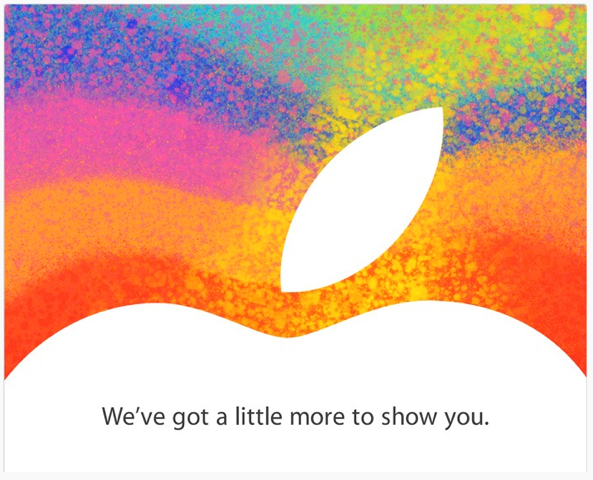
This is Apple flexing its muscles, arming its warheads, positioning the fleet, and pointing the finger directly at Microsoft. The sad thing for Microsoft is, it’s not even that aggressive a move. It’s as if Apple doesn’t really want or even need to spend much energy deflecting Microsoft’s efforts. A single press conference and product might do it. Even the event invitation’s slogan, “We’ve got a little more to show you,” makes the whole thing sound like an afterthought.
Apple to Surface missiles
What’s Apple’s problem, then? Apple is winning in smartphones and tablets — 85 million-plus iPhones sold in the US alone, 68-percent market share in tablets — and while Windows may dominate the home PC market, Mac OS X’s market share has been improving. Not that improving PC sales mean much. As we all know, PC sales are going nowhere but down at the moment.
Is this all about the Surface? Possibly, yes. Apple probably doesn’t relish the idea of another competitor trying to steal away some of its precious market share, and it’s obviously worried enough about the impact of cheap Android tablets to introduce a cheaper, smaller iPad. Microsoft has confirmed that it’s targeting the iPad with the official pricing of its tablets, with the 32GB Windows RT Surface going for $500, $100 less than the equivalent iPad. In the UK, that same 32GB Surface is £400, exactly the same price as a 16GB iPad.
It’s a sound business decision on Apple’s part to crash Microsoft’s party, but we can’t help but wonder if Microsoft CEO Steve Ballmer’s words from an interview earlier this year initially woke the beast. Speaking to CRN.com, Ballmer was referring to Apple’s lead in innovation when he said: “We are not going to let any piece of this go uncontested by Apple, not the consumer cloud, not hardware or software innovation. We are not leaving any of that to Apple by itself. Not going to happen. Not on our watch.”
Now that’s just asking for trouble.
But looking back, perhaps Apple did land the first blow. In April, during a quarterly earnings call, CEO Tim Cook criticized Microsoft’s attempt to merge tablets and PCs with Windows 8. “You can converge a toaster and a refrigerator, but you know those things are probably not going to be pleasing to the user… And you wouldn’t want to put these things together because you wind up compromising both and not pleasing the user. Some people will prefer to own both, and that’s great there. But I think to make the compromises of convergence, we’re not going to that party. Others might. Others might from a defensive point of view, particularly. We’re going to play in both.”
A carefully crafted strike
The timing of Apple’s event is no accident: it’s a carefully crafted pre-emptive strike against Microsoft, which it hopes will crush any resistance that may be forthcoming. Apple wants to dilute whatever buzz surrounds Windows 8 and keep the eye of attention on itself throughout the holidays. It’s all very “shock and awe,” but Apple is proving that it’s has its eye on the steadily rising wave of competition. Is all this noise and brashness merely to cover up a degree of fear creeping in at Cupertino? If so, it needs to be careful. Predators can smell fear from miles away.
Yes, it looks like a Galaxy S3, but what's the point?
The Samsung Galaxy S3 Mini has been officially announced by the South Korean firm at an event in Germany, which showed off the 4-inch, Android toting handset.
The Galaxy S3 Mini sports a 4-inch, 480 x 800 display Super AMOLED display, 1GHz dual-core processor, 1GB of RAM, 16GB of internal memory, 5MP rear camera with LED flash, front-facing VGA snapper, NFC, microSD card slot and a 1,500mAh battery.
Less than SPEC-tacular
JK Shin, Samsung's head of communications said yesterday that the Galaxy S3 Mini won't be found wanting in terms of specifications when compared to its big brother, and while the slimmed down offering may ship with Android 4.1 out the box, some fans may be disappointed by what's inside.
Gone is the quad-core grunt and HD display of the Galaxy S3, and the 5MP camera is on a mediocre par with the Samsung Galaxy Nexus, and below what you find on the Galaxy S2.
Obviously the Galaxy S3 Mini is kinder to your pocket and easier to hold in the hand, with it measuring 121.55 x 63 x 9.85mm and weighing 111.5g – it's smaller and lighter than the original S3, although it is slightly thicker.
Currently the Samsung Galaxy S3 release date and price are unknown, but we'd expect it to arrive in time for the lucrative Christmas market.
JK Shin, Samsung's head of communications has now confirmed that the Korean firm will indeed release the Galaxy S3 Mini on October 11.
Expect big power in a smaller package
Shin also said that Samsung fans shouldn't be concerned about the specifications of the Galaxy S3 Mini, as the handset won't be found wanting in that department, and would have a "full form factor".
It's unclear if the Samsung Galaxy S3 Mini will sport exactly the same quad-core processor and 8MP camera as found in the S3 - although that would be pretty fantastic, we also reckon it's highly unlikely.
Our money is on a punchy dual-core chip and potentially toned-down camera – however this would mean the Galaxy S3 Mini would be similar, if not slightly less featured packed than the still excellent, but now reasonably priced Samsung Galaxy S2.
The 4-inch display means the Galaxy S3 Mini could turn out to be a direct rival to the new iPhone 5, which sports, for the first time on an Apple smartphone, a bigger display.
The Galaxy S3 Mini could also come running Android 4.1, which would be the first handset in Samsung's core range (ignoring the Galaxy Nexus) to sport the Jelly Bean software.
Luckily we've not got long to wait, with all our questions being answered tomorrow. We spoke to Samsung, and a spokeperson for the company said: "The Galaxy S III Mini will come with a 4" display and we are going to unveil the product tomorrow (Oct 11th)."
According to Samsung's JK Shin, the company will announce the Galaxy S3 Mini at an event in Frankfurt on October 11.
Last week, an invitation to a special Samsung event did the rounds, but rather than the company’s usual Unpacked logo and glitzy location, it was written in German and the event itself was to be held in Samsung’s own store in Frankfurt. The slogan across the top of the document was translated into English, and found to say “ So big can be small. And so small can be big,” or words to that effect, plus there was a familiar “S” logo in the background too.
This was all taken to be proof of a Galaxy S3 Mini device, and that Samsung was preparing it for launch at the October 11 event. Now, with a day to go until the mysterious event, Samsung’s Mobile Communications boss, JK Shin, has spilled the beans in a chat with the Korean press.
He appears to have confirmed that the event is indeed for a Galaxy S3 Mini, with TheVerge.com translating the article and finding these words “We’ll be launching a 4-inch Galaxy S3 on the 11th in Germany,” and adding that “there’s a lot of demand for a 4-inch screen device in Europe. Some call it an entry-level device, but we call it ‘mini.’”
You can read the Korean report here, but Google Translate doesn’t do as good a job as whoever translated for TheVerge.com.
Leaked specs recall the Galaxy S Advance
This isn’t the first we’re hearing of the Galaxy S3 Mini though, as it has previously been leaked after it was spotted in T-Mobile Netherlands computer system, where it was listed as having a 4-inch screen with an 800 x 480 pixel resolution, a 5-megapixel camera and a 1GHz, dual-core processor. Sammobile.com also repeated these specs in its own leak, and added a possible 250 euro/$320 price tag for good measure.
While this spec list is a considerable step down from the Galaxy S3 we’re already familiar with, that low-end price tag is less than half the cost of the full-size model, potentially pitting the S3 Mini up against Apple’s cheaper iPhone 4S, and leaving the iPhone 5 to its big brother.
The only thing is, the above specification is almost identical to the Galaxy S Advance, a re-worked version of the original Galaxy S which was released earlier this year. Could Samsung be taking the S Advance’s internals and popping them inside an S3-style body, purely to pull the range together and make it easier for the marketing folk? If so, that could explain why it’s not making a big deal over the S3 Mini’s release.
Whatever happens, we’ll find out tomorrow, October 11, when Samsung unveils something small in Frankfurt.