Showing posts with label customers. Show all posts

Wednesday, November 14, 2012

T-Mobile releases Jelly Bean for the Galaxy S III

T-Mobile is the second US carrier to unleash Android 4.1 Jelly Bean to its Galaxy S III customers. Last month Sprint started seeding the Jelly Bean update to the Galaxy S III units on its network.


The update is available OTA or from Samsung's Kies software. Users who are rooted and don't want to wait can download the update from here and then manually flash it on their devices.

The Galaxy S III will receive Project Butter for a smoother, more fluid UI performance, the improved notifications, "freestyle widgets" that automatically reorder your homescreen content before they are placed and more.

Here's a video by Samsung showcasing the various improvements. Below it is a video dedicated to the improvements and novelties in TouchWiz itself.

Now with T-Mobile on the bandwagon it seems AT&T and Verizon are lagging behind, something their customers are very vocal about in their respectful forums.

Source | Via


Source : http://www.gsmarena.com/tmobile_releases_jelly_bean_for_the_galaxy_s_iii-news-5081.php

Friday, October 19, 2012

O2 rolling out Android 4.1 to Samsung Galaxy S3 today

O2 rolling out Android 4.1 to Samsung Galaxy S3 today
Buttery smooth experience with Android 4.1

O2 has confirmed that it will start rolling out the Android 4.1 update to its Samsung Galaxy S3 customers today.

Three was the first network in the UK to push the Jelly Bean update out to Galaxy S3 owners yesterday, and it has now been joined by O2.

The news was revealed yesterday on O2's community forum, with Abs from the O2 Social Media Team saying:

"From tomorrow, 19th October '12, you'll be able to upgrade to the much awaited 4.1 Jelly Bean update over Wi-Fi or via Kies."

Auto-update alert

In our Samsung Galaxy S3 review the handset received high praise and sits proudly at the top of our 20 best mobile phones in the world today – which goes some way to explaining why it's been so popular.

We're yet to hear from Orange, T-Mobile or Vodafone on Jelly Bean, but all three are expected to push the update to customers in the coming weeks.

Update: A T-Mobile spokesperson has told TechRadar: "T-Mobile is working closely with its device manufacturing partner Samsung to roll-out a Jelly Bean update for as soon as possible. As soon as we have an exact timeline in place we will confirm."

Update: Samsung has told us: "Samsung UK can confirm that the roll out of Android 4.1 (Jelly Bean) has begun for our Galaxy S III customers and will be available across all networks over the coming weeks, pending software testing and approvals."


Source : http://www.techradar.com/news/phone-and-communications/mobile-phones/o2-rolling-out-android-4-1-to-samsung-galaxy-s3-today-1105501

Thursday, October 18, 2012

Jelly Bean arrives on Samsung Galaxy S3 in the UK

Jelly Bean arrives on Samsung Galaxy S3 in the UK
Three gets there first with Jelly Bean

The Samsung Galaxy S3 is finally getting the Android 4.1 update in the UK, as network Three starts pushing Jelly Bean out to customers.

The data-championing network took to Twitter to announce the news, tweeting: "#ThreeSoftwareUpdate Jelly Bean has arrived for #GalaxySIII users :-)".

By the looks of it the update is available over the air, meaning you won't need to dig out your USB cable and tackle the somewhat disappointing Kies desktop software.

Update time

You'll need to head over to Settings > About device > Software update on your Galaxy S3 to check if Android 4.1 has made it to you.

It won't necessarily appear today as these updates sometimes take a few days to filter through to every handset, but you should be enjoying Jelly Bean on your S3 very soon.

We've contacted the other networks about their Galaxy S3 updates, but we're still waiting to hear back from O2, Vodafone, Orange and T-Mobile.


Source : http://www.techradar.com/news/phone-and-communications/mobile-phones/jelly-bean-arrives-on-samsung-galaxy-s3-in-the-uk-1105330

Monday, October 15, 2012

Softbank’s $20 bln Sprint takeover: Everything you need to know

new sprint softbank wireless carrier

Japan's Softbank, a telecom and Internet giant, is taking a 70 percent stake in Sprint for $20.1 billion. What is it thinking? Can Sprint customers expect anything from the deal?

In a surprise move, Japanese mobile operator Softbank has made a deal to acquire a 70 percent stake in Sprint, the United States’ number-three mobile operator. At $20 billion, the takeover represents Softbank’s largest overseas acquisition to date — and the biggest deal inked by a Japanese company in the United States in something like three decades. Acquiring Sprint gives Softbank a major entry point into the still-growing U.S. mobile market — perhaps a welcome move, since Japan’s mobile market is mostly stagnant.

However, for Sprint customers the takeover brings uncertainty. What will change at Sprint once Softbank is holding the reigns? Given that Sprint has lost money in its last 19 quarters (nearly 5 years) — with a 20th on the way — is Softbank out of its mind to sink $20 billion in cash into the company? And, most importantly, can Sprint customers — and potential customers — expect any benefits from the deal?

How the Softbank takeover will work

Sprint CEO Dan Hesse (July 2010)

Like many other high-profile deals, Softbank’s takeover of Sprint is complicated, but it’s also an example of one of the fundamental axioms of business: cash talks. Softbank is putting a total of $20 billion in cold hard cash into Sprint. Softbank will be spending a total of $12.1 billion on Sprint stock: the bulk will go toward buying up about 55 percent of current Sprint shares for $7.30 each, with some $3.1 billion of that money earmarked for buying shares in a new publicly-traded company dubbed “New Sprint,” for the time being. On top of that, Softbank will be pouring another $8 billion in cash into the new company, providing it with substantial operating capital.

Taken at face value, Softbank putting $20.1 billion into Sprint means it valued Sprint at about $28.6 billion — some two-thirds higher than Sprint’s total market capitalization as of the markets’ close last week.

Softbank Sprint structure

That operating capital will likely be all about fueling Sprint’s 4G LTE expansion. Right now, Sprint has LTE service up and running in a couple dozen markets, but that pales in comparison to the hundreds of markets where Verizon Wireless currently offers LTE service. The new Sprint will most likely use that $8 billion in cash to not only accelerate its planned rollout of LTE services, but quite possibly to make additional acquisitions to bolster its spectrum holdings and reach. The most likely candidate there is Clearwire, where Sprint already has a 48 percent stake, but MetroPCS may not be out of reach either, even through it’s agreed to a reverse merger with T-Mobile.

Softbank’s cash is coming from its own bank accounts, plus financing from three Japanese banks (Mizuho Corporate Bank, Sumitomo Mitsui Banking, the Bank of Tokyo-Mitsubishi UFJ), along with Deutsche Bank. The $7.30 in cash Softbank is offering for Sprint shares represents a 27 percent premium over the company’s stock price when the deal was announced. Softbank expects the stock purchases to be completed by mid-2013. Once the deal is complete, Softbank will hold 70 percent of “New Sprint,” while Sprint’s existing shareholders will retain about 30 percent of the new company.

For all these changes, there will be some continuity. Sprint’s current CEO Dan Hesse will stay on as the CEO of the new company, and Sprint’s headquarters will stay in Overland Park, Kansas. “New Sprint” will have a ten-member board of directors, with at least three of those members coming from Sprint’s existing board (and that includes Hesse himself on the board).

What is Softbank thinking?

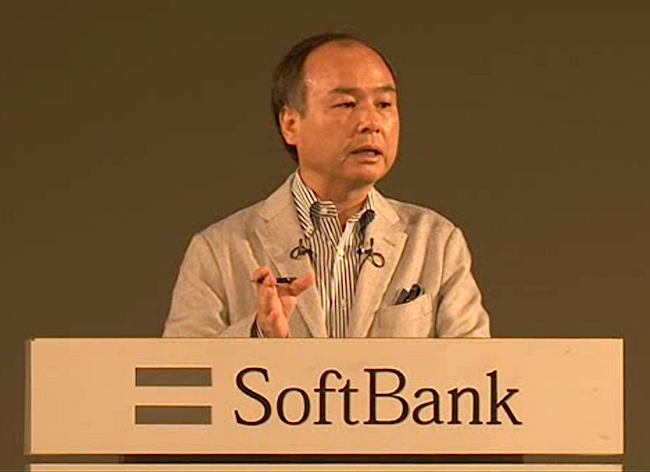
Masayoshi Son Softbank

Softbank’s decision to put $20 billion into Sprint may seem like folly. After all, Sprint has been a money-losing proposition since 2007 and it’s far behind competitors Verizon Wireless and AT&T in rolling out 4G LTE. What’s more, Sprint has been losing subscribers, it’s saddled with $15 billion in debt, and the company is still trying to crawl out from under a near-disastrous merger with Nextel in 2005. Sprint doesn’t seem like a good takeover target.

But that’s not the way Softbank sees it. Softbank’s CEO Masayoshi Son isn’t cut from the risk-averse, conservative cloth of many other Japanese business magnates: he’s a risk-taker who isn’t afraid to do something seemingly crazy he believes will pay off in the long run. And he’s done it before. Back in 2006, Softbank sunk $15.5 billion into acquiring Vodafone’s Japanese unit—and, as with the Sprint deal, most industry watchers thought Softbank overpaid and was utterly out of its head. And, at first, the deal did not seem to go well, costing Softbank a billion a year for the next four years. The 2008 financial crisis also hit Softbank hard: the company had poured ¥75 billion into an investment based on credit-default swaps, some of which defaulted in the financial meltdown. Softbank incurred tremendous debt, but the bet in acquiring Vodafone was sound, and Softbank bolstered its core business by (for a while) being the exclusive Japanese carrier of the Apple iPhone. Son had pledged to retire Softbank’s debt by early 2014, but had recently backpedalled a bit on that, saying that the company only needed to get its debt to manageable levels before looking at new acquisitions.

In Japan, Softbank has been very aggressive about deploying LTE service — and, moreover, Softbank’s flavor of LTE is Time-Division Long-Term Evolution (TD-LTE), which is similar to the LTE technology currently being rolled out by Sprint partner Clearwire. Although some of Softbank’s experience building out LTE in Japan is not directly applicable to the United States — the geographies are radically different, after all — the company’s experience with both network management and offering differentiated services that capture subscribers from other carriers are well-established. In many ways, Softbank’s bet on Sprint is very similar to its bet on Vodafone six years ago. And, on average, Japan’s mobile networks have long offered far more bandwidth than those in the United States. U.S. mobile operators are still learning what it means to offer high-bandwidth services to consumers: Softbank has been doing it for years.

But the Japanese mobile phone market is almost stagnant, and has almost no growth prospects, particularly with Japan’s population growth near zero. That means Softbank’s only way to grow in Japan is through acquisitions. Softbank has just announced a $2.3 billion effort to acquire Japanese mobile provider eAccess in a bid to become Japan’s number-two mobile operator, but Sprint is far more tempting. The United States’ mobile market is still growing, and only about half of the United States’ 320+ million mobile users are carrying a smartphone. That means half are still using feature phones; Softbank sees this as a tremendous growth opportunity.

Moreover, the time is right for Softbank to move. Japanese interest rates are at record low levels and the yen is near all-time highs against other world currencies. There may never be a cheaper time for a Japanese company to make a major play in the U.S. market.

How could things go wrong?

Sprint

Softbank’s bet on Sprint is not without significant risks. The new company is not going to be able sit back and watch the dollars roll in.

Market experience: Softbank has zero experience in the U.S. market. None. Although Softbank is determined to keep Sprint CEO Dan Hesse on board along with (it seems) a portion of Sprint’s existing management, there’s no telling if Softbank will be able to develop working strategies to differentiate Sprint’s service to consumers and grow its business.

Overextended management: Softbank just bought eAccess in Japan in a bid to become Japan’s second-largest mobile operator: that was ambitious in itself. Taking over the much-larger Sprint may be more than Softbank’s management can handle. Moreover, Sprint already had its hands full: Sprint is in the middle of a $15 billion+ commitment to Apple to carry the iPhone and spending billions to bring LTE to its network as part of its Network Vision plan. The good news is that the $8 billion in cash from Softbank should help Sprint carry through on both those initiatives; the bad news is that Sprint is now adding a corporate restructuring to its already daunting to-do list.

“There’s a huge risk that the deal will not go to plan and could weaken both companies at critical times,” noted Informa Telecoms & Media principal analyst Mike Roberts.

Debt: Softbank’s takeover of Sprint will have Softbank once again swimming in debt: Sprint already has $15 billion in outstanding debt, and Softbank is still carrying about $10 billion in debt. Those numbers push Softbank’s debt-to-capital ratio into dangerous territory, and could place significant pressure on Softbank’s operating cash in the next few years as it’s forced to work on retiring debt rather than growing its business. Softbank may wind up owning Sprint but unable to do much with it — particular if the world economy takes another downturn.

Who could win?

clear clearwire logo

All that said, Softbank’s bet on Sprint may be risky, but many parts of it make sense.

Clearwire: Sprint and Softbank emphasized that their deal does not require Sprint to take any actions with Clearwire. However, the deal could leave Clearwire sitting in a very nice spot. Clearwire has been moving its network away from WiMax 4G service it debuted in 2009 to LTE. (Sprint and other investors had bet that getting out the door first with WiMax 4G services in 2008 or 2009 was a better bet than waiting until 2012 or 2013 for LTE to become a reality, though it doesn’t seem to have helped much.) Clearwire has a substantial portfolio of spectrum licenses in the 2.5GHz range — that’s well above the building-penetrating 700GHz range preferred by AT&T and Verizon Wireless, but would still add significant coverage to Sprint’s LTE efforts. However, Clearwire hasn’t been able to capitalize effectively on those licenses due to a lack of money to invest in its network. The bulk of its users are actually from Sprint, thanks to a wholesale agreement, so the tighter Clearwire becomes with Sprint, the better.

The $8 billion in operating capital Sprint is receiving from Softbank would go a long way toward building out LTE services in Clearwire’s spectrum. Moreover, Softbank’s LTE services in Japan are also built in the similar 2.5GHz spectrum blocks, and use the same TD-LTE service that Clearwire is deploying on its network. Some industry watchers expect Sprint to invest even more heavily in Clearwire, or move to purchase it outright.

Clearwire had no comment on Softbank’s acquisition of Sprint.

Sprint: Being acquired by Softbank makes Sprint more directly competitive with AT&T and Verizon Wireless in one important way: subscriber numbers. In the second quarter of 2012, Verizon and AT&T sported 105 and 102 million subscribers, respectively, accounting for 33 percent and 31 percent of the U.S. mobile market. Sprint is in a distant third place with 56 million subscribers. However, Softbank boasts some 34 million subscribers in Japan, meaning once Softbank acquires Sprint it will have an effective customer base of about 90 million people. That’s not far behind Verizon and AT&T, and should help the new Sprint negotiate more advantageous deals with equipment and handset providers. Softbank ought to be able to pay less for networking gear than Sprint, and have access to a better deals and a broader range of gear and handsets from equipment manufacturers. That may include Apple, since Softbank probably wants to keep Japan’s NTT Docomo from getting the iPhone.

The upshot could be a wider range of handsets, tablets, and other mobile gear available on Sprint at the same time they launch on other major U.S. carriers.

Upshot

Bringing the iPhone on board has helped Sprint gain subscribers and revenue. (Just ask T-Mobile how it feels to not have the iPhone.) Unfortunately, it hasn’t swung the company back to profitability. After 19 straight quarters of losses, Sprint needs a turnaround.

Sprint’s kind of turnaround seems to be Masayoshi Son’s specialty. The Japanese mobile market is dominated by KDDI and NTT Docomo, and Son was able to buy Vodafone, revamp it, and make it a solid competitor against a duopoly. In the United States, the mobile market is dominated by the duopoly of Verizon Wireless and AT&T. With Sprint, Son sees an opportunity to bring his successful turnaround model to the United States.

“I think we can provide much better competitive technology and services that U.S. citizens have never experienced,” Softbank’s Masayoshi Son said in a conference call with analysts today.

Sprint customers certainly hope he’s right. But changes won’t come overnight: Softbank’s acquisition of Sprint won’t be complete until the middle of next year, and still needs regulatory approval. In the meantime, AT&T and Verizon won’t be sitting on their hands. Verizon Wireless plans to light up its 400th LTE market this week.


Source : http://www.digitaltrends.com/mobile/softbank-sprint-takeover-explained/

Thursday, October 11, 2012

Samsung Galaxy S3 Jelly Bean update arrives in Korea

Samsung Galaxy S3 Jelly Bean update arrives in Korea
Another country gets the sweet taste of Jelly Bean

Word from South Korea is that the Android 4.1 Jelly Bean update has started rolling out to Samsung Galaxy S3 customers.

Last month we saw Samsung push the Jelly Bean update out to Galaxy S3 handsets in Poland, with the Korean firm telling us the latest version of Android would be "gradually being introduced to other markets".

Apparently this South Korea update is just for the 3G model of the Galaxy S3, with a 4G compatible Android 4.1 upgrade still in the pipeline.

Still no word on rest of the world

Korean Galaxy S3 owners aren't currently able to download Jelly Bean over the air, instead being forced to plug their handset into their computer and use Samsung's hit-and-miss Kies desktop software.

There's still no word on when the likes of Britain, USA or Australia will see the latest version of Google's mobile platform hit their Galaxy S3 devices, but hopefully there's not too long to wait now.

We've contacted Samsung to find out when we may be able to expect Android 4.1 on our devices, and we'll update this article once we hear back.


Source : http://www.techradar.com/news/phone-and-communications/mobile-phones/samsung-galaxy-s3-jelly-bean-update-arrives-in-korea-1103657

Wednesday, October 3, 2012

What the T-Mobile and MetroPCS merger means for you

T-mobile metropcs carrier merger

T-Mobile and MetroPCS are merging to expand spectrum holdings and network coverage. What do current (and future!) customers get out of it?

T-Mobile parent company Deutsche Telekom has announced that it’s struck a deal to merge with regional pre-paid mobile operator MetroPCS. For MetroPCS, the merger represents a tremendous growth opportunity: instead of being a regional operator limited to a few markets, its customers will get nationwide service. For T-Mobile, the merger significantly deepens the company’s spectrum holdings in key cities and regions, enabling it to make a serious play as a value-conscious LTE operator. And for Deutsche Telekom, the merger finally represents a way to one day get out of the business of being a U.S. mobile operator, following its failed effort to sell T-Mobile to AT&T last year.

But what does the merger mean for consumers and customers of both T-Mobile and MetroPCS? Can customers expect better service and wider LTE coverage? Or, like so many mergers, will the new company just be bigger and more expensive?

The merger’s basic idea

T-Mobile MetroPCS merger execs

The T-Mobile and MetroPCS merger is designed to give number-four T-Mobile more scale and deeper spectrum holdings in several major metropolitan areas, meaning it will more wiggle room to offer 4G LTE services and compete aggressively against the likes of Sprint, AT&T, and Verizon. The combined company will still be the number-four U.S. mobile carrier (behind number three Sprint), but will bump up to about 42 million subscribers. Although MetroPCS uses CDMA phone technology and T-Mobile is based on GSM, MetroPCS is already in the process of phasing out CDMA, and its spectrum holdings are broadly complementary: both companies live and breathe in the 1,700 MHz and 1,900 MHz spectrum bands.

The combined company will do business under the T-Mobile name, although MetroPCS and T-Mobile will continue to operate as distinct customer units. Contract-based mobile service (along with services for businesses) will be under the T-Mobile name, and pre-paid and no-contract service will be available under both T-Mobile and MetroPCS brands.

The pre-paid market — or, as Deutsche Telekom likes to refer to it, “value-focused” market — is one area where the combined company gets interesting. MetroPCS is exclusively a no-contract and pre-paid provider — also one of T-Mobile’s strong points. According to T-Mobile, the two companies will have about 14.6 million no-contract subscribers (9.3 million from MetroPCS), putting it nearly neck-and-neck with Sprint’s no-contract operation, which currently has about 15.4 million customers. The combined T-Mobile/MetroPCS no-contract business looks poised to earn more money than Sprint’s: in the second quarter of 2012, Sprint pulled in $1.2 billion from no-contract subscribers, where the combined T-Mobile/MetroPCS pulled in $1.6 billion. Basically, the combined T-Mobile and MetroPCS will likely become the biggest no-contract mobile operator after AT&T and Verizon — we only say “likely” because those companies don’t break out revenue from their prepaid/no-contract businesses.

The terms of the merger are unusual: technically, MetroPCS is acquiring T-Mobile in a reverse acquisition. MetroPCS will declare a 2-for-1 reverse stock split, pay $1.5 billion to its existing shareholders (a bit over $4 per share), and then buy all of T-Mobile’s capital stock by giving Deutsche Telekom 74 percent of MetroPCS. In the end, Deutsche Telekom winds up the majority owner of MetroPCS, and the new company will have nearly $25 billion in revenue and about $2.1 billion in free cash flow for the year. T-Mobile’s current CEO, John Legere, will be the CEO of the new company; MetroPCS CFO J. Braxton Carter will be the new company’s CFO. MetroPCS’s CEO, Roger Linquist, will apparently retire — he is 74 years old. Regulators have to approve the deal, and that will take a while: the companies expect the deal to be formally closed by June 2013. The new company will operate out of T-Mobile’s Bellevue, Washington HQ, but will maintain a “significant presence” in the Dallas area.

One of the consequences of the reverse merger is that the new T-Mobile will be a public company: before, it was a private company owned by Deutsche Telekom. Although Deutsche Telekom has agreed to provide a $5.5 billion commitment to support some existing MetroPCS transactions, write down the value of some of its investment in T-mobile, and offer the new company a $500 million unsecured credit facility, setting up T-Mobile as a public company gives Deutsche Telekom something it’s always wanted: a way out of the slow-growing U.S. mobile market. That’s why it tried to sell T-Mobile lock, stock, and barrel to AT&T in one giant transaction. Taking T-Mobile public doesn’t give Deutsche Telekom a swift and sudden exit from the American market, but it does put the company in a position to sell off its shares of the new company in the future.

If you’re a T-Mobile customer…

T-Mobile MetroPCS merger combined LTE spectrum (major markets)

In the short term, the merger probably won’t affect T-Mobile customers: the company is continuing its $4 billion built-out of LTE services using AWS (Advanced Wireless Services) spectrum on its network. However, looking ahead, the merger means T-Mobile’s LTE offerings should be much stronger in the areas where MetroPCS currently offers service. Assuming all of MetroPCS’s AWS spectrum gets converted over to LTE — which should happen over time — T-Mobile will have an average of 50 MHz of LTE bandwidth in major areas like New York, Los Angeles, Boston, San Francisco, Detroit, and Las Vegas — and 60 MHz in MetroPCS’s hometown of Dallas — and that includes a full 2×20 MHz in many areas, meaning T-Mobile’s LTE network should be able to keep up with competitors in terms of raw bandwidth. T-Mobile’s current GSM and HSPA+ handsets will continue working, too.

Going forward, T-Mobile’s move toward LTE also means T-Mobile customers can expect to have a greater selection of handsets. Instead of having to rely on phone makers to create special devices for T-Mobile’s own flavor of HSPA+ connectivity, T-Mobile should be able to offer customers mainstream LTE handsets. T-Mobile is hoping that, one day soon, that will include the iPhone, but the company will also be happy to offer customers the latest LTE devices running Android and Windows Phone, as well as accept iPhone migrants from other carriers.

MetroPCS has also been noted for its highly automated self-service capabilities, making it easier for customers to add minutes, pay bills, switch plans, and get a new phone without incurring a ton of customer support costs. On an investor call today about the merger, T-Mobile executives said they expect to be able to leverage that to improve its customer service levels — which would be welcome. T-Mobile’s customer service used to be lauded; recently J.D. Power and Associates has been rating it lowest in customer service among all carriers.

If you’re a MetroPCS customer…

T-Mobile MetroPCS merger combined coverage map

If you’re a MetroPCS customer (and familiar with wireless technology), this merger is putting four letters in your mind: CDMA. MetroPCS’s voice network runs on CDMA, which is incompatible with T-Mobile’s GSM network. How can these incompatible technologies work together?

Short answer: they won’t. MetroPCS customers will be stuck on MetroPCS coverage and limitations until they migrate to new, future, handsets that will incorporate service for both networks. We also learned on the call today (and this long document) that the combined company anticipates keeping some of MetroPCS’s existing CDMA service operating through the first half of 2015, so customers have almost three years to transition to a new handset. MetroPCS’s all-contract business has an exceptionally high handset turnover: each year, between 60 and 65 percent of MetroPCS’s customers get new handsets, so transitioning away from CDMA in a span of nearly three years isn’t expected to be a major problem for most MetroPCS customers.

And MetroPCS customers should get some significant benefits from the deal once they transition, including substantially expanded mobile coverage, without being forced into roaming deals (including international roaming options). That expanded coverage area also makes it more likely MetroPCS customers can keep their service if they move to a more rural area. Although MetroPCS has already been rolling out LTE service, with T-Mobile it will have access to a much broader LTE network (once it’s built out), along with a wider choice of handsets — perhaps one day including the iPhone.

MetroPCS customers also get some stability: MetroPCS is the fifth largest mobile operator in the U.S., but it was still a regional provider going it along with limited growth opportunities. The combined company is larger, more stable, and backed by the considerable financial resources of Deutsche Telekom — which is still an investment-grade stock.

When life hands you lemons…

T-Mobile merging with MetroPCS is the latest move in the company’s gotta-stay-alive strategy in the wake of AT&T’s failed takeover attempt. When the AT&T merger failed, T-Mobile was left with comparatively few options, and none of them were great. The company has settled on a “challenger” strategy that isn’t aiming to unseat AT&T or Verizon, but instead to offer a fourth stable, national competitor in the U.S. market.

Since it became single again, T-Mobile has made four major moves to position itself as a viable alternative to AT&T and Verizon:

  • It picked up AWS spectrum holdings (as well as a roaming deal) from AT&T as part of its break-up fee when acquisition fell through
  • It announced a $4 billion upgrade plan to offer LTE services on its AWS network — that involves upgrading 37,000 sites over three years
  • It picked up still more AWS spectrum from Verizon as a condition of Verizon’s deal with cable operators
  • It sold rights on 7,200 towers to Crown Castle for $2.4 billion in cash to fuel its LTE transition

T-Mobile MetroPCS merger top 100 markets spectrum

For T-Mobile, merging with MetroPCS is about making the best play it can to build competitive 4G LTE services. The company has no spectrum holdings in the attractive 700 MHz bands recently vacated by broadcast television: those bands are particularly appealing for LTE and mobile services because they’re good at penetrating structures. With the MetroPCS merger, T-Mobile is still left out of 700 MHz LTE service, but it will be able to significantly increase the density of LTE services it can offer in higher-frequency AWS bands: they don’t penetrate buildings as well, but T-Mobile is hoping to make up some of the difference by widening the amount of spectrum it uses in many metropolitan areas, as well as by being particular about how it upgrades its towers — it’s been hoping to improve in-building coverage by about 20 percent just through its network modernization, which includes new antennas with integrated radios.

Those efforts probably won’t be enough to compete head to head with the likes of AT&T and Verizon Wireless, but T-Mobile and MetroPCS are a good fit in another way: no-contract customers. The U.S. mobile market is mostly saturated. Very few new mobile customers are being created: some estimates have the U.S. mobile market growing by about 3 to 5 percent a year through 2017. However, tough economic times and the high cost of smartphone voice and data plans means the no-contract and pre-paid segment of the U.S. mobile phone market could grow by 9 to 10 percent in that same period. The combined T-Mobile and MetroPCS should be a major player in that faster-growing market segment — particularly if the combined company can keep to its strategy of unlimited mobile data plans.

The next move is probably Sprint

Sprint Logo

What will be the next move in the mobile industry? Look to number-three Sprint. MetroPCS’s deal with Deutsche Telekom to merge with T-Mobile was actually MetroPCS’s second choice: earlier this year, MetroPCS nearly closed a deal to be acquired by Sprint. That deal was rejected by Sprint’s board, and MetroPCS had to go looking elsewhere for a buyer.

Sprint has indicated it intends to be a leader in consolidation in the mobile industry — and its most likely targets are LEAP Wireless or working out a deal with Dish Network. Dish, in particular, might be tempting: the satellite TV operator holds a number of licenses in the 2000 to 2200 MHz band that it intended to use to build out its own satellite-assisted LTE network. However, the FCC is on the verge of action that could make some of Dish’s licenses relatively useless to Dish…but useful as an add-on to Sprint’s built-out of LTE service in the 1900 MHz range. Sprint is already building out its LTE service, where Dish hasn’t really started.


Source : http://www.digitaltrends.com/mobile/t-mobile-metropcs-merger-explanation/

Saturday, September 22, 2012

Certain black iPhone 5 reportedly come with dents out of the box

It seems to have become a routine now. Every year Apple releases a new iPhone and while most of the customers are delighted a small subset of buyers pull the short end of the stick. With the iPhone 4, it was the antennagate issue, with the iPhone 4S it was the battery life problem and now some iPhone 5 buyers are noticing dents on their prized possession.


Yes, several owners, particularly of the Black & Slate colored model, are reporting dents and scratches along the chamfered edges of their new iPhone right out of the box. We haven't seen many reports from owners of the White & Silver model, but that just might be because the color isn't particularly popular.

Now, anodized aluminum is known to pick up scuff marks easily. Because the color is painted on top, even a minor scuff can make it come off, revealing a shiny silver spot below. Also, aluminum is a soft metal, so it dents very easily, especially along thin edges. You'll find scuffs and dents on practically every anodized aluminum object that has been used for a while.

Which is why it wasn't a shock to us when we saw the iPhone picking up dents along the edges in this drop test. However, it is surprising when the device comes with scuff marks out of the box and points to poor quality checks at Apple's end.

Of course, Apple will readily replace any such device for you. But if you're importing this device to a different country (and we know many do), you will need to be careful and hold on till the issue gets sorted.

Source • Image Source


Source : http://www.gsmarena.com/certain_black_iphone_5_reportedly_come_with_dents_out_of_the_box-news-4844.php

Thursday, September 13, 2012

Vodafone confirms iPhone 5 Facetime over 3G included in data allowance

Vodafone confirms iPhone 5 Facetime over 3G included in data allowance
Say cheese

Vodafone has confirmed that its customers will be able enjoy Facetime over 3G (VoIP) on the new iPhone 5 as part of their data allowance.

TechRadar was told that customers on a Vodafone Red plan, which start at £29 per month, would have Facetime over 3G included in their bundled data allowance.

A Vodafone spokesperson said: "The iPhone 5 will be available on Vodafone Red plans, giving customers access to Voice over IP services (including Facetime over 3G) as part of their data allowance."

iPhone 4 and 4S also included

He continued: "Existing pay monthly iPhone 4 and 4S customers on price plans of more than £40 a month already have VoIP included and anyone can move to Vodafone Red plans without extending their commitment provided they pay the same or more each month."

Networks are hastily trying to court customers to choose the iPhone 5 on their network, and especially as EE has the latest handset exclusively on 4G, the likes of Vodafone and O2 are pulling out all the stops to entice Apple lovers their way.

O2 announced earlier today that it was looking to accelerate the development of its 4G network, and is offering customers an early upgrade to a 4G handset next year, if they buy the iPhone 5 at launch.

We've contacted the other networks to see if Facetime over 3G will be included in their data allowances as well, and we'll update this article once we hear back.


Source : http://www.techradar.com/news/phone-and-communications/mobile-phones/vodafone-confirms-iphone-5-facetime-over-3g-included-in-data-allowance-1097097

Tuesday, September 11, 2012

Vodafone offering nano-SIM cards ahead of iPhone 5 launch

Vodafone offering nano-SIM cards ahead of iPhone 5 launch
Vodafone pulled a blog-post about the availability of nano-SIMs

Vodafone says it has 500,000 nano-SIM cards in stock and ready to be dished out to customers, on the eve of the iPhone 5 launch.

The network has stocked up on the new SIM standard, which is likely to make its debut in the new iPhone, which is all-but-certain to be announced in San Francisco on Tuesday evening.

Vodafone made the announcement in a post on its official blog, which Pocket-Lint points out has now been removed as nano-SIM-enabled devices are not yet available.

The post from Vodafone comes a week after T-Mobile Germany informed retail partners that the next-generation of SIM technology will be winging its way to them.

Handle with tweezers

"They're so slim and tiny you might only be able to handle them with tweezers - but imagine the extra space the new nano-SIM card frees up inside your handset," Voda's post read.

"The first devices have now been announced – and Vodafone has now got 500,000 of the new 12.3 mm x 8.8 mm nano-SIMs in stock."

The nano-SIMs, which became the new European standard after a legal battle involving Apple, Motorola, Nokia and RIM, are 40 per cent smaller than the micro-SIMs that live within the iPhone 4S.

We'd say there's a very good chance Vodafone will republish this post as soon as the iPhone 5 is announced in tomorrow evening.


Source : http://www.techradar.com/news/phone-and-communications/mobile-phones/vodafone-offering-nano-sim-cards-ahead-of-iphone-5-launch-1096358

Thursday, September 6, 2012

Nokia announces further upgrades for Windows Phone 7

Nokia announces further upgrades for Windows Phone 7
Nokia sticking by older customers

Kevin Shields has confirmed that new functionality will be coming to the likes of the Lumia 900.

With the launch of the Nokia Lumia 920 came a number of technological enhancements, through both software and hardware.

Nokia's senior vice president Shields talked through the new apps, which include the ability to erase unwanted objects from photos, and then gave hope to those who shelled out for a Nokia earlier this year: "We'll be shipping versions of the technology to current devices."

But what will it be?

However, he didn't confirm which apps would be making it through to the older phones, though the likes of City Lens (which uses augmented reality to give info on restaurants and retail outlets) and the object removal tool are primed to make the move backwards through the range.

There might be a question mark over whether some phones will be able to handle such functionality though – in our interview with Nokia's Marko Argenti he confirmed that the dual core chip is necessary to handle tasks like erasing unwanted elements from photos.

But this does re-confirm Nokia's strategy to not leave any Windows Phone user behind – along with Windows Phone 7.8, this builds on Nokia's pledge to supply the likes of DLNA support to older phones and will undoubtedly go some way to placating those that bought into the Nokia/Windows Phone deal and then found they couldn't get an upgrade to the software.


Source : http://www.techradar.com/news/phone-and-communications/mobile-phones/nokia-announces-further-upgrades-for-windows-phone-7-1095078