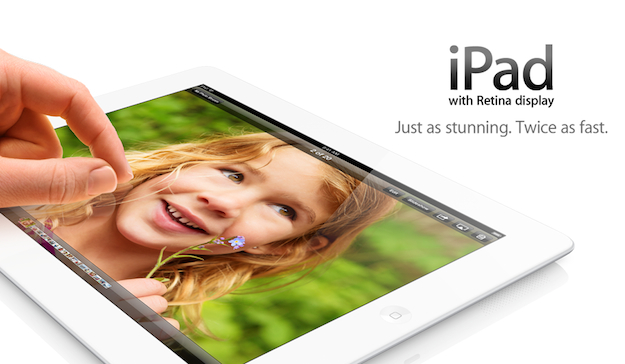
In addition to launching the iPad Mini, Apple has also refreshed its full-size iPad range, bringing it in-line with the new tablet, the iPhone 5 and new iPods.
Apple has announced the fourth generation iPad. Introduced by Phil Schiller on stage at a special event in San Jose in California today, just prior to the new iPad Mini, the refreshed model falls in-line with the other new additions to Apple’s mobile range.
At first glance, the new iPad (should that be the new, new iPad?) looks identical to the iPad introduced earlier this year. Get a little closer and you’ll see that the 30-pin connector has been replaced by the new Lightning connector, just like the one featured on the iPhone 5, iPods and the new iPad Mini.
Externally, nothing else has changed, and the tablet still has the same 9.7-inch, 2048 x 1536 pixel ‘Retina’ display dominating the front panel. Inside though, there are a few more alterations.
The major change is with the processor, as the fourth-generation iPad uses the new A6X, which apparently doubles the graphics and CPU performance over the A5X. This should mean the tablet will be even faster, and Apple also promise improved gaming, quicker app launch times and sharper photos and videos.
Other new features include an updated FaceTime camera with 720p video, an improved 4G LTE radio, dual-band Wi-Fi and like the iPad Mini, even more 4G LTE network compatibility.
Apple has kept the pricing the same too, with the 16GB Wi-Fi model up for $500, or $630 if you want to add cellular connectivity. It’s not available through the Apple Store online yet, but should be up for pre-order on October 26, just like the iPad Mini.
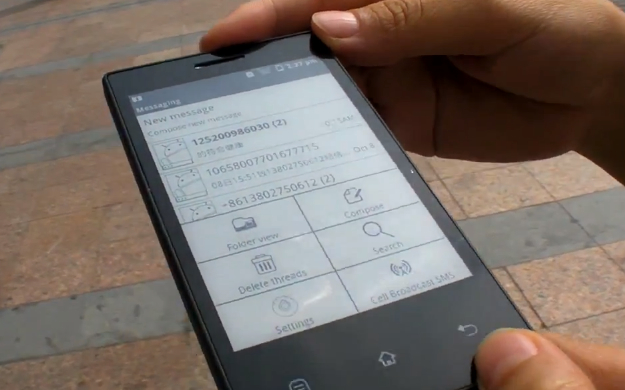
Onyx International, a company known for its range of e-readers, has shown off a prototype Android smartphone with an E Ink display. While the outdoor legibility and battery life are both excellent, the screen does let it down in other areas.
As every owner knows only too well, smartphone screens are difficult to view in direct sunlight, and while pushing the brightness up to maximum can help, it doesn’t do wonders for the battery life.
Here’s an interesting solution to the problem from a company named Onyx International, a smartphone with an E Ink screen. Onyx has plenty of experience in the world of E Ink screens, as it produces the Boox series of e-readers. The handset is only a prototype at the moment, but you can see a working version in the video below, where its screen is compared to a Galaxy Nexus.
The result is spectacular, as the Nexus device just looks like it’s turned off the entire time, while the Onyx phone’s display is crisp and sharp, despite being viewed outdoors. This probably won’t come as a surprise to anyone who has used an e-reader over the past few years, and the superior performance of an E Ink screen in sunlight formed the basis of a recent Amazon Kindle ad campaign.
Surprisingly, the Onyx phone runs Google Android, which has been extensively modified to run on a monochrome screen, but as you can see, the core functionality is still there. Because E Ink screens only take little sips of battery power, the standby time on the prototype is a week. Try that on any other smartphone.
There are, however, one or two little drawbacks. E Ink displays aren’t known for their speed, and sure enough the refresh rate is terribly slow, meaning any multimedia or gaming would be impossible. Viewing text webpages is good though.
While it’s an impressive technical feat and the use of an E Ink screen on a phone certainly has its benefits, the thought of enduring those long refresh times and not being able to do the things that almost all other smartphones can do, would probably make ownership too frustrating. After all, If I wanted a long standby time, a monochrome screen and little else, I’d buy a basic feature phone.
Take a look at the video showing the phone in action and see what you think.
As expected, Samsung has announced the Galaxy S3 Mini, a mid-range Android 4.1 smartphone that has a similar design to its big brother.
Samsung has announced the Galaxy S3 Mini, just as promised by the company’s mobile communications boss yesterday, but can it live up to our expectations, especially as it shares the same name as one of the very best Android smartphones on the market?
The answer to that question very much depends on your expectations, and if they’ve been kept in check. Let’s put it this way, it’s not a Galaxy S3 in a slightly smaller body, but a small phone aimed at a different buyer. Here’s what it’s all about.
Design-wise, it’s very close to its big brother, with the same “natural” flowing edges, rounded corners and smooth rear panel. No lawsuit over the design of this one, then. So how mini is the Mini? It measures 121 x 63 x 9.8mm and weighs 111 grams, so it’s a touch larger than an iPhone 4S, but noticeably smaller than the full-size S3’s 136 x 70 x 8.6mm dimensions and 133 gram weight.
Inside is a dual-core, 1Ghz ST-Ericsson NovaThor processor, with 1GB of RAM and either 8GB or 16GB of internal storage memory. As expected, the Super AMOLED screen measures 4-inches and has a 480 x 800 pixel resolution, while the camera has 5-megapixels, 720p video recording and an LED flash. There’s also a VGA video call camera above the screen.
Android 4.1 onboard
The good news is the phone will come with Android 4.1 Jelly Bean, so there won’t be any waiting around for Samsung to issue an update, plus there’s the TouchWiz user interface and some of the cool software features from more expensive Galaxy hardware, such as S Voice, Direct Call and Smart Stay. Other features include NFC, DLNA, GPS, a microSD card slot and a 1500mAh battery.
So, the Galaxy S3 Mini is a concoction of the Galaxy S3 and the Galaxy S Advance. Many will bemoan the lack of 4G — although it does support HSDPA and HSUPA — and the processor missing two more cores, but those are features for upper range phones, not a solid mid-ranger like the S3 Mini.
Using the S3 title is certainly a win for the marketing team, but the S3 Mini is far from being an embarrassment to its good name; after all, the design was, and still is, a winner. Plus, Samsung isn’t wrong, in stature it is a miniature S3.
The more sensible spec also means a more sensible price tag. While Samsung hasn’t talked about the cost just yet, Clove Technology has put a SIM-free S3 Mini up for pre-order in the UK for £298, or $477, which is about £120/$192 less than the full-size S3.
Samsung has remained quiet on availability too, but Vodafone UK has tweeted that the device is coming soon to its network. There’s no word on a US release at this time.
Research indicates Lenovo has become the world's number one PC manufacturer, as the company announces plans to expand its smartphone range.
Lenovo is riding a wave of success at the moment, after announcing some exciting Windows 8 tablets, and now it appears the company has become the world’s number one PC manufacturer, and is preparing to release its smartphone range internationally too.
Research firm Gartner has released data that shows Lenovo has pushed past Hewlett-Packard to take the number one spot, and the figures read like this: HP can claim a 15.5-percent global market share, with 13.55 million units shipped, while Lenovo has a 15.7-percent market share with 13.77 million units heading out the door this quarter.
Perhaps more importantly, Gartner shows HP’s sales as down 16.4-percent on last year, while Lenovo is up by just under 10-percent. If you had to choose a direction as a company, you’d want to be the one going up.
According to Reuters, researchers from IDC still put Lenovo ahead of HP, with market shares of 15.7 and 15.9-percent respectively. HP told them that IDC’s report was “more expansive,” but then, they would say that. Almost regardless of who’s right today, the trend certainly indicates the position swap will happen soon.
HP’s CEO Meg Whitman has been quoted as saying the company is in the first year of a five-year restructuring plan, but despite the much-publicized downturn in PC sales — IDC says global sales have dropped by 8.6-percent since July — it still hasn’t made up its mind about re-entering the smartphone and tablet market. Recent reports seem to indicate confusion regarding this market segment within HP.
Lenovo to enter international smartphone market
Lenovo feels rather differently. It already produces smartphones for a variety of Eastern markets and in June this year, overtook both Nokia and Huawei to take second place in the Chinese market. Perhaps most tellingly — and a point HP needs to hear — is that its phone sales surpassed that of its PC sales for the first time there too.
It’s not just low-end hardware the company produces either, as it introduced the LePhone K860 in August, which has a 5-inch display with a 720p resolution, a quad-core processor (actually Samsung’s Exynos 4 Quad, also seen in the Galaxy S3), Android 4.0 and an 8-megapixel camera. It’s destined for Japan sometime later this year.
The momentum is there for Lenovo, and it’s already producing some interesting hardware, so it’s no surprise to see the following message posted on its Facebook page: “We won’t stop at laptops and tablets. For the first time, Lenovo is making plans to sell smartphones outside China.”
Introducing new hardware into the already massively competitive US and European markets isn’t going to be easy, but Lenovo knows it has little choice. Besides, it can always look at the lucrative African, Russian and South American markets initially, before hitting the rest of Europe and the US with devices such as the K860.
Lenovo hasn’t provided any further details, and we’d be surprised to see any releases this year, but it’s still a very positive step from a highly motivated company. Whether HP will respond remains to be seen.
Apple unveiled a snappy new ad for its refreshed iPod devices on Wednesday highlighting the range of colors on offer.
As Apple begins shipping the first batch of orders for its refreshed iPod range of media players to expectant customers around the world, the tech company has launched a new ad called ‘Bounce’ featuring the new devices.
The 30-second slot, posted on YouTube on Wednesday night and set to air on TV, features a bunch of iPods (touches, nanos and shuffles) bouncing around to a funky track called Yeah Yeah by London-based singer Willy Moon. It’s pretty, slick, and quick, and you can check it out below.
Apple unveiled a new iPod touch last month, featuring a larger 4-inch screen identical in size to that of the iPhone 5. Compared to its predecessor, the updated fifth-generation device is slimmer and lighter, and sports a vastly improved 5-megapixel camera. More RAM and a faster processor make for a much zippier device compared to earlier touches, too. It also comes in six colors – no longer just black and white – a feature that forms the basis of the new ad.
The new seventh-generation iPod nano, described as the thinnest nano to date, has done away with the small square design of its predecessor and returned to the longer look of the fifth-generation nano. An extra color has been added to the range, too.
As for the shuffle, three new colors have been added to the range.
Sprint has announced the LG Mach, a new QWERTY slider Android smartphone that sits just below the Motorola Photon Q in the network's range.
The QWERTY slider form factor still has its fans, and Sprint wants to make sure they’re well catered for on its network, so it has introduced the new LG Mach. Now, with a name like that, you’re probably expecting incredible performance, but while the Mach isn’t a basic phone, it’s not quite up there with the range-toppers of today.
What we’ve got is a 4-inch touchscreen with an 800 x 480 pixel resolution, which slides to the side to reveal a big QWERTY keyboard, providing users with the best of both worlds. You’ll have to be prepared to compromise on size and weight when comparing it to its touch-only peers though, as the LG Mach is a chunky beast at 12mm thick and 168 grams.
Deep inside the phone is a 1.2GHz, dual-core processor and 1GB of RAM, while the operating system is Android 4.0 Ice Cream Sandwich. Although LG doesn’t talk about it in the press release, CNet.com says the Mach will be upgradeable to Android 4.1 Jelly Bean, but doesn’t offer any timescale.
There is a 5-megapixel camera on the rear of the phone, which can also shoot 1080p video, plus a basic 0.3 megapixel forward-facing video call lens above the screen. LG makes a point of highlighting the Mach’s eco-friendliness, saying it’s 56-percent recyclable, and has been given the seal of approval by a couple of environmental foundations too.
The Mach will connect to Sprint’s 4G LTE network and other features include Bluetooth 4.0, a 1700mAh battery, 8GB of internal storage memory, GPS, a microSD card slot and NFC.
As unusual as the LG Mach’s form factor may be these days, it’s not alone on the market, and one of its closest rivals is also offered through Sprint. The Motorola Photon Q has a slightly larger screen at 4.3-inches, an 8-megapixel camera and a 1.5GHz, dual-core processor, so the LG Mach will likely come in at a slightly lower price. It does win over in one key area though, as the Mach is ever-so slightly lighter and slimmer than the Photon Q.
Sprint hasn’t provided any release information or pricing structure at all, so if you’re interested in the phone, you’ll need a little patience.
Sharp has announced it has started production of a 5-inch, 1080p display, which will be coming to a mobile device near you soon.
Many of the current top-of-the-range smartphones — iPhone 5 apart — have screens with a 1280 x 768 pixel resolution or similar, which is good enough to be labelled as HD. However, just as it did with flat screen TVs, 720p is about to be replaced by 1080p — as Sharp has announced that it has started production of its own 5-inch, full-HD smartphone displays.
The new panel boasts a resolution of 1920 x 1080 and a pixel density of 443ppi. As a comparison, the Samsung Galaxy S3’s 4.8-inch display has a resolution of 1280 x 720 and a pixel density of 306ppi, while the 4-inch iPhone 5 has 1136 x 640 pixels and 326ppi.
Sharp may say its 5-inch screen is headed for smartphones, but any device with a display that large usually gets put in the smartphone/tablet hybrid category, joining the likes of the Galaxy Note, Note 2 and the LG Optimus Vu.
The benefits of such a high resolution screen almost go without saying, but Sharp states that it’ll bring “crisp text, super clear maps and amazingly real HD images.” Sharp doesn’t mention on which devices its new super-screen will appear, but along with making its own smartphones, Sharp also supplies screens to other manufacturers too.
The mobile industry loves big numbers, as they help convince prospective buyers that one device is “better” than another, and a 1080p screen with 443ppi is about as impressive as screens can get. Questions will no doubt be raised concerning just how much difference a 1080p resolution and a 443ppi density will make on a screen this small, but answers will have to wait until the first device with such a screen goes on sale — and judging by the increase in activity from these companies, we shouldn’t have that long to wait.
Sharp’s press release notes that the screen will be displayed at the CEATEC show — a CES-style technology exhibition — in Japan, which starts on October 2 and will run to October 6.
A video showing the BlackBerry 10 L Series and N Series handsets has been leaked, giving us our first proper look at RIM's 2013 range.
A marketing video showing what’s believed to be the BlackBerry N Series and L Series phones was discovered yesterday, giving us our first, good look at the devices that are charged with bringing RIM back from obscurity next year.
Originally posted to Vimeo, the video has subsequently been removed, a move that more often than not proves its legitimacy. Crackberry.com managed to grab some interesting screenshots prior to this point, as did Pocket-Lint.com.
The touchscreen L Series phone, codename London, has been spotted several times before, and is similar to the Dev Alpha phones currently doing the rounds with developers. Previous leaks have pointed to the phone having a dual-core processor and a 1280 x 768 pixel resolution, 4-inch screen.
Far more interesting is the N Series, or Nevada, as it’s our first proper look at the BB10 QWERTY keyboard phone. Phones with keyboards are a BlackBerry trademark, and this one looks, well, it looks like all the others. Except that is, for one big difference — the disappearance of the optical trackpad.
The N Series will have a touchscreen of course — possibly with a 720 x 720 pixel resolution — but previous BlackBerry phones with touchscreens kept the handy optical trackpad too. It made single-handed use surprisingly easy, particularly when navigating the endless menus. The call send and end buttons have gone too, presumably to be replaced by touchscreen buttons.
The image you see above puts the pair together, giving us a preview of the early 2013 BlackBerry range, and it’s a little uninspired. Yes, there are BlackBerry fans who want keyboards, yes it’s harder to make phones standout these days, and no, the answer to BlackBerry’s problems isn’t flashing lights and a 3D display. But is a Palm Pixi-alike and yet another monolithic touchscreen handset the best it can do?
But, we’ll reserve judgment until the L Series and N Series are firmly in our hands, as like the iPhone, high-end BlackBerrys often feel better than they picture. When will this be? We’re still waiting for an exact date, with RIM only committing to the first quarter of 2013, although some are taking the January 21, 2013 deadline for entries into RIM’s developer contest as a distinct possibility.
The Samsung Galaxy Mini 2 showed up at MWC 2012 in February and slides in at the lower end of Samsung's range, but it's not the firm's bargain basement offering.
Replacing the original Samsung Galaxy Mini, the Galaxy Mini 2 can be picked up for around £150 ($200) SIM-free and you can get it for free on contract starting at just £10.50 per month.
As we've mentioned, the Galaxy Mini 2 isn't Samsung's entry level handset - that accolade goes to the Galaxy Y – which means it lines up against the likes of the Nokia Lumia 610, HTC Desire C and Sony Xperia U.
Pick up the Galaxy Mini 2 and you're met with that undeniably plastic finish which graces Samsung's whole range of smartphones from the quad-core Galaxy S3 flagship, all the way down to the likes of the Galaxy Ace 2 and Galaxy Y.
Not that we expect flashy, aluminium frames at this price point and the Galaxy Mini 2 is a solid little handset which nestles snugly into the hand, with the rounded rear complementing the curvature of the palm.
While it's easy to get your mitt round the Samsung Galaxy Mini 2, keeping it there is slightly more of a challenge as the smooth plastic offers little in the way of grip, and we came close on several occasions to dropping the handset during our review period.
The Galaxy Mini 2 may only weight 105g, but it has a solid build and we didn't experience any flexing of the chassis when we put it under pressure, so even if you were to let it slip out of your sweaty grasp, we reckon this little Samsung could take a few knocks.
Up top there's a 3.5mm headphone jack and the power/lock key is found at the top of the right side of the Galaxy Mini 2 – the position of choice for Samsung on all its smartphones these days.
On the left you'll find the volume rocker switch, which is easy to hit thanks to the petit 109.4 x 58.6 x 11.6 mm frame of the Samsung Galaxy Mini 2, allowing you to manipulate every last millimetre of the handset, even when held in one hand.
Below the volume switch there's also a microSD card slot, covered by a small but easy to open plastic door – allowing you to expand on the average 4GB of internal storage and thanks to the handy side-access, you can swap between cards without having to remove the battery or even the rear cover.
The bottom of the Samsung Galaxy Mini 2 sports a centralised microUSB port and a pin hole for the microphone, while round the back there's a 3.15MP camera and a small, slightly raised speaker grill next to it.
There's no LED flash for snapping in low-light, nor is there a front facing camera for video calls and vanity checks.
What you do get on the front of the Samsung Galaxy Mini 2 is a 3.27-inch TFT display with a 320 x 480 resolution – so an improvement on the 3.14-inch, 240 x 320 screen of the original Galaxy Mini.
Below the display there's the famous physical Samsung Galaxy home button, flanked by touch-sensitive menu and back keys – all of which we found to be suitably responsive to our various pokes and prods.
Switch the Galaxy Mini 2 on and the screen lights up to provide a decently bright and clear display, with text easy to read and colours relatively well represented – more than acceptable for a smartphone in this lower price bracket.
Flip the handset over and peel off the colourful yellow cover (black is also available), which is well connected to the rest of the frame but still easy to take off, and you'll notice that on the other side of it there's a black sticker which is actually the NFC pad.
It's good to see NFC making it ways into the cheaper handsets, with BlackBerry having led the way at the lower end of the market with this latest technology.
There's a removable 1,300mAh battery, which isn't huge, but with the small screen and 800MHz single-core processor on the Galaxy Mini 2, this isn't too much of an issue.
Pop the battery out and you'll then have access to the full-sized SIM card slot, no sign of micro- or nano-SIM support here.
The Samsung Galaxy Mini 2 is a good looking, budget handset with a strong build quality and manageable size – and the bright colour option for the rear cover will probably resonate with fashion-conscious teens.
Are you ready to say hello to Huawei's Windows Phone 8 devices?
The Huawei Ascend W1 may get unveiled next week as the Chinese firm looks to launch its range of Windows Phone 8 devices.
According to Chinese site winp, Huawei will launch the Ascend W1 in a range of four colours (black, white, blue, pink) on September 25 with a different design to the likes of the Ascend P1 and Ascend P1 S.
Although no specifications were leaked alongside this information, the Huawei Ascend W1 will apparently be available from either November or December in Europe, China and the US.
Fab Four
Huawei is one of four manufacturers given the green light by Microsoft to produce the first wave of Windows Phone 8 devices, and looks set to be the last to announce its handsets.
We've already seen the Samsung Ativ S, Nokia Lumia 920 and Lumia 820, and HTC has a press conference scheduled for Wednesday in New York, where it's expect to unveil its Windows Phone 8 offerings.
We've contact Huawei to find out more information and we'll update this article once we hear back.
Steve Ballmer hinted that Microsoft's yet-to-be-released Surface tablet would most likely fall within the same price range as Apple's iPad.
Squashing our collective dreams of a $200 Surface tablet, Microsoft CEO Steven Ballmer implied a price more comparable to the iPad than the Kindle Fire in a recent interview with Seattle Times.
Ballmer said the “sweet spot” for the PC market runs somewhere between $300 and $800. Not exactly a concrete price for the company’s first Windows 8 tablet, but at least it’s a ballpark number — even if it varies by $500.
Microsoft’s CEO elaborates on his opinions of budget-minded tablets in the interview:
“I think most people would tell you that the iPad is not a superexpensive device. … (When) people offer cheaper, they do less. They look less good, they’re chintzier, they’re cheaper.
If you say to somebody, would you use one of the 7-inch tablets, would somebody ever use a Kindle (Kindle Fire, $199) to do their homework? The answer is no; you never would. It’s just not a good enough product. It doesn’t mean you might not read a book on it….”
We’re not surprised Microsoft is holding off on naming a specific price for its upcoming tablet. Having an undisclosed price provides a market advantage, a chance to see what the iPad Mini will cost if its released next month. Then Microsoft can release the Surface with a competitive price that truly reflects the market.
Right now, you can get an iPad for anywhere between $400 to $800, depending on which generation, storage size, and connectivity options you choose. Based on this pricing, our guess would have the Surface RT priced around the lower side of the iPad pricing. Meanwhile, the Surface Pro — aimed at a more professional market — would cap out near the high-end of that spectrum.
If Microsoft wanted to be extra gutsy, it could always undercut the iPad and price the base model of the Surface RT at less than $400, but more than $200. That way it could still be marketed as a superior product to 7-inch tablets — as Ballmer seems to want — while still being more affordable than the cheapest iPad.
Regardless of pricing, however, Ballmer seems to have complete faith in the success of Windows 8 as a whole.
“I’m not paid to have doubts. (Laughs.) I don’t have any. It’s a fantastic product,” Ballmer told Seattle Times in the same interview.
What do you think the ideal price for Microsoft’s Surface tablet would be? Do you think it will be a success no matter what it’s priced at?
There’s so much information out there, that its big reveal on September 12 could be less exciting than Apple events of old. Provided that is, the leaks really do relate to the new iPhone, and aren’t part of an elaborate smokescreen to obfuscate the true new device.
If that’s the case, then Tim Cook and his team will have done an impressive job of fooling us all, but if it’s not, then will the event hold any surprises at all?
Leaving aside the prospect of an iPad Mini, what about the iPod range? 9to5mac.com suggests a new Nano and Shuffle could join the new iPhone at the Yerba Buena Center this week, along with the possibility of a third — potentially new — iPod model too.
The report says the new Nano and Shuffle will come in various colors, and that one — presumably the Nano — will come with a choice of memory capacities, while the other will only have one option. Nothing is known about the mystery third device.
The Nano is perfectly placed for an update then, and as Apple combined the iPhone and iPod launch for its October event last year, it’s not a stretch to see them doing the same this year.
The good thing is, we’ve not seen or heard very much about any new iPods — bar a version of the Nano sporting a camera at the beginning of the year – so even if the iPhone looks familiar when it makes its debut, at least they’ll be a surprise.
The Sony Xperia Tipo is the latest addition to the Xperia smartphone range, and it's undoubtedly the baby of the family. It comes in at around £100 (around $160), with an 800MHz single-core processor, 512MB of RAM, 2.5GB of internal storage, a 3.2MP camera and a 3.2-inch 320 x 480 display.
The Sony Xperia Tipo (also known as the ST21i) is priced at around the same level as the Huawei Ascend G300, Samsung Galaxy Y and LG Optimus L3. In other words, it's an entry-level Android smartphone.
But while its specs are mostly the same as its competitors - or even slightly weaker in some cases - it is one of very few handsets at around this price point that currently runs Android 4.0.
The first thing that hits you with the Sony Xperia Tipo is just how chunky it is, at 13mm (0.5 inches) thick. Conversely, its height of 103mm (4 inches) and width of 57mm (2.2 inches) are both on the small side, as you'd expect from a low-end phone.
The build quality isn't bad, though at 99.4g (0.22lbs) it's pretty lightweight. Rather than sporting a plastic back like most of its rivals, the Sony Xperia Tipo comes with a "premium rubber" coating on the battery cover. This is designed to wipe clean with a wet cloth, keeping your phone looking new and unmarked.
Though we didn't want to push our luck too much, these claims seemed true in our tests, with minor stains wiping straight off. The coating also makes it easy to get a solid grip on the handset. Shiny plastic covers have a tendency to feel precariously slippery in the hand, but this has no such problems.
The cover is quite easy to remove, which is just as well because the battery, SIM card and microSD card slot all lie behind it. There's a small groove at the bottom of the phone that you can use to pull it straight off, and replacing it is just as easy.
The microSD card slot and SIM card can only be accessed by removing the battery itself. It's an unfortunate placement, particularly in the case of the microSD card slot, since that 2.5GB of internal storage will quickly get eaten up.
Heavy users of media and apps may find the need for more than one microSD card to store all of their stuff. So it would be nice if they were switchable on the fly. Still, it can take cards of up to 32GB, which will likely be more than enough for most users.
The top-left corner of the Sony Xperia Tipo houses the power key, which can also be tapped to lock or wake the phone. Along from that on the top-right you'll find a 3.5mm headphone jack.
On the right edge of the handset near the top there's a volume rocker, which can also be used to zoom the camera. There's also a strap hole near the bottom.
On the left-hand side all you'll find is a micro USB slot, which is used primarily for charging the phone and connecting it to a computer. It's not an ideal position, since it gets in the way and makes it unnecessarily awkward to operate the phone while it's charging. A better position would have been the top or bottom edge. It also doesn't help that the charging cable provided with the phone is very short.
The camera lens is on the back of the phone, as you'd expect, as is a speaker. Finally, the front of the phone has the ear speaker at the top and three soft touch keys at the bottom. These are specifically the back key on the left, the home key in the centre and the menu key on the right.
At first glance, Amazon has announced a series of winning products, neatly avoided the thorny issue of advertising — sorry “special offers” — and is undoubtedly listening to the sound of virtual cash registers ringing right now.
However, that old Amazon problem — international distribution of its hardware — is still exactly that: A problem.
This stretches back to the original Kindle e-reader, which took a couple of generations to make it elsewhere in the world, and now continues with the Kindle Fire and most importantly, the 8.9-inch Kindle Fire HD.
Here’s the good news. Amazon has done the decent thing and launched the updated Kindle Fire in five international stores — the UK, France, Germany, Italy and Spain. All these countries will also get the 7-inch Kindle Fire HD.
Pricing looks like this: The Kindle Fire will be sold for £129/159 Euros, the 16GB 7-inch Kindle Fire HD for £159/199 Euros, and the 32GB for £199/249 Euros. They’re all up for pre-order now, with a release date of October 25.
Limited international availability.
Notice anything about those lists? Right, there’s no 8.9-inch Kindle Fire HD, nor is there a new Kindle Paperwhite. Also missing is Canada, as it appears it won’t get any new devices at all, and Asia too.
While the Kindle Fire is cheap — and with a 1024 x 600 pixel resolution screen, it wants to be — it’s the Fire HD that will be most desired. Except, the 7-inch model isn’t really that desirable. It has a 1280 x 800 pixel resolution and a dual-core processor, plus features regular folk won’t care about, such as dual-band, twin antenna Wi-Fi and Dolby Digital Plus.
Without the exciting 8.9-inch Kindle Fire HD at the top of the list, will anyone be rushing to buy a 7-inch Fire over the Google Nexus 7? After all, the Nexus 7 is the same price and has the same screen size and resolution, a quad-core processor, the much-improved and completely un-abused Android 4.1 OS, no forced advertising, movie rentals, plus at the tap of a button, a free Kindle and Amazon app store app too. The Kindle Fire HD has twice the memory for the same price, but that’s all.
What’s more, the Nexus 7 is on sale in Canada and some European countries, and has been for a while, plus it has recently gone up for pre-order in parts of Asia.
Regarding the Kindle Paperwhite, which is exclusive to the US Amazon store at the moment, Kobo’s Glo will become even more tempting to international buyers now.
This will inevitably all change in the future, and Amazon’s Jeff Bezos has made it clear that he wants to “get into as many places as we possibly can over time.” But for now, while Amazon is welcoming its US customers with open arms, it’s nudging its international customers into the equally welcoming arms of its competitors.
HTC is ready to pull out all the stops when it comes to its new range of Windows Phone 8 handsets, as the Taiwanese firm looks set on making the new operating system a success.
It's no secret that HTC will be producing handsets running Windows Phone 8, after Microsoft revealed it, along with a handful of other firms, had been selected to manufacturer the first batch of smartphones featuring its new OS.
Speaking at the HTC Frequencies event in New York, Jason Mackenzie, President of HTC Global Sales and Marketing said: "We've got a strong pipeline of products and I'll say HTC is extremely bullish on Windows Phone 8 and we're going big. Bull in a china shop
"We're going big on it and that's got nothing to do with our position on Android, we're still big on Android too. We believe we can compete aggressively on both Android and Windows Phone at the same time.
"It's actually easier for us to support both as they are complementary, and we believe we can be the leader on both operating systems."
HTC has a special even planned for September 19, where we expect to see it reveal its Windows Phone 8 handsets to the public, and the phones should hit stores in time for the Christmas rush.