Showing posts with label readers. Show all posts

Friday, November 9, 2012

Google pushes Nexus to the next level

Google pushes Nexus to the next level
We checked out the Kobo Mini this week

It's been a busy old week here at TechRadar: we've got new phones, new tablets, new e-readers and a small tear in our eye as we wave goodbye to an old friend.

First up is Windows Phone 8, codenamed Apollo - but is it like Apollo 11, the one that landed on the moon, or is it like Apollo 13, the one that was all explodey and Tom Hanks-y? Mary Branscombe has been investigating, and she tells us it's very much the former: "this is a real step in quality from Microsoft and gives us hope for variety in the smartphone wars."

Did someone say smartphone wars? The Nexus 4 is Google's latest weapon in that particular battle, and Phil Lavelle reckons it's a little cracker. While it doesn't "solve famine, pick up the kids up from school and decipher Mandarin Chinese in a millisecond" the Nexus 4 "comes SO close to that, it's unreal." Phil is currently having a nice lie down in a darkened room.

Did someone say ten-inch tablet? No? Okay! The Nexus 10, you'll be stunned to discover, is the big brother to the Nexus 7 tablet, and it's a big cracker. James Rogerson's Big Book of Superlatives has been given a damn good thumbing for this one: it's "brilliant", "stunning" and "swingorilliant". OK, maybe not that last one.

It's good, but is anything good-er? We've updated our guide to the ten best tablet PCs in the world today, and while we don't want to give away the ending we can tell you that the top four places are taken by iPads and Nexuses.

Big or small?

Whether you're an Android fan, an Apple one or a Windows one there's never been a better time to get a tablet - and Gary Marshall reckons that for most people, smaller is better.

As he points out, small tablets used to be rubbish, and now they're great: "Processors are better, batteries are better, ecosystems are better, OSes are better... look at the huge strides Android has made in three years.

Compare an early Android crapper with a Nexus 7 and you'll see what I mean." That makes them hard to beat: "They're more portable than their bigger brothers.

They're lighter to hold, easier to fit into a large pocket or handbag, easier for kids to handle - and they're much, much cheaper too." Marshall is so confident that small tablets will be big sellers, he's promised to eat an iPad mini if it doesn't account for the lion's share of this quarter's iPad sales.

Many people buy tablets to read ebooks, but e-ink readers are still easier on the eyes - and they're much cheaper too. Would bookworms be better off with the £59.99 Kobo Mini, or its £99 big brother, the Kobo Glo? The cheaper Kobo is nice enough, Jamie Carter says, but it's a bargain basement offering: it'd be "a great occasional e-reader".

Ebook fiends would be better off with the slightly pricier Glo, which beats the similarly illuminated Kindle Paperwhite by supporting EPUB files without having to convert them first. Carter reckons it delivers "a top quality reading experience". It's a really nice bit of kit and an interesting alternative to the ubiquitous Kindle.

IM off

We didn't just say hello to a bunch of new things this week: we also said goodbye to an old friend. Windows Live Messenger, the service formerly known as MSN Messenger, is closing, and Microsoft is urging users to migrate to its Skype service instead.

Gary Marshall remembers Messenger's glory days very well: "For many of us MSN Messenger and Hotmail were part of the plumbing of the internet, the programs we used when we were supposed to be doing something else such as sleeping, working or studying," he says.

However, "that was a long time ago... these days, most of us want to talk somewhere else."


Source : http://www.techradar.com/news/world-of-tech/google-pushes-nexus-to-the-next-level-1111178

Monday, October 29, 2012

Jelly Bean update for HTC One X boosts performance

The Android 4.1 Jelly Bean update for the HTC One X recently started rolling out and it brings a good performance boost with it. One of our readers (thanks, Safal) sent in screenshots of some benchmarks he ran on a JB-running One X.


SunSpider • Quadrant * AnTuTu

The web browser saw the biggest boost and it’s the area where the HTC One X most needed one. The old results just weren't fit of its quad-core flagship status. A slight boost in AnTuTu and Quadrant point to an overall performance increase too.

Here's how the updated phone stacks up against its ICS-running self and other high-enders.

AnTuTu

Higher is better

  • Samsung Galaxy Note II
    13562
  • HTC One X (Tegra 3, JB)
    12932
  • Samsung Galaxy S III (JB)
    12288
  • Meizu MX 4-core
    11820
  • LG Optimus 4X HD
    11735
  • HTC One X (Tegra 3)
    11633
  • LG Optimus G
    11226

Quadrant

Higher is better

  • LG Optimus G
    7439
  • HTC One X (Tegra 3, JB)
    6822
  • HTC One X (Tegra 3)
    5952
  • Samsung Galaxy Note II
    5916
  • Samsung Galaxy S III (JB)
    5375
  • Meizu MX 4-core
    5170
  • LG Optimus 4X HD
    4814

SunSpider

Lower is better

  • Apple iPhone 5
    915
  • Samsung Galaxy Note II
    972
  • Motorola RAZR i XT890
    1059
  • HTC One X (Tegra 3, JB)
    1117
  • Samsung Galaxy S III (JB)
    1192
  • Meizu MX 4-core
    1312
  • LG Optimus G
    1353
  • LG Optimus 4X HD
    1446
  • HTC One X (Tegra 3)
    1468

The Jelly Bean-running HTC One X gets ahead of a Jelly Bean-running Samsung Galaxy S III, at least in these benchmarks, and makes it very competitive with the LG Optimus G (which has a next-gen Snapdragon S4 Pro chipset but ICS is keeping it back).

Note that we're talking about the regular One X here, not the zippier One X+ and its overclocked Tegra 3 chipset (it will launch with JB out of the box too).


Source : http://www.gsmarena.com/jelly_bean_update_for_htc_one_x_boosts_performance-news-5010.php

Friday, October 19, 2012

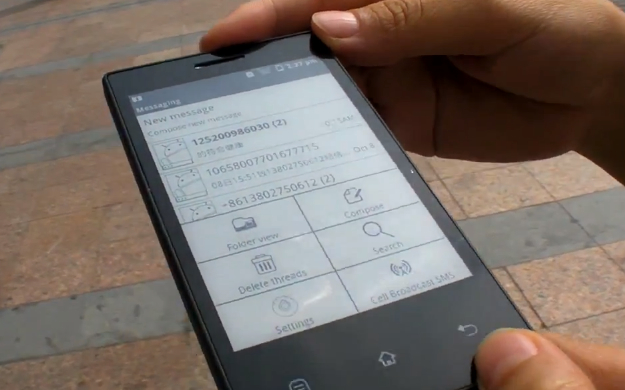
Prototype E Ink Android phone puts your AMOLED screen to shame (but only in direct sunlight)

Onyx E Ink Smartphone

Onyx International, a company known for its range of e-readers, has shown off a prototype Android smartphone with an E Ink display. While the outdoor legibility and battery life are both excellent, the screen does let it down in other areas.

As every owner knows only too well, smartphone screens are difficult to view in direct sunlight, and while pushing the brightness up to maximum can help, it doesn’t do wonders for the battery life.

Here’s an interesting solution to the problem from a company named Onyx International, a smartphone with an E Ink screen. Onyx has plenty of experience in the world of E Ink screens, as it produces the Boox series of e-readers. The handset is only a prototype at the moment, but you can see a working version in the video below, where its screen is compared to a Galaxy Nexus.

The result is spectacular, as the Nexus device just looks like it’s turned off the entire time, while the Onyx phone’s display is crisp and sharp, despite being viewed outdoors. This probably won’t come as a surprise to anyone who has used an e-reader over the past few years, and the superior performance of an E Ink screen in sunlight formed the basis of a recent Amazon Kindle ad campaign.

Surprisingly, the Onyx phone runs Google Android, which has been extensively modified to run on a monochrome screen, but as you can see, the core functionality is still there. Because E Ink screens only take little sips of battery power, the standby time on the prototype is a week. Try that on any other smartphone.

There are, however, one or two little drawbacks. E Ink displays aren’t known for their speed, and sure enough the refresh rate is terribly slow, meaning any multimedia or gaming would be impossible. Viewing text webpages is good though.

While it’s an impressive technical feat and the use of an E Ink screen on a phone certainly has its benefits, the thought of enduring those long refresh times and not being able to do the things that almost all other smartphones can do, would probably make ownership too frustrating. After all, If I wanted a long standby time, a monochrome screen and little else, I’d buy a basic feature phone.

Take a look at the video showing the phone in action and see what you think.


Source : http://www.digitaltrends.com/mobile/prototype-e-ink-android-phone-demonstrated-on-video/

Wednesday, October 3, 2012

How to pick the right e-reader

ereader comparison: e-ink kindle sony reader nook

Are you ready to take your book collection digital and buy your first e-book reader? We're here to help. We break down the best e-readers from Amazon, Barnes & Noble, and others.

If you’re looking for a new e-reader, whether you’re upgrading or buying your first device, you’ll find there are a lot of options. There are four big names in the e-book reader market and they each offer a range of e-readers to suit different budgets and requirements. There’s a reason these companies are dominating the e-reader scene, so if you want quality, great features, and reasonable prices, there’s no need to look beyond them.

We are going to focus on dedicated E Ink devices for reading e-books here, so we won’t delve into full-fledged tablets. We’ll also ignore discontinued lines, although there are bargains to be had out there in the secondhand market. Let’s take a look at the options and then we’ll compare at the end.

Barnes & Noble Nook

The popular Nook from Barnes & Noble comes in two flavors. There’s the Barnes & Noble Nook Simple Touch with GlowLight, and the Barnes & Noble Nook Simple Touch Reader.

For the basic Reader you’ll need to shell out $100. It has an E Ink display, which is easy to read, even in direct sunlight. It also has a 6-inch touchscreen and can hold up to 1,000 books, magazines, or newspapers. A single charge will last you up to two months based on an average of 30 minutes reading per day.

Nook GlowLight Nook Simple ereader barnes & nobleThe GlowLight version is $20 more at $120. It is essentially the same, but it has a backlit touchscreen so that you can read in the dark. The GlowLight reduces the battery life to a, still respectable, one month. That’s also based on an average of 30 minutes reading per day.

Both devices have a microSD card slot so you can expand memory by up to 32GB. That’s a lot of books.

For more details you can read our in-depth review.

Amazon Kindle

A perfect marriage of content and hardware has allowed the Kindle range to really drive the widespread adoption of e-readers. You have quite a few choices if you want to buy an e-reader from Amazon. There’s the basic Kindle, the Kindle Keyboard 3G, the Kindle DX, the Kindle Paperwhite, and the Kindle Paperwhite 3G.

At just $70, the basic Kindle is a steal. It has a 6-inch e-ink display that’s easy to read, even in direct sunlight; it can hold up to 1,000 books, magazines, or newspapers; and a single charge will last you up to one month based on an average of 30 minutes reading per day.

The Kindle Keyboard 3G costs $140 and it adds a physical keyboard into the mix and 3G connectivity. It also has double the storage of the basic Kindle and it boasts stereo speakers. A single charge will last you up to two months based on an average of 30 minutes reading per day. It is also larger and heavier.

amazon kindles ereadersFor anyone seeking something even bigger, there’s the Kindle DX. It has a 9.7-inch screen, free 3G, stereo speakers, 4GB of storage, and a physical keyboard. However, it costs a whopping $380 and battery life is just three weeks.

The Paperwhite is Amazon’s answer to the GlowLight Nook. It also allows you to read in the dark, but the screen is not backlit, instead there’s a light at the top. The basic Kindle Paperwhite is $120. It boasts an extremely sharp 6-inch touchscreen, can store over 1,000 books, and can also last up to two months on a single charge, once again, based on a half hour of daily reading.

The top of the range choice is the Amazon Kindle Paperwhite 3G which costs $180. It simply adds free 3G to the basic Kindle Paperwhite.

You can pay an extra $20 for any of the entries in the Kindle range in order to avoid any advertising. The special offers take the form of adverts on your screensaver and at the bottom of your home screen. There is no intrusion on your actual reading.

Kobo

It doesn’t have as big a name, but Kobo does offer a good e-reader range. There’s the Kobo Mini, the Kobo Glo, and the Kobo Touch.

The Kobo Mini costs $80. It has a 5-inch e-ink touchscreen. It can store 1,000 books and the battery can also last up to one month, but no usage estimates in terms of daily reading are provided. The one month battery claim is also contradicted in the Kobo FAQ which says two weeks.

Kobos mini ereaderAs you might expect, the Kobo Glo allows you to read in the dark and it costs $130. It has a 6-inch E Ink touchscreen, can also hold around 1,000 books, and the battery will give you 55 hours of continuous use with the light on.

The Kobo Touch also costs $130, although you’ll find it discounted in a lot of places. It has a 6-inch E Ink touchscreen. It has the standard 2GB storage which is room for up to 1,000 books. The battery life is up to one month.

The Kobo Glo and the Kobo Touch also have microSD card slots so you can expand the storage by up to 32GB.

Sony Reader

You current options are the Sony Reader PRST2HBC and the Sony Reader PRST2RC. As far as we can make out both devices are the same except for the color options. The Sony Reader PRST2HBC is standard grey/black while the PRST2RC comes in white or red.

sony reader eink ereaderThe Sony Reader costs $130. It has a 6-inch E Ink touchscreen. There is just 1.3GB internal memory, but there is a microSD card slot so you can expand storage up to 32GB. It can also last up to two months on a single charge, once again, based on a half hour of daily reading.

What to buy?

If low price is your prime concern then you can’t beat the basic Kindle at $70. We’d give second place to the Barnes & Noble Nook Simple Touch Reader at $100. You could also consider the Kobo Mini at $80 but it has a smaller screen and poorer battery life.

If you want to be able to read in the dark then it’s a straight head-to-head between the Barnes & Noble Nook Simple Touch with GlowLight at $140 and the Amazon Kindle Paperwhite at $120. The Nook has expandable memory, but the Kindle has a sharper screen, and coupled with the lower price, it edges this one. The Kobo Glo could be worth a look at $130, but it falls down on battery life again.

The presence of 3G, which will allow you to connect to a mobile network and download books even when you are out and about, is only available on selected Kindles now. Is it worth the premium? We think probably not. Most people will be happy to load up books using Wi-Fi and won’t feel the need to connect all the time.

As with any expensive purchase, we would strongly recommend that you try these out before you buy. The feel of an e-reader is very important. If you want something light then the Kobo Mini and the Sony Reader are actually the lightest, closely followed by the basic Kindle. The sharpest screen on the market is the Kindle Paperwhite at 212 ppi.

Ultimately, the Barnes & Noble Nook and the Amazon Kindle range get our strongest recommendation. You are unlikely to be disappointed with either.


Source : http://www.digitaltrends.com/mobile/ereader-comparison/

Thursday, September 6, 2012

Content is king: What Amazon’s new tablet armada means for the rest of the industry

Amazon's latest batch of e-readers and tablets signals its true intention: Crushing Apple's iTunes content ecosystem with a consumption device for every buyer and budget.

Amazon’s exclusive event in Los Angeles Thursday saw CEO Jeff Bezos unveil a number of new devices. He kicked off by talking about the fact that a lot of Android tablets have come out, but no one bought them. Why? Because, “People don’t want gadgets anymore, they want services.” Amazon spent last year proving that: The Kindle Fire has accounted for 22 percent of tablet sales in the US since it was released. 

Bezos contends that the Kindle Fire is so great because it’s ultimately more of a service than a device. This is the key to Amazon’s offerings. It’s not just about producing great hardware – it’s about creating a whole ecosystem that serves the customer every step of the way. And because this Amazon we’re talking about, it can do so at incredibly competitive price points. So, while Samsung wants to take on Apple by trying (and mostly failing) to convince us  that tablets should be productivity devices, Amazon is not only churning out pure consumption devices… it’s betting it can beat Apple at the consumption game. By getting affordable hardware into the hands of consumers in each price bracket, Amazon can focus on selling content. The proposition it is offering as a complete service is straightforward, easy to grasp, and very attractive.

Three devices to rule them all

Thursday’s presentation included the Kindle Paperwhite, an updated Kindle Fire, and the Kindle Fire HD in 7-inch and 8.9-inch form. Each one credibly takes on all comers in its respective market tier, beginning with the e-reader tier that Kindle essentially created way back when it seemed like Amazon was happy to cede the top end of the tablet market to Apple. The new Kindle Paperwhite is lighter and thinner than previous devices, with a patented light guide feature, which sheds an even LED light on the screen for reading in the dark. That helps Amazon to compete with the Nook GlowLight. This new Kindle also has amazing battery life and it looks like a great device for $119. There’s also a version with international 3G for $179, and that means the entry-level Kindle without the touchscreen will drop to just $69.

The original Kindle Fire has been upgraded with a faster processor, a bigger battery, and more RAM. It’s supposed to be 40 percent faster than its predecessor and it will cost just $159. That’s a clear shot over Google’s bow, as the Nexus 7 went on sale at $199.

Amazon Kindle Fire HD tabletThe biggest news is the Kindle Fire HD, which comes in two sizes. There’s a 7-inch device and an 8.9-inch device. The larger tablet looks like competition for the iPad. The 7-inch 16GB version of the Kindle Fire HD goes head-to-head with the Nexus 7 at $199. The 16GB version of the 8.9-inch Kindle Fire HD is an attractive $299. Then there’s the 32GB 8.9-inch Kindle Fire HD with support for 4G LTE, which will cost $499.

These are extremely aggressive prices and Amazon knows it. “We want to make money when people use our devices, not when they buy our devices,” Bezos said.

Content is king

Amazon is a strong position when it comes to content. Amazon Prime has over 25,000 movies and TV shows. The Kindle store has 1.5 million e-books. The curated Amazon Android App Store boasts over 50,000 apps now and over 30,000 of them are compatible with the Kindle Fire. Meanwhile, iTunes has about 4,500 movies, 2,000 TV shows, and iBooks carried only 150,000 titles in March 2010 — Apple hasn’t released any figures since then. Apple’s App Store does notably outsize Amazon’s with more than 725,000 apps, and more than 100,000 specifically for the iPad.

When it comes to pricing, Amazon Prime looks like a real winner. Prime started off as simply a way to get free two-day shipping on anything Amazon sold, but the with Kindle it’s evolved into something far more impressive: instant access to streaming video with no ads, and access to thousands of books through the Kindle Owners’ Lending Library, all for a flat $79 per year fee. You can share that membership with your family, and there’s a free one-month trial. 

Kindle Fire HD hands-on

That’s a lot of content and it’s seamlessly integrated through Amazon’s Android interface. It gives people access to movies, books, games, and apps from a brand they already know and trust. If Apple has always been about keeping things simple and having services “just work” across devices, then it could learn a thing or two from Amazon’s approach to content. To get the same content through iTunes would necessitate multiple purchases and be a lot more expensive.

And usability is queen

All this focus on service doesn’t overshadow the fact that the Kindles are evolving quickly in the features department. Front-facing HD cameras with pre-installed Skype, as well as improved email syncing and exchange integration on the Fire HDs provide the communication functions consumers expect from tablets. Whispersync is enhanced with audiobooks and can now sync your place between devices – a function that works for games as well. The X-Ray search feature now works not only with books, but also movies, and Amazon’s ownership of IMDB further enhances movies by integrating actor and actress information into pop ups that can display as you watch. Support for multiple profiles and a set of parental controls round off a thoughtful feature list that’s sure to be a hit with a wide audience. That mix of features and an enticing content deal hits a real sweet spot for families. 

Setting the tablet market on fire

It’s a space that’s really been heating up in the last few months and with rumors of that Apple iPad mini still on the horizon there’s plenty of fighting left to be done. All of this competition is great for consumers. Amazon has released an impressive line-up here that represents real value for money. From the basic Kindle up to the Kindle Fire HD, Amazon has a device for every budget. It wants to make sure that there’s a device for every kind of buyer, that those devices are as affordable as possible, and that they are always connected to the content pipeline. Whether through higher speed Wi-Fi or the latest 4G LTE, Amazon is equipping customers with affordable windows to its content store.

As a complete ecosystem, a one-stop, all-you-can-eat, content buffet, Amazon’s offering is a very real threat to Apple. It doesn’t feel the same pressure to turn a profit on hardware because the hardware is just a vehicle for the content, and that’s where the battle for customer loyalty and the rolling profits kick in.


Source : http://www.digitaltrends.com/mobile/amazon-battles-on-multiple-fronts-with-new-device-line-up/

Kobo pushes out new Mini and Glo e-readers, plus the Arc Android tablet

Kobo Arc Tablet

Online e-book retailer Kobo has announced the Kobo Arc Android tablet, plus the Kobo Glo and Kobo Mini e-readers.

Kobo, the online e-book retailer, has swooped in to steal some of Amazon’s thunder by announcing three new products — the Kobo Mini and Kobo Glo e-readers and the Kobo Arc Android tablet.

Let’s start with the Kobo Arc tablet. This isn’t the first tablet that Kobo has released, as the Kobo Vox came out late last year, but was eclipsed by the better specced, more exciting Kindle Fire. Not being Google Certified didn’t help the Vox either, but it appears Kobo has learned from its mistakes with the Arc.

Powering the 7-inch, 1280 x 800 pixel display is a 1.5Ghz, dual-core Texas Instruments processor, along with 1GB of RAM, while the operating system is built around Android 4.0 Ice Cream Sandwich.

Kobo has included the Google Play store this time around too, but has also added its own user interface over the top of the Android OS, along with a new feature called Tapestries.

At first it sounds like a customizable homescreen really, as you can “pin” favorite books, pictures, videos and web links to your Tapestry, but it gets a little more interesting as the Arc will then offer content suggestions based on what you’ve pinned to the screen.

Kobo has also added features such as Wi-Fi, Wi-Fi Direct, a front-facing 1.3-megapixel camera, and a battery that should provide 10 hours of continuous reading. Two models will be made available, one with 8GB and the other with 16GB of internal memory, and they’ll be priced at $199/£169 and $249/£199 respectively when it’s released in November.

Kobo Glo and Kobo Mini

On to the Kobo Glo, then, which is a 6-inch e-reader. The E Ink touchscreen boasts an impressive 1024 x 768 resolution with 210 dots-per-inch, which at the moment, trumps the competition.

The clue as to what makes the Glo standout is in its name, as the screen has an adjustable front light, so it can be read in the dark. Naturally, this affects battery life, and with the light on you can expect 55 hours of reading time, but more than a month with both it and the built-in Wi-Fi switched off.

There’s 2GB of internal memory with a microSD card slot to boost this by 32GB, plus the Glo will accept .ePub books protected by Adobe DRM too. This is especially helpful, as unlike the Kindle, you won’t be restricted to a single store from which to buy your books. It’s set for release on October 1 for $129/£99.

Finally, we come to the Kobo Mini, the company’s basic e-reader. It features a stock 5-inch E Ink screen, 2GB of internal memory, Wi-Fi and a lightweight 134 gram chassis. It too will be out on October 1 at the bargain price of $79/£59.

Kobo’s new hardware range looks great, and is priced competitively, however it will still need to contend with whatever Amazon, Barnes & Noble and potentially even Apple have in store for us before the all-important Holiday season. Will these devices help put Kobo’s name on the map?


Source : http://www.digitaltrends.com/mobile/kobo-new-mini-glo-arc-tablet-ereaders/