Wednesday, October 17, 2012

Google sends out invites for an Android event on October 29

Google has just sent out invites to the media for an Android event to be held on October 29. The event will be in New York at 10:00 AM and will be streamed live on YouTube.


As far as the purpose of the event is concerned, our psychic powers tell us it is going to be a new Nexus device, the same LG manufactured unit currently known as the Nexus 4 we have been seeing for a while now. There is a possibility that there could be multiple Nexus phones this year but other than some rumors we have seen zero proof to confirm that, so we won't be holding our breath for them.

It's likely that Google will launch this new Nexus device with a new version of Android, most likely the Android 4.2 that has been floating around these days. Other than that we expect to hear some updates on the Nexus Q, which has been an unmitigated failure since it was launched during Google I/O, enough for Google to pull it off shelves and go back to working on it. Google could also announce the 32GB Nexus 7 that we have been hearing about recently.

You may have noticed by now that the October 29 date coincides exactly with the Windows Phone 8 launch date and it would be naive to think that's a coincidence. Google must be pretty confident in its product(s) if it thinks it can go head to head with multiple Windows Phone 8 devices on the same day. We'll just have to wait and see how things turn out.

Brace your wallets cause next week is going to be a doozy.

Source


Source : http://www.gsmarena.com/google_sends_out_invites_for_an_android_event_on_october_29-news-4962.php

Report claims iPhone 5 already accounts for 3% of web traffic

Report claims iPhone 5 already accounts for 3% of web traffic
The iPhone 5 already accounts for 3% of mobile web traffic

A recent report from ad network Chitika indicates iPhone 5 users are connecting to the web more than any other smartphone.

The Chitika study found that since it launched on September 24, the iPhone 5 has rapidly risen through the ranks, and now singlehandedly accounts for three per cent of web traffic from mobile phones.

When combined with previous iOS devices, Apple's ecosystem contributes to 46 per cent of all mobile web traffic. That's a significant lead over its nearest rivals, Samsung, which accounts for a total of just 17 per cent.

Samsung vs Apple continues

It's not just the iPhone 5 performing well though. Chitika claims that the Galaxy S3 from Samsung, launched back in May this year, currently accounts for two per cent of mobile web traffic.

While there's a huge difference between Apple and Samsung, it has also become obvious that the Korean giant has become the leading Android handset maker, with all other mobile devices accounting for just 37 per cent of traffic combined.

Chitika conducted the study by conducting a user agent analysis on "millions of mobile ad impressions, spanning a 7-day time frame from October 3rd through October 9th, 2012".

While there is debate about how reliable information garnered through ad impressions is as a tool for measuring web traffic, it does reinforce the idea that the current smartphone marketplace is becoming a two horse race.

Via: TechCrunch


Source : http://www.techradar.com/news/mobile-phones/phone-and-communications/report-claims-iphone-5-already-accounts-for-3-of-web-traffic-1105219

RIM boss Thorsten Heins hits back at BlackBerry-bashing NY Times article

BlackBerry World 2012 Thorsten Heins

RIM CEO Thorsten Heins has hit back at a recent NY Times article that interviewed a number of disgruntled BlackBerry owners. In a letter published by the newspaper on Wednesday, Heins accused the piece of lacking balance and said there were still "millions of BlackBerry fans out there."

RIM CEO Thorsten Heins must have had smoke coming out of his ears when he read a New York Times article on Monday entitled The BlackBerry as Black Sheep.

His company is struggling, for sure, but he’s hoping it can turn things around with the launch of its next-generation operating system, BlackBerry 10, early next year. Until then, he needs to hold on to his customers, and prevent the company’s image from being bashed about any more than it is right now. His heart will have sunk when he read the NY Times piece.

It pretty much ripped into the phone maker, interviewing users who had apparently become embarrassed about pulling their BlackBerry phone out of their bag. “I’m ashamed of it,” said one, who claimed to hide her device under her iPad for fear of being judged by clients.

Another said she wanted to “take a bat to it,” which, let’s be honest, seems like something of an overreaction when it comes to feelings about a mobile device. There were a few favorable words towards the end of the piece from a BlackBerry owner called Mr. Fenton who said he couldn’t understand what all the fuss was about when it came to the iPhone, but in case the reader might start to think that perhaps RIM’s phones weren’t so bad after all, the article finished off with someone called Mr. Mindel laying the boot in, saying, “I’m considering removing my BlackBerry battery, pouring in cement, and using the BlackBerry as an actual paperweight.” You get the picture. 

So imagine Heins in his office earlier this week, NY Times in hand, reading this article. Of course he wasn’t going to let this go without saying something. He hammered out a response and on Wednesday the newspaper published it.

In his letter, Heins accused the publication of lacking “the balance your readers expect,” before going on to explain that carriers and partners around the world have recently told him “there are millions of BlackBerry fans out there who not only find great value in their device, but also pride in being a BlackBerry owner.”

He says that he takes reports of dissatisfaction among BlackBerry users very seriously, adding that he was encouraged by the supportive comments received in response to the NY Times article.

After trotting out a couple of stats, Heins ends his letter confirming that RIM is on track to deliver BlackBerry 10 in the first quarter of 2013, and offers thanks to “the customers who have remained loyal to the BlackBerry platform.” He also says RIM is looking forward to “winning back many who have left.”

Heins is all too aware that having nothing to show for at least another 10 weeks gives BlackBerry bashers ample time to keep on bashing, and that what RIM must do is keep current users on board while trying to put a positive spin on a very difficult situation. Of course, there will be those who say RIM has done a decent job of beating itself up in recent years with various PR blunders and missteps, but Heins is steering the ship now and is doing everything in his power to save the company from collapse.


Source : http://www.digitaltrends.com/mobile/rim-boss-thorsten-heins-hits-back-at-blckberry-bashing-ny-times-article/

Google announces Android event on October 29

Google announces Android event on October 29
Nexus launches coming at Android event?

Google has sent out press invites to an unspecified Android event on October 29 in New York.

Following recent speculation, the event is likely to showcase the next Nexus smartphone, which is widely thought to be the often-leaked LG Nexus 4.

Reports have also suggested HTC has been working on a 'Nexus 5' phablet, while Google-branded Sony and Samsung devices have also been mooted.

Multiple devices launches would not be a huge surprise, following widespread reports that Google intends to break from tradition and work with multiple manufacturing partners for the next Nexus launch.

There has also been widespread talk of a 32GB version of the Google Nexus 7 tablet as well as a 10-inch Nexus 10.

Live-streamed for the masses

The event is also likely to bring news on Android 4.1 Jelly Bean updates, so it would be a major surprise if there were any mention of the forthcoming Android 5.0 Key Lime Pie OS just yet.

The invitation itself features the Google search bar widget from Android filled with the cryptic message 'The playground is open.' Behind it, and the company logo is image of the New York City skyline.

The press conference will take place at 10am ET (That's 3pm UK time) and will also be live-streamed for the masses at YouTube.com/Android.


Source : http://www.techradar.com/news/phone-and-communications/mobile-phones/google-announces-android-event-on-october-29-1105207

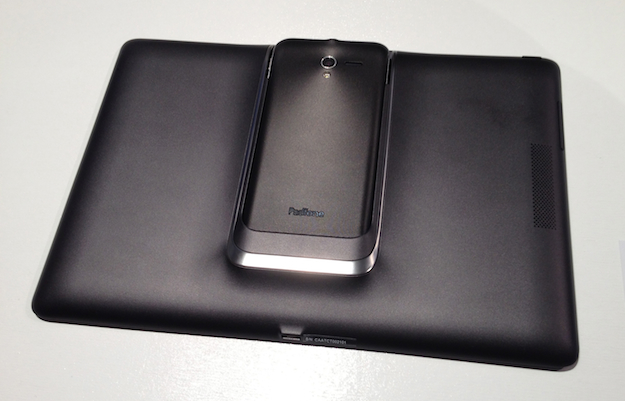
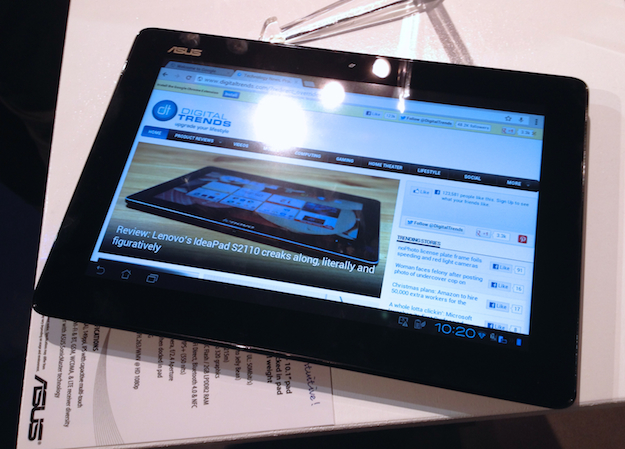
Asus PadFone 2 hands on: A phone and tablet merger that actually works

A hands-on preview of the Asus PadFone 2, an innovative device that combines a smartphone with a tablet, and somehow does appear to give us the best of both worlds.

There can’t be all that many people who don’t think that, in principle, the idea of the PadFone 2 is a good one. After all, it combines the two most popular — and fastest growing — consumer electronics markets into one handy device. At the PadFone 2’s launch event today, I had the chance to spend some time playing with Asus’s unusual device, and while it’s still not exactly clear at whom it’s aimed, it’s a clever machine with considerable potential for the future. Asus’s tagline for the tablet is “It’s intuitive.” I have to agree.

The first thing you notice about the smartphone is how light it is, feeling lighter in the hand than both the Galaxy S3 and iPhone 4, despite them all being within a couple of grams of each other. The phone is made of plastic, as is the brushed metal-look band around the edge, and since the rear panel is non-removable, the battery won’t be able to be swapped out for a new one.

Installed on the PadFone 2 at the event was Android 4.0 (Ice Cream Sandwich), but an upgrade to Android 4.1 (Jelly Bean) should be coming in December. This means the European PadFone 2, which should arrive early next year, will most likely come with the latest version of Android already installed.

Padfone 2 Hands-on Front and Back

Padfone 2 Hands-on Dock

Quad-core power

The Snapdragon S4 Pro quad-core processor gives the smartphone incredible performance. Even without Jelly Bean’s “Project Butter,” scrolling was smooth and precise, and video was expertly handled. Scrolling could still be “sticky” in the browser though. A 1.5GB HD video file could be scrubbed back and forth with no delays in playback, and when the Adreno 320 GPU was put to work on a Need for Speed game, it looked stunning.

Grasping the tapered body of the PadFone 2’s phone section, it’s simple to slot it into the tablet and in fact, you don’t even need to look at what you’re doing. This makes perfect sense when you consider the sharing aspect of the PadFone 2, as you can be looking at a photo on the phone, which then appears on the tablet’s screen almost instantly when you dock them together. Fiddling around on the back of the tablet would spoil this experience completely.

Slotting the phone into the tablet station is precise and satisfying, and ends with a positive push to lock it into place, feeling not unlike docking an iPhone into a well-made audio dock. It’s not going anywhere either, as even turning it upside down and shaking it about failed to see the phone slip out and clatter onto the floor.

Padfone 2 Hands-on Back

Instant sharing, with a catch

Using the tablet is a very similar experience to using the phone as it’s the same OS, but with this comes a slight drawback — the browser wants to open mobile websites. Visiting DigitalTrends.com, the BBC and YouTube on the tablet resulted in exactly that happening, but a better YouTube experience could be had using the standalone app. This is a problem on most Android tablets.

The instant sharing is also flawed at the moment, as it only works with certain applications. Say you’re reading a website using Chrome on the smartphone, but decide you want to read it on the larger screen, so you plug it into the tablet station. Sadly, it doesn’t just appear and you need to open Chrome as usual. Sure, your content is there straight away, but it adds a step or two to the process. The answer is to use the standard browser instead, which does instantly start when you dock the two devices, as does the gallery, the camera app, Google Play and the standard email app too. But generally, if you’re doing something on your phone before you plug it in, prepare to have to re-open that task.

Asus says that many apps are undergoing a certification process, so by the time the PadFone 2 goes on sale, this could all change. Hopefully it will, as it’s one of the standout features of the device.

Padfone 2 Hands-on Tablet

Intuitive and pleasantly surprising

Using the PadFone 2 for only a short time confirms that Asus is right to call it intuitive, primarily because of the instant sharing feature and the easy docking, but learning the ins-and-outs of the lightly skinned Android OS was a breeze too. This, along with the all-in-one nature of the PadFone 2, makes it a good choice for anyone new to smartphones and tablets.

Such simplicity, design innovation and power doesn’t come cheap though, with the 32GB model priced at 800 euros ($1,042) for the smartphone and the tablet station. Before you snort derisively at this figure, think about this: A 32GB iPhone 5 costs 790 euros on its own, and you’re stuck with that battery and that screen size. Add a 32GB Wi-Fi and Cellular iPad and you’ll need another 700 euros, giving a total of 1,488 euros ($1,940) for the pair. Pop over to Amazon for a SIM-free Galaxy S3 and a Galaxy Note 10.1 and you’ll still need the best part of 1,100 euros.

So, although the initial outlay sounds like a lot, that’s quite a savings when you consider how much buying two separate devices to emulate the PadFone 2’s abilities costs. It is, however, still a big price for a relative newcomer to ask for an quirky product. It could also be saved if U.S. wireless carriers decide to subsidize the phone and tablet combo deeply enough, it could be quite affordable. But with how badly the Motorola Atrix + Laptop Dock were priced, it’s difficult to be hopeful.

In the short time I had with the PadFone 2, it was certainly winning me over, and it’s impossible not to be impressed by the Snapdragon S4 Pro’s performance. I have the feeling a lot of people are going to be surprised by the PadFone 2, it just takes an open mind, a calculator and good, solid test run.

Video playing on the PadFone 2

The PadFone 2 camera


Source : http://www.digitaltrends.com/mobile/asus-padfone-2-hands-on/

Ads to invade Facebook mobile app News Feed

Ads to invade Facebook mobile app News Feed
The pressure's on

Users might notice new ads pop up on their smartphones' Facebook News Feed as the social network has opened up its latest strategy to make money through its mobile app.

In August, Facebook began testing a new "mobile app install ads" program that wasn't connected to users' social ties.

The test was apparently a success as Facebook announced Wednesday via its developer blog that it's opening the service up to all developers.

The test program allows an undisclosed amount of third-party developers purchase ad space on the mobile News Feed to help drive buyers to their apps.

Those advertisements then lead users to the developer's app store purchase page either through the Android or Apple app store.

It all ads up

"For years, many apps and games on Facebook.com have used ads as an important part of their growth strategy," Facebook's Vijaye Raji wrote on Facebook's developer's blog.

"Now we are bringing these opportunities to mobile apps," Raji continued.

"With these new ads, mobile apps and games of all sizes across any category can reach the right audience, at scale."

In the post, Raji touted the new program's ability to help developers reach more relevant audiences and drive up install rates.

He pointed to game creator TinyCo, which saw a 50 percent higher click-through rate when it participated.

Other advertisers reached 8-10 times the audience and Ad Parlor clients saw consistent 1-2 percent increases in click-through rate from the home feed, according to Facebook.

This is a bit of a break from the Facebook ad norm. Traditionally, ads pop up on users' pages because they or a friend liked the brand.

But with this program, dev advertisers will be able to target the audience they want to sell to, instead of who likes them. Facebook is banking on the hope that those two groups will have a large cross-section.

Since the ad program is new, Facebook will still need to work out a few kinks to smooth out the user experience.

The company will also improve the program's ad targeting abilities, as well as make sure developer ads aren't targeting users on the wrong platform.

Facebook in free fall

The program comes as Facebook tries to monetize its mobile space.

The social network as a whole has felt the pressure to become more profitable after its failed IPO in May. In September, the stock hit a new low at $17.55 (UK£11.14, AU$17.33) from its starting price of $38 (UK£23, AU$36).

We'll see if the new mobile app install ad program wows investors next Tuesday, when Facebook calls to share its third-quarter earnings.


Source : http://www.techradar.com/news/phone-and-communications/mobile-phones/ads-to-invade-facebook-mobile-app-news-feed-1105154

HTC J Butterfly has our hearts aflutter with it’s high-res screen

HTC rolls out a new version of the HTC J -- the J Butterfly. The handset will be exclusive to Japan, but comes with a screen that will make the world envious. It's 5-inch display comes packed to the brim with 440ppi resolution.

HTC brought its latest creation to Tokyo today, and now we’re wondering how long it takes a butterfly to fly over the Pacific Ocean. The HTC J Butterfly is the new flagship handset from the Taiwanese phone maker and it comes fully equipped with a screen that you just can’t help but to stare at. There’s plenty to see with the 5-inch HD Super LCD 3 display that is ready to run at 1080p — the highest resolution yet for a phone.

The screen isn’t the only attraction on the J Butterfly, the successor to the HTC J. The black-and-red skinned phone will come running Android 4.1 (Jelly Bean). It’s powered by a 1.5GHz Snapdragon quad-core processor and 2GB of RAM and is equipped with a 2020mAh battery that will have its work cut out for it. It’s also loaded with an 8-megapixel camera with a f/2.0 lens. All of this is housed within a thickness of 9.1mm. A quick comparison of the specs makes the J Butterfly most comparable to the One X, the crowd-pleasing offering from HTC released earlier this year.

It’s that screen that puts the J Butterfly in the league of its own, though. The HTC One X came with an impressive Super LCD screen that was worthy of comparison with the best displays on the market. The J Butterfly aims to float above the competition, and may well do so. It’s promising a resolution that reaches 440-pixels per inch (ppi). For comparison purposes, the iPhone 5 sits at 326ppi. I’d hate to be the guy that has to try to pack all those pixels in. That’s how those things work, right?

The J Butterfly will be exclusive to the Japanese market, but that doesn’t mean the Super LCD 3 screen won’t find its way on the front of some U.S.-bound handsets. Until then, we’ll just have to look forward to the day we can wipe the drool off our screen.


Source : http://www.digitaltrends.com/mobile/htc-j-butterfly-has-our-hearts-aflutter-with-its-high-res-screen/