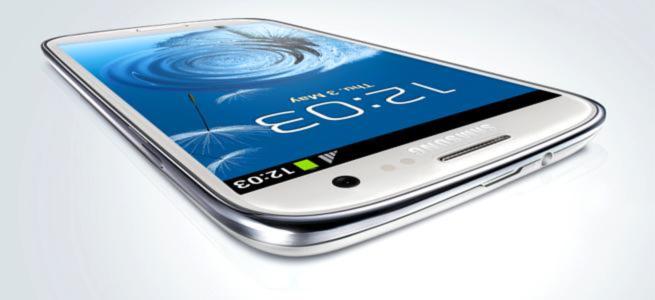
According to the latest research, the Samsung Galaxy S3 has become the world's most popular smartphone, after it outsold the Apple iPhone 4S and the iPhone 5 between July and September 2012.
Research into global smartphone sales for the July to September period of 2012 has revealed that the world’s number one smartphone was the Samsung Galaxy S3, knocking the Apple iPhone 4S into second position.
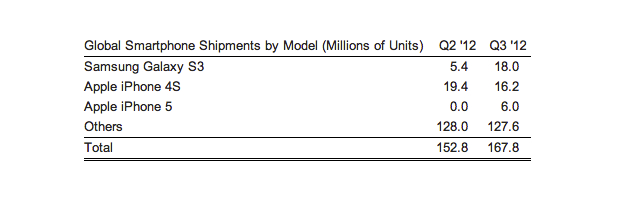
The report comes from research firm Strategy Analytics, and it puts the Galaxy S3 in first place with 18 million devices sold globally, and the iPhone 4S trailing with 16.2 million sold. In third place it’s the iPhone 5 with 6 million sales.
So, its a fanfare for Samsung, a company well on its way to beating Apple in the battle for smartphone supremacy. But is it? Well, as a headline, it is indeed good news for Samsung, but the sales from the third quarter of 2012 tell only a percentage of the story.
Samsung released the Galaxy S3 at the beginning of May 2012, spreading it to as many networks and countries as possible. In the slightly truncated second quarter results, it shifted 5.4 million phones.
But take a look at the iPhone 4S’s performance. The 4S went on sale in October 2011, and still sold 19.4 million in the second quarter, and then 16.2 this quarter. Not bad for a phone that was a fairly unremarkable evolution of the previous model, that has been on sale for, now at least, more than a year.
These past couple of months have also been filled with anticipation over the iPhone 5, which then arrived at the tail end of September, and it still managed to sell more than the Galaxy S3 did in its opening weeks, and in a shorter time too.
Many potential iPhone 4S buyers decided to wait for the iPhone 5 in the run up to its release, which explains the drop off in 4S sales, and in effect, allowed Samsung to swoop in and grab the “world’s best selling smartphone” crown.
The question is, can it retain its crown in the all-important Christmas period between October and December? Strategy Analytics doesn’t think so, and expects Apple to “soon reclaim the title.”
The Galaxy S3 unquestionably deserves to top the charts, but the figures also highlight the struggle it faces to maintain that position over a longer period of time.
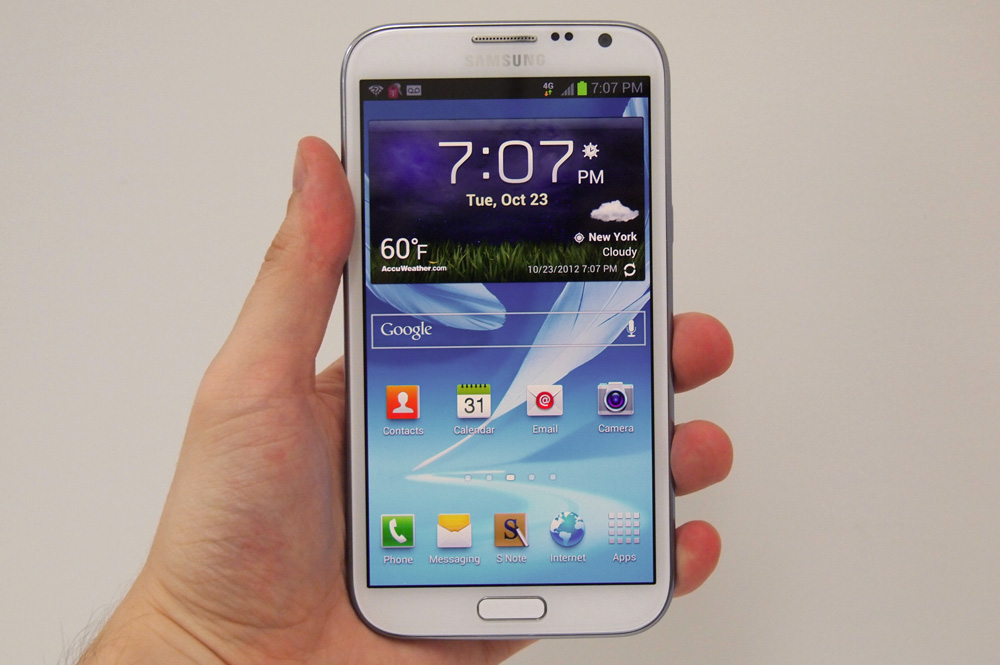
Samsung have once again outdone themselves, this time with the Galaxy Note II. The 5.5-inch phablet is now ticking in 3 million pockets worldwide, just 37 days after the September launch.
"The rapid Galaxy Note 2 sales have a meaning of not just creating a new category of smartphone, but also of popularizing the category." – says Samsung.
While the number is not as impressive Galaxy S III and far from Apple’s iPhone 5 sales, it’s still a milestone for the company and for any device in this class. The first Galaxy Note managed to sell just 2 million units four months after its premiere (way more than the initial expectations), so the Note II is a sound success indeed.
Samsung has announced that it has sold 3 million Galaxy Note 2 tablet/smartphone hybrid devices, despite it only have been on sale since September. That's a lot of sales for a niche product, so where is its competition?
Samsung must be looking at the latest sales figures for the Galaxy Note 2, which it has just made public, shaking its head and then having a good laugh. It has released a device nobody thought they wanted and critics instantly took against, then went on to sell millions of them. So why is it laughing? Because there still isn’t any competition.
The Galaxy Note 2 went on sale during September in Korea, reached the UK on October 1, and has steadily made its way to the US and other regions around the world since. According to Samsung, in 37 days it has racked up more than 3 million sales.
The original Galaxy Note arrived in September 2011, but didn’t reach 1 million sales until the end of December, so the Note 2‘s performance is impressive going, particularly when you take into account the Note 2 is still a niche device.
But is it so niche that it doesn’t need some competition? Who does Samsung think it is? Apple? Has it really produced an initially derided product that in reality, just caught other manufacturers napping?
Rumors and half-releases
It seems so, as viable alternatives to the Note 2 are few and far between, despite the product line having been on sale for more than a year. There’s the LG Optimus Vu, or the LG Intuition if you buy it from Verizon; but in its infinite wisdom, LG hasn’t bothered to give it a wide release, so its sales are unlikely to impress.
HTC’s bizarrely named J Butterfly phone has a 5-inch, 1080p screen, but it’s only available in Japan, while Panasonic has picked up its 5-inch Eluga Power and taken it home, after it failed to gain any traction in the European market. At least these have seen a release, as phones such as the LG Optimus Vu II, the Oppo Find 5, Lenovo’s S880 and the Thomson X-View 2 are all seemingly in some kind of release date limbo.
Huawei and ZTE have woken up and started talking about their own tablet/smartphone hybrid machines. For Huawei, it will be the Ascend D2 and the rumor is it will be equipped with a quad-core chip and a 720p 5-inch display. ZTE’s Nubia Z5 will have the same specification, but will add a 13-megapixel camera too. Neither are confirmed though, and both are likely to do the rounds in China before possibly going international sometime next year.
There are also a few other rumored devices with 5-inch-plus sized screens coming soon. HTC may adapt the J Butterfly for international release — possibly to be named the Droid DNA and launched on the Verizon network — while the Sony C650X, codename Odin, may arrive next year too, along with a 6-inch screen version codename Yuga. Both of these and the Droid DNA are said to have 5-inch, 1080p screens.
All this gives the Galaxy Note 2 an almost entirely open playing field until well into 2013. How many Note 2 handsets will it have gone on to sell before a true alternative finally goes on sale?
The new eBay redesign is here, and it looks a lot like Pinterest -- if Pinterest's goal was to help you spend tons of cash.
Earlier in September, eBay announced that a “new eBay” was coming, teasing the audience with a logo rebranding to reveal a slimmer, more modern take on what used to be a clunky, bulbous design. Today, eBay takes the next step in unveiling a site overhaul that shows off a Pinterest-like grid interface to help shoppers browse more comfortably and more visually.
The “old” eBay allowed shoppers to view search results in a list or grid view, with price, auction end date, and Buy It Now options either lining the right side of the screen or hidden in grid view. The new design is tailored to be more mobile friendly, allowing for larger photos and fitting more listings in one page without having to scroll through search results. The redesign is even more helpful for shop owners, as they can have a prettier place to display all the items being auctioned off while their star ratings are located promptly at the top of their profiles to offer credibility.
Furthermore, eBay users can view a feed of watched items, featured, recently viewed, or “My Feed,” which showcases a grid of things you’ve chosen to curate under your profile. This way, even if you aren’t selling the item yourself, you can promote your customers to a list of products they might like based off purchases they’ve made from your store before.
“The future of commerce is personal, driven by data. Search results and recommendations are no longer enough,” eBay President Devin Wenig writes in an announcement post. “Consumers want insight. And they want personal, curated selection that is relevant to them, controlled by them.”
EBay joins Facebook in revealing a Pinterest-ified e-commerce element this week. The social network recently unveiled its Collections feature, a brand-facing tool that gives retailers a visual, pinboard-formatted way to show off their goods. The mechanism also introduced “Collect” and “Want” actions to Facebook, giving users the ability to create wishlists and show off their purchases, as well as click-through buying power. And, of course, it all looks incredibly similar to the site that really ignited the social shopping craze — Pinterest. The hype about its profit-turning power has been enough to get e-commerce hopefuls mimicking its design.
The more contemporary, clean eBay interface is slated for launch in the upcoming weeks stateside, while a global launch should be anticipated by the year’s end. It’s definitely eBay’s answer to being more intuitive, and making shoppers spend money faster in an Amazon-like fashion. If you’re already an avid eBayer, the redesign might make it that much more appealing for you to keep auctioning the things you want and want to sell, but it’s still going to be a tough to compete with the hoards of loyal Amazon users.
It would be tough to turn around any faltering company, let alone one that posted record losses of $1.73 billion (€1.4 billion EU, £1.1 billion UK, $1.7 million AU) during the second quarter of 2012.
That's more than four times what Nokia lost in the same time during fiscal 2011.
It seems the tough times have continued as Credit Suisse downgraded Nokia to "underperforming," and even suggested Nokia may want to sell off some assets.
If new reports are true, that's just what Nokia is planning to do.
Movin' out
A report from Finnish paper Helsingin Sanomat indicates Nokia may want to sell off its headquarters in Epsoo.
Nokia financial director Timo Ihamuotila spoke to the paper about the company's recent financial woes, even going so far as to divulge potential plans.
"We are exploring different options for our property assets. This includes a possible sale of our headquarters," Ihamuotila said.
Of course, just because Nokia sells off their HQ, that doesn't mean they have plans to actually vacate the premises.
Ihamuotila added Nokia has no plans to leave the head office, giving some credence to the idea Nokia may continue renting the space from the potential buyer.
The strategy is quite common in business when a failing company needs a quick influx of cash assets.
Is it enough?
Despite having several irons in the fire for the future, including planned Windows Phone 8 devices, and their ballyhooed Nokia Maps, Nokia may still have a tough time recouping losses.
Nokia has continued to lose market share to both Android and iOS devices, both of which have shown continued growth over the same time period.
With so little of the market up for grabs, it will certainly be a tough battle ahead for Nokia if the company hopes to become profitable, and please investors once again.
TechRadar has reached out to Nokia, and will update this story if and when a request for comment is returned.
RIM CEO Thorsten Heins has delivered his BlackBerry 10 Jam Americas keynote, where his enthusiasm for BlackBerry 10 was palpable
September 25 saw the beginning of the BlackBerry 10 Jam Americas conference, where CEO Thorsten Heins took to the stage to entertain and encourage 1,500 attending developers and partners.
He began by talking about what BlackBerry 10 would offer customers when it’s released, promising that productivity, reliability, security and multi-tasking would all be taken “to the next level.” Also on the list was a new keyboard with improved predictive text, and a completely new web browser he described as “killer.”
Rarely did Heins describe BlackBerry 10 as a smartphone operating system though, preferring to say that it’s a step forward in “mobile computing,” and emphasized its suitability for individual business users and enterprise clients.
This was particularly evident during the brief demonstration of BB10, where the calendar was shown off, as well as a feature named BlackBerry Balance, where the phone can be switched between personal and business accounts. Both sets of data are totally separate, right down to the security and access to the BlackBerry App World store.
Hub, Flow and Peek
Much was made of the BlackBerry Hub, Peek and BlackBerry Flow, which make up the basic user interface of BB10. The Hub collects all incoming information and notifications — which RIM says isn’t like a unified inbox at all, but everyone else will probably disagree — while Peek lets you swipe aside open apps to return to the Hub, then swipe in a new app to use.
Finally, a feature named Flow seemed to provide fluid movement through the Hub, but wasn’t expanded upon during the presentation.
Sadly, the demonstrations highlighted the Dev Alpha device’s inability to recognize touch gestures on more than one occasion, and while enthusiasm concerning BB10’s interface was high, it wasn’t quite as exciting in real life.
Time and again, the example of a “business man running through an airport” was trotted out, particularly to show the ease with which BB10 can be controlled using one hand and one thumb.
Also highlighted was RIM’s increasing interest in Asia and other emerging markets, from the prevalence of locations in India, Africa and the East on Heins’ tour map, to making a point of intelligent multi-language support in BBM, without the need to manually change keyboards mid-flow.
On track for early 2013 release
So when is it coming? For all Heins’ high-fives and gusto during the keynote, the story of BlackBerry 10’s release is still the same — early next year. He said everything is “on track” and that release is “a few short months away,” plus they are currently testing better devices too.
A degree of positivity regarding BB10’s impending release came from the news that next month, the hardware and software will be sent to carriers for testing, although in another interview RIM’s chief marketing officer warned that this process can take anywhere between six and twenty weeks. While this won’t be true of every network all over the world, it could see some releases delayed until March 2013 at the earliest. In the same interview, it was revealed that BlackBerry 10 will initially debut in America, Europe, Australia, Asia and Africa.
Heins, like the rest of the tech world, knows what’s at stake with BlackBerry 10, calling it “our most important launch ever” and going on to share what sounds like a realistic expectation of how it will perform: “We have a clear shot at being the number three platform in the market” he said.
The 40-minute keynote finished with the news that the company’s user base has grown to 80 million subscribers, and that BBM has 60 million users worldwide. A new SDK will be released this week and app submissions will start on October 10. To show how RIM loves its developers, it serenaded them with a song. Yes, really.
According to a very positive Thorsten Heins, there’s “a new culture, new energy and a lot of fighting spirit at RIM,” and solely based on his upbeat BlackBerry Jam keynote performance, it’s becoming easier to believe him.
At its event in San Franciso on September 12, Apple finally lifted the veil on the long-awaited iPhone 5. Our complete guide to Apple's newest flagship phone.
Confirming all the rumors detailing its appearance, internals, and bundled earbuds, the iPhone 5 launch was very predictable. But lack of shock-factor aside, the new handset still has a lot to offer. Apple’s newest iPhone has been slimmed down, suped up, and redesigned. If you want to know more about the iPhone 5 then you’ve come to the right place.
Advanced Retina Display
With the iPhone 5, Apple changed the size of the iPhone screen for the first time ever. The new screen is elongated, with a widesceen aspect ratio to 16:9. The new 4-inch, Retina display is described by Apple as “panoramic” and boasts 44 percent more color saturation than the iPhone 4S, making it full sRGB (aka: it’s gorgeous).
Apple also introduced new touch technology to the display of its latest smartphone. Rather than having two layers, the pixels in the screen and the touch sensors have been integrated into a thinner, single layer. The pixels actually sense the user’s touch all on their own, without the need for separate components. What does this mean for you? Much better viewing angles, a clearer image, a lighter device, and a thinner profile.
Updated Design
The design of the new iPhone was no surprise as Apple has obviously lost control of its secrets in a post-Jobs era. The iPhone 5 looks exactly as it was portrayed in many leaked images. Lead designer Jony Ive said Apple has “never built a product with this extraordinary level of fit and finish.” Made with a glass display and an aluminum unibody, the iPhone 5 comes in the standard color options: black or white. Thanks to its new touch-integrated display, the iPhone 5 is the thinnest LTE smartphone in the world at just 0.29 inches. It’s also 20 percent lighter than the 4S at 112 grams or 3.95 ounces.
A6 Processor
A new iPhone means a faster CPU. This one’s called the A6 — following the established numbering system — and Apple claims it is two times faster than it’s predecessor, able to load web pages 2.1 times speedier.
iOS 6
One advantage of buying the latest Apple product is having a device designed specifically for the latest and greatest software version. iOS 6 brings a lot of new features to the table, and builds on many of those introduced in iOS 5. For instance, Siri will now play nice with Yelp, Opentable, and Fandango. It’s also able to launch apps (finally). Facebook is now integrated into the OS alongside Twitter, and Safari has an offline reading list. Apple’s thrown in its own version of Google Maps with Yelp support and turn-by-turn navigation. Passbook is a new feature as well, essentially a wallet app that can store your boarding pass, Starbucks card, and more. Read our full breakdown of iOS 6 for extra details.
Connectivity
“Ultrafast Wireless” is the moniker Apple’s chosen for its latest wireless chip. The single chip supports standards necessary to operate on all carriers, according to Apple. It can handle HSPA+ (20Mbps), DC-HSDPA (42Mbps), and LTE (max 100Mbps). The iPhone’s Wi-Fi has been beefed up as well, sporting 802.11N (dual-channel, 2.4GHz and 5GHz) and a max speed of 150Mbps. The iPhone can, like most modern routers, switch between connections for the best results.
Sadly, Verizon said recently that the iPhone 5 will not support simultaneous voice and data connections, even on LTE. This is in direct contrast to the rest of its LTE phones, which can all handle voice and data. The feature won’t be supported by Sprint either. AT&T, however, has confirmed with The Verge that its customers can simultaneously access voice and data over HSPA+ or LTE.
Improved Audio
Wanting to make its iPhone refresh as thorough as possible, Apple made sure its audio components underwent a makeover as well. The iPhone 5 features three microphones: one on the bottom, back, and front. As a result, the sound quality of recordings and voice calls will be improved. In a truly impressive move, Apple has managed to include noise cancelling without the need for external hardware. In real world use, this means background noise should be muted as much as possible during voice calls. And with what Apple calls, “wideband audio,” the iPhone 5 will use more bandwidth to transmit higher-quality audio over your network. This feature will depend on carrier support, however.
The internal speakers are now 20 percent smaller and yet have grown from three to five magnet transducers for a richer sound.
Last but certainly not least, the EarPods are Apple’s latest bundled earphones for its new mobile devices. Designed to be much more comfortable and better-sounding than the current unwieldy earphones, the EarPods are also more ergonomic and meant to fit comfortably in the ear. We look forward to trying these out.
Camera Features
Apple spent a lot of time talking up the iPhone’s camera improvements in its live event, putting the strongest emphasis on its new panorama mode, though it blissfully ignored the fact that most high-end smartphones already have this feature. It works much the same here, you simply pan the phone across an area and the software will stitch the images together for you. The iPhone 5 will even correct blur from your shaky hands and remove any moving objects.
The back camera keeps the five-element optics and 8-megapixel sensor (3264 x 2448) found in the 4S. It also has backside illumination, an f/2.4 aperture (slower than the F/2.0 aperture on the HTC One X and Evo 4G LTE), and a hybrid infrared filter. A few video features have been tossed in as well: still photo capture while recording, improved image stabilization, and face detection.
The iPhone 5 also ships with a dynamic low light mode. The new image processing chip picks out the areas of a photo in need of noise reduction and leaves the rest alone. Because of this, Apple claims photography in low light is much improved. In addition, photos can be taken 40 percent faster than the 4S, which already has a super fast shutter. Even the lens has been revamped, this time made with a sapphire crystal (the next hardest material to diamond).
FaceTime is now in 720p HD and, as long as carriers play nice, video conversations will be available over a user’s cellular network. Like the rear-facing camera, the front-facing one has face detection built-in. According to The Verge, Verizon has recently stated users may run FaceTime over the network with no extra charge, regardless of which data plan they have. Sprint has also said it won’t be charging for the service, while AT&T will only allow it if you sign up for a new Mobile Share data plan.
Lightning Connector
Here’s where Apple’s going to frustrate a lot of Apple users who have undoubtedly amassed a large collection of 30-pin connectors Luckily (or unluckily, depending how you look at it), the new, smaller 8-pin connector can still be used with older cords by purchasing a $30 adapter. A neat feature of the Lightning connector is its reversible orientation, it will plug into your device no matter which side is up.
Battery Life
The battery life of the iPhone 5 is nowhere near the impressive numbers shown earlier this month in Motorola’s newest RAZR line, but for the average user, it will do. Apple states the official numbers as 225 hours on standby, 8 hours of 3G talk, 8 hours of browsing with LTE, 10 hours on Wi-Fi, and 30 hours of video.
Availability and Pricing
On September 21, the new iPhone will be available in the United States, Canada, UK, Germany, France, Australia, Hong Kong, Singapore, and Japan. Availability will extend to the remaining countries on September 28. Pre-orders began at midnight on Sept. 14. If you’re trying to get an iPhone 5 at launch, keep informed with our “How to Find an iPhone 5” article, which we’re updating with availability information as we get it.
The iPhone 5 will come in three different storage sizes and price points: 16GB for $200, 32GB for $300, and 64GB for $400. These prices include a two-year contract, however. At full price, the phone starts at $650 for the 16GB model. And since the iPhone 4S is old hat now, it will be offered for $100 on a two-year contract with the iPhone 4 costing zilch, nada, nothing after signing on the dotted line.
After the dust has settled, the iPhone 5 still stands tall as a premium gadget offering superior performance, outstanding build quality, and snappy wireless speeds. But is that enough? Will you be waiting in line for the sixth generation of Apple’s infamous smartphone-to-rule-them-all or are you sitting this one out?
LG and Qualcomm sent invitations for a joint event that will be held in New York on September 19.
The invitation clearly shows that it will be all about some new smartphone and it would be a real shocker if the device in question isn't the US version of the Optimus G.
The event is called Live Without Boundaries, but that doesn't really give us much information about the nature of the smartphone to be announced. However there's still an important clue to be found on the invitation, pointing to the fact that the it's going to be quad-core Krait-powered LG Optimus G.
The LG Optimus G has already been announced for Korea so we have an official photo of it. Now if you use some image editing software to edit the invitation image and brighten up the shadows (as we did), you can see the device pictured has the same back as the Optimus G. The most telling evidence is the loudspeaker grille location and the texture on the back.
Of course it could all be merely a coincidence and LG might announce something else entirely, but chances of that happening are slim. We’ll be covering the event for you, so feel free to come back next Wednesday to find out.
The Sony Xperia T is expected to make its way into shops between September 27 and 29, but if you fancy some SIM-free action you might have a bit of a wait.
Speaking to a spokesperson from Expansys, TechRadar was told that Sony is planning to launch its latest flagship smartphone between the 27 and 29 of this month, however the exact date is yet to be finalised.
This date falls in line with a statement we recieved earlier today from Sony, which said: "We are still on track to deliver the Sony Xperia T before the end of the month."
Contract killer
However the site doesn't expect to be able to stock the Xperia T until as late as possibly January, as talks with Sony revealed the handset will be only available on contract first, direct from networks and from a couple of high street retailers.
Carphone Warehouse and Phones4U, understood to be the two retailers given exclusive access to the Sony Xperia T early doors, already have a range of tariffs associated with the smartphone on their sites, but currently only with Orange and O2.
Three has also confirmed that it will be ranging the Sony Xperia T, although we're yet to hear any pricing details, and we'd expect Vodafone and T-Mobile to follow suit in due course.
The spokesperson also mentioned that Expansys expected to see the Sony Xperia J arrive during mid-October, following its talks with the Japanese manufacturer.
The iPhone 5 has finally been announced. Pre-orders start September 14 and the phone hits the streets on September 21. We've got a guide to getting yours.
The September 12 announcement of the iPhone 5 was anything but shocking to the tech world, but that doesn’t mean we won’t all dash out to get one. That’s the crazy thing about Apple products: the information can leak days in advance, but the official announcement can put consumers in a trance until they wake up in line on launch day. There’s no stopping the horde of fruit phone frenzied zombies, so you may as well prepare yourself to join in.
Before you decide to jump head-first into the pool of iPhone 5 early adopters, make sure that you take a look at everything that’s out there. The market is full of worthy competitors, from the Galaxy S3 to the new Razrs, and even Apple’s own iPhone 4S. Who are we kidding, though? You want the iPhone 5. I mean, just look at the thing. If you’ve made up your mind and are already packing your tent to camp out at the Apple Store, make sure to arm yourself with this information.
Basics
The iPhone 5 will become available for pre-order online through the Apple Store on Friday, Sept. 14. The phone will officially be available on the following Friday, Sept. 21. Apple stores open at 8:00 a.m., so make sure you’ve got a fresh cup of coffee for the morning. The lowest price rung for the iPhone will be the 16GB model for $200, followed by the 32GB for $300, and the 64GB for $400.
Pre-Order Details
Sprint customers should sprint to Sprint’s iPhone page to do their own pre-order. While the site will remain filled with old model information until the 14th, the service provider will start their own pre-order offer at 12:01 a.m. AT&T users can also get themselves geared up to keep hitting the refresh button come Friday, because they have a pre-order option available as well. The information is likely to live right after midnight on AT&T’s iPhone page. No word has come from Verizon about a Friday frenzy, but it’d be a safe bet for customers to bookmark the iPhone landing page there.
What to Expect when Pre-Ordering
If you decide to be one of the brave few (million) that decide to stay up to snag an early purchase of the iPhone 5, there are a few things you should prepare for. First of all, slow loading. These sites are built to manage a fair amount of traffic, but any event like this is sure to cause the servers to take a beating. If you have to refresh a few times, don’t be too shocked. Once you do get through, you should make sure that you’ve received email confirmation of your order. This will come in handy when you decide to pick up your phone from the local carrier of choice.
What to Expect In-Store
Buying an Apple product on the day of launch historically calls for a camping session the night before. There might not be s’mores in store, but there are no bears either, and you’ll be getting the ultimate Swiss Army Knife when you wake up in the morning. Needless to say, though, you should arrive as early as you possibly can to secure your spot in line. If you’re not committed to the cause and you didn’t pre-order, don’t bother. Wait for the madness to die down after the first few weeks so you can easily slip in and out of the store without running the risk of being squished or body-surfed to the back of the line. But if you want an iPhone on launch day and don’t want to pre-order, be prepared to get in line and wait there… for many hours.
Apple showed off a new design for its iPod Nano and iPod Touch at the September 12 event in San Francisco.
After revealing the long-awaited iPhone 5 (confirming all the rumors) and its new version of iTunes, Apple brought a new line of iPods into the limelight. Presented to a packed room by Greg Joswiak, the crowd was treated to a newly designed iPod nano and iPod touch.
The 7th-generation iPod Nano is 50 percent thinner than its predecessor. It has a multi-touch, 2.5-inch display capable of widescreen video and will come in seven colors: silver, black, purple, green, blue, yellow, and pink. There’s a built-in FM tuner with a live pause feature. Fitness seems to be a big part of the Nano with a built-in pedometer and native support for Nike+. The new Lightning connector has been extended to the iPod line up as well, guaranteeing a few more sales of the new adaptor. Bluetooth support is included, handy for wireless headphones or speakers. And even with all that, Apple still promises 30 hours of music playback on battery.
The new iPod Touch has slimmed down as well. It’s thinner than ever, measuring just 6.1mm and weighing in at 88 grams. It’s loaded with the same widescreen, updated 4-inch Retina display of the iPhone 5. The older A5 processor is packed in, offering performance up to seven times better than past generations. As for battery, we’re looking at 8 hours of video or 40 hours of music. The camera’s been upgraded to a 5-megapixel iSight, able to shoot 1080p video and take advantage of the new Panorama feature. AirPlay mirroring was shown off as well, definitely a welcome addition.
The new Touch also underwent a few aesthetic changes. It can now be purchased in five different colors: silver, black, blue, yellow, and pink. There’s also a hidden button on the rear of the phone that allows for a matching wrist loop to be attached. It looks a lot like the wrist straps on a Wii remote, only plastic instead of nylon.
Both the new Nano and Touch have an additional Project RED version with a portion of the profits going to fight AIDS in Africa. The 16GB iPod nano is $150 and the new Touch will be $300 for 32GB and $400 for 64GB. Availability is set for sometime in October.
Apple also debuted a set of redesigned headphones, calling them “EarPods.” We covered them previously and the new design is exactly what was shown in these leaked photos. The EarPods have been reshaped to funnel music into the ear, rather than splash it all over like the current headphones on offer by Apple. They’re available as a standalone accessory starting today, but will thankfully be bundled with the new iPod Touch, iPod Nano, and iPhone 5.
The iPhone 5 release date will be announced on September 12
Although widely expected, there was no iPhone 5 in 2011, though the company did announce the iPhone 4S.
So it's surely high time for a total revision of the iPhone, and with an Apple event taking place today, 12 September, we're expecting to see the iPhone 5 break cover in a matter of hours.
We've gathered together all the latest rumours on the new iPhone 5 to give us a reasonable picture of what Apple's latest handset might be like.
The shadow on the invite shows a 5, which almost definitely means Apple is to call its latest handset the iPhone 5 - so thankfully no more 'new' names as in the new iPad.
It looks like the new iPhone 5 will be an entirely new form factor unlike the iPhone 4S - there are full details of all the leaks below - while it looks like we'll be seeing yet another SIM card standard launch, called a nanoSIM. The leaks suggest a 7.6mm thick handset, making it 1.7mm thinner than the iPhone 4S.
We're also expecting a four-inch display, 1GB of RAM and a new quad-core ARM processor, probably called the Apple A6. 4G internet speeds will also surely be supported by the new standard, especially given the EE announcement of a 4G UK network.
As has been much rumoured - again, full details below - we'll also see a new 8-pin dock connector to replace the now common 30-pin Apple iPod, iPad and iPhone standard.
Apple has been making the final preparations to the Yerba Buena Center for the Arts in San Francisco, the building where the iPhone 5 launch event will be held - we've not long to wait!
iPhone 5 release date
Of course, today's launch is all very well, but when will the new iPhone hit the streets? It looks like the iPhone 5 release date will be 21 September, though there is some speculation it could be September 24.
This rumour has been further exacerbated by news that US networks AT&T and Verizon have reportedly told staff to forget taking holiday around the 21 Sept, which is often the biggest sign of an impending iPhone launch - and FedEx is apparently preparing for 'surge volume' between September 21 and 24.
At Apple's WWDC 2012 event in early June we learnt a lot more about iOS 6, but there was no hardware (well, apart from new Macs). Check out the launch news as well as iOS 6: everything you need to know.
You'll find all the other iPhone 5 rumours below, but why not check out our new iPhone 5 rumours video first?
The other rumours we reported on leading up to today's iPhone 5 launch are below...
It seems that Foxconn will again be manufacturing the handset. It'll put the Samsung Galaxy S3 "to shame" according to the CEO of Foxconn, Terry Gou - though he didn't say how.
Update: Now Apple has sent out the invite to its event on September 12, it looks every more likely the sixth generation of iPhone will be confusingly called the iPhone 5.
We reckon iPhone 5 is still the possible name of the new iPhone, but it could follow the new iPad and end up being called, simply, the new iPhone. We really hope not. One thing is for sure, Apple has already filed a complaint over the ownership of the iPhone5.com URL.
Apple is apparently testing two versions of the next iPhone, which are known as "iPhone5,1" and "iPhone5,2" - so could handset number six for Apple actually be called number five?
iPhone 5 form factor
Unlike the iPhone 4S, the new iPhone will be a completely new design from what has gone before, so that means an entirely new casing as we saw with the iPhone 3G and, later, the iPhone 4.
Interestingly, someone who claimed to have seen a larger iPhone 5 prototype said in 2011 that Steve Jobs canned the new size and opted for the iPhone 4S. According to Business Insider, it was feared that a new size would create a two-tier iPhone ecosystem.
Beatweek also claimed in November 2011 that the 5-inch was scrapped "because Apple wouldn't be able to do it properly" this year. However, the Daily Mail (make of that what you will) then suggested that a four-inch version was likely and that Sony has already shipped top secret demo screens to Apple.
A new iPhone 5 backplate leaked in early May - they were acquired by 9to5 Mac, but look like the combination of a lot of the other rumours we've heard about the shape and size of the new handset. These feature bigger speaker grills as well as a four inch screen and a two-tone back with brushed aluminum .
The two-tone back was also spotted in a video from eTrade Supply, which again showed the relocation of the headphone jack as well as a smaller connector and redesigned speaker grills.
A detailed video render of all the iPhone 5 rumoured/leaked images was also uploaded to YouTube in early June.
Another video claims to show off the front panel of the new iPhone, and confirms a similar width to the iPhone 4S but will be taller and thinner. The SIM trays will also be smaller than the previous microSIM options, with the new nanoSIM style the default now for even tinier component - which is backed up by news of mobile operators stockpiling nanoSIMs.
We've also seen a Chinese site claim to have a fully assembled iPhone 5 chassis - bringing together all the design aspects mentioned in previous leaks, including a smaller dock, relocated headphone jack, centralised front facing camera and two-tone back.
We've also seen another 'complete' iPhone 5 from another site, posted side-by-side with the iPhone 4... but let's be honest, these mock-ups are appearing all over the place now.
iPhone 5 connections
If you're a fan of your current iPhone dock, then look away now: rumours surrounding that famous Apple 30-pin connector on the base of the iPhone have flared up again, with Reuters reporting that the dock connector is getting smaller to make room for a 3.5mm headphone jack on the base of the new iPhone 5.
Some rumours are even claiming Apple will opt for a smaller 8-pin option over the current 30-pin port or rumoured 19-pin version - or a slight change to a 9-pin offering that will appear on the base of the device.
The latter seems to have been confirmed by a USB cable set for the new range of Apple products - although it looks a bit dull compared to the iconic 30-pin connector of yore.
Well, it had to happen sometime didn't it?
iPhone 5 specs
Based on the roadmap of mobile chip design specialist ARM (of which Apple is a licensee), we'll see a quad-core processor debut in the new iPhone 5 - probably called the Apple A6. We've seen other quad core handsets debut in 2012, so it's not too much of a stretch to say that the new iPhone 5 will be the same.
We had expected some kind of help in terms of predicting the iPhone 5 CPU from the launch of the new iPad, but the announcement of a slightly tweaked A5X processor really didn't help things there.
According to a tip to 9to5Mac, the CPU will be the S5L8950X. Again this could be a derivative of the A5, but as 9to5Mac points out, Apple is probably working on a low-power 32nm version of the processor. As we could well have guessed, that processor will be manufactured by Samsung but designed by Apple itself.
New photos have shown what some believe to be the new internal chipset, which features an A6 power unit, which may up the level to quad-core power - or could be more to allow things like NFC on board too.
Alternative other pics have hinted that we're just going to see a dual-core power unit, which would fit with previous Apple strategy of not always going for specs...many believe dual core chips are still powerful enough, and Apple could definitely follow suit.
The same report suggests 1GB of RAM, which seems right to us. Other recent reports suggest that Apple is trying to ditch Samsung as a supplier for the iPhone 5's DRAM and NAND chips - but it's nothing to do with the two companies' patent battle, honest.
Images of a range of internal gubbins, all claiming to be parts of the iPhone 5, have made their way onto the internet - possibly revealing more about Apple's sixth generation handset.
These are interesting for a number of reasons: the battery size update is only 10mAh, which hints at not much increase in processor power, nor screen size. However, it's perfectly plausible Apple has managed to make a more efficient version of its chipset ahead of a flagship phone launch.
The antennas inside the motherboard are updated too, so once again signal performance should be enhanced... and really does make it seem likely that we'll see some sort of 4G support.
After the new iPad's launch brought 4G (of sorts) to an Apple device, it's widely expected that 4G will come to iPhone 5. And with many 4G handsets already announced in the US, it can't be long before the iPhone supports 4G technologies - even if there isn't a UK spectrum auction until late this year or maybe early next.
Because of the 4G fuss over the new iPad in the UK, we'd expect this to be played down in any UK handset - or the UK might get a different version to the US entirely, although this is unlikely, since Apple would rather keep the production costs down through manufacturing only one model.
Update: According to a report in the Wall Street Journal, the iPhone 5 will come with international LTE support, allowing users to jump easily between 4G networks in different countries and continents.
Update: We have had the biggest hint yet that the iPhone 5 will indeed come with 4G. According to EE CEO Olaf Swantee, the phones to get 4G connectivity will be "from Samsung, HTC and Huawei and... one more thing... other firms soon.
Many sites have reported that Steve Jobs was working hard on the iPhone 5 project, which will apparently be a "radical redesign". We shall see... but the fact the iPhone 4S was so similar to the iPhone 4 suggests that he was working on something pretty special before his death.
The Wall Street Journal has previously reported that: "One person familiar said the fifth-generation iPhone would be a different form factor than those that are currently available… it was unclear how soon that version would be available to Verizon or other carriers."
According to Bloomberg, sources familiar with Apple's plans said Jobs "had worked closely on the redesigned phone before his death".
Update: The iPhone 5 launch is so important to the US that it may well raise the country's GDP. This is according to the chief economist to JP Morgan, who reckons it will be "the biggest upgrade in consumer electronics history."
Various sources claim the iPhone 5 will feature a larger, 4-inch screen. Digitimes quotes the source as saying that Apple is expanding the screen size "to support the tablet PC market as the vendor only has a 9.7-inch iPad in the market."
On 23 May 2011, we reported on rumours that the iPhone 5 could feature a curved glass screen. These rumours also came from Digitimes, which said that Apple has purchased between 200 and 300 special glass cutting machines because they're too costly for the manufacturers to invest in.
In March 2012, new reports suggested that the new iPhone 5 would come sporting a larger 4.6-inch retina display, while April rumours even suggested the next iPhone will use new touch technology.
However, Apple CEO Tim Cook seemed to dampen the 'larger screen' speculation at the recent D:10 conference, saying the company has "one phone with one screen size, one resolution".
Those of you who are keen Apple watchers will, however, know that he is wrong - the currently-available 3GS does not have the same resolution as the iPhone 4 and 4S.
Whatever, it seems Sony is involved with the display and it has been making the screen since February, ramping up production from May. A larger screen will also be welcomed by developers, as Mobilebloom points out.
The consensus now is that the new iPhone 5 will sport a 4-inch screen, which is merely lengthened to enable older apps to run with black lines above and below. It will also use new in-cell technology to produce a thinner, lighter screen.
We've seen what looks like the front panel of the new iPhone through an online video, suggesting a larger screen, 4.06-inches in size and with a 16:9 aspect ratio. The fact that the beta version of iOS 6 has a scalable option to increase the OS to fit a 640 x 1136 resolution has added more fuel to the larger screen fire.
With the tech being inside the Google Nexus S and Samsung Galaxy Nexus, as well as a host of other top smartphones, the time for NFC may finally be here.
On 24 June 2011 it was reported that the Google Wallet mobile payment platform could feature on the new iPhone. Eric Schmidt admitted that Google is looking to port the software to other manufacturers.
The developer in question has not been named, but is working on a dedicated iOS app which includes NFC reading for mobile transactions. When questioned how confident he was on the information he had received his reply was "Enough to bet the app development on".
We've also seen a pic of the internals for the new iPhone (pinch of salt and all that) that shows a space perfectly formed for the contactless technology.
However, hopes were seemingly dashed on September 6 2012 when new photos of the iPhone 5's innards revealed that the space in question is probably meant for the front-facing camera. Of course, it's not definite but things aren't looking too good for NFC fans.
Apple would be a big name to add into the NFC ranks, and would help push the technology more firmly into users' pockets. The likes of Visa and Mastercard are working hard on making contactless payments a part of every day life, and while our conversations with these companies haven't yielded concrete information, they're very hopeful Apple will be coming on board soon.
iPhone 5 camera
Sony makes the camera for the iPhone 4 and iPhone 4S. Speaking at a live Wall Street Journal event, Sony's Sir Howard Stringer was talking about the company's camera image sensor facility in Sendai, a town that was recently ravaged by the recent Japanese earthquake and tsunami.
According to 9to5Mac, he said something along the lines of, "Our best sensor technology is built in one of the [tsunami] affected factories. Those go to Apple for their iPhones… or iPads. Isn't that something? They buy our best sensors from us."
Sources have also suggested the new iPhone could have an 8MP camera again. Indeed, Sony announced in January 2012 that it had developed new back-illuminated stacked CMOS image sensors which are smaller in size. It's also been reported that the new iPhone will have an HD front-facing camera as well.
An interesting titbit via MirrorlessRumors is that a removable iPhone back panel that would include the camera lens has been spotted in a patent document. It seems to show that the device would work either by swapping the panel, or rotating the panel to change lenses - but don't expect this to be used in the new iPhone, since Apple very much likes to keep things simple.
iPhone 5 price
If the iPhone 5 is an evolutionary step like the move from the iPhone 4 to the iPhone 4S then we'd expect the price to stay more or less the same, although in the UK higher VAT rates may well mean a higher price tag.
It's pretty much nailed on that the new iPhone will cost around £500 in the UK for a 16GB or 32GB model (depending on the capacity Apple whacks in there). Unless the iPhone 5 comes with some truly next generation technology, that pricing model should hold firm.
In the US, the iPhone 4S came in at $199 for the 16GB model, 32GB for $299 and 64GB for $399 on a two year deal - and the same will likely appear again, although there's a chance we'll see a 128GB capacity for an even higher price.
Update: A source at a "well-known U.S. retail chain" has revealed the prices for the upcoming iPhone 5 (codename: N42) variants - and it looks like they'll be the same as the iPhone 4S launch prices.
iPhone 5 pre-orders
TechRadar has joined forces with uSwitch to bring all the latest iPhone 5 pre-order deals from all the UK networks right to your inbox. Sign up here.
The reason it would be so cool is that it would give the iPhone the same 'premium' feel while offering a new style of design. We might not see it yet, but there will likely be an iPhone based on this material in the future.
iPhone 5 review
TechRadar is renowned for its detailed phone reviews where we look at every aspect of a handset, and we'll be bringing you a full, in-depth iPhone 5 review when we get our hands on one.
So whether you're reading our new iPhone 5 review or the more standard iPhone 5 review, you'll know that you're getting a knowledgable and fair take on Apple's latest device. If it's worth upgrading to we'll let you know, and we'll be heavily comparing it to the best on the market... which just happen to be from Apple's courtroom adversaries, HTC and Samsung.
AT&T added another appealing mid-ranger to its 4G LTE smartphone lineup with the LG Escape. The previously leaked handset will hit the retail shelves on September 16, priced at $49.99 with a two-year contract.
The LG escape features a 1.2 GHz dual-core processor. There's 4GB of built-in memory on board, which can be further expanded via microSD card slot. The display is a 4.3” qHD true-color IPS unit with qHD resolution, covered by Corning Gorilla Glass. There a 5MP snapper on the smartphone's back and a 1.3MP front-facing unit for video calls. Full connectivity suite including NFC is present. The handset is powered by a beefy 2150mAh battery.
Software wise, the LG Escape features Android 4.0 Ice Cream Sandwich, dressed in LG's latest UI. The handset will come with a number of software enhancements for its camera, as well as a Browser Bar extension for accessing social media pages.
Like every new AT&T smartphone offering, the LG Escape comes with the usual Mobile Minute promo video. Check it out below.