Showing posts with label preview. Show all posts

Thursday, November 1, 2012

Apple releases iOS 6.1 beta to devs, complete with new Map Kit framework

Apple releases iOS 6.1 beta to devs, complete with new Map Kit framework
iOS 6.1 is expected to arrive sometime after the holidays

Following its mini-update to iOS devices Thursday, Apple released iOS 6.1 beta and a Xcode 4.6 preview for developers to tinker with.

On Apple's developer website, engineers have identified a file named "Build 10B5095f" as the iOS 6.1's beta.

It's the first peek at the next version of iOS 6. Now programmers can play with the beta in the iPhone 5, 4S, 4 and 3GS environments as well as on the fifth and fourthiPod touches and the full versions of the iPad.

A version of iOS 6.1 that works with the new iPad mini has yet to pop up on the site. It it, however, expected to appear Friday.

New tools for making Maps

The most notable new tool is a class called "MKLocalSearch" for the Map Kit framework.

The kit lets programmers "search for map-based addresses and points of interest," plus lets developers enter placename information and portions of addresses and have search returns that match the info and provide additional data.

One example given by Apple was if a user searched for "coffee," the new tool would generate returns with the location of local coffeeshops and provide extra info on each java joint.

The new Xcode 4.6 per-release was released too. It's said to be identified as "Build 4H90b." It includes the software development kits for both iOS 6.1 and Mac OS X 10.8 for the desktop.

The beta version comes stocked with Xcode IDE, the iOS simulator and all the necessary tools and frameworks for building OS X and iOS apps.

Maps still lost with 6.0.1

The release of both betas comes the day Apple updated iOS to version 6.0.1, which was mainly aimed at fixing a host of bugs. Since iOS 6 is about a month old, Apple still had some kinks to work out.

Those hoping Apple Maps would be fixed during the incremental update should continue to hold their collective breath.

Many users have been upset with the inaccurate and missing data in the navigation app Apple launched during iOS 6 to replace Google Maps.

After the public backlash, Apple CEO Tim Cook apologized to customers through an open letter.

In it, Cook said Apple was working on Maps' problems and recommended other avenues (like Bing and even Google Maps) that would help customers find their way until Maps was fixed.

Finding a way for Maps

Since Tim's letter there have been rumors that Apple was enlisting its army of Apple Store employees to help fill in the information gaps. But there hasn't been much movement on the Map-improvement front for a while.

The release of these new map-themed developers tool is the first glimmer of hope that Maps might become more accurate and informative. Or at least tell users where to get a decent cup of coffee.

We'll know after the new iOS 6.1 launches, which is expected to release some time after the holidays.


Source : http://www.techradar.com/news/software/operating-systems/apple-releases-ios-6-1-beta-to-devs-complete-with-new-map-kit-framework-1109424

Wednesday, October 17, 2012

Asus PadFone 2 hands on: A phone and tablet merger that actually works

A hands-on preview of the Asus PadFone 2, an innovative device that combines a smartphone with a tablet, and somehow does appear to give us the best of both worlds.

There can’t be all that many people who don’t think that, in principle, the idea of the PadFone 2 is a good one. After all, it combines the two most popular — and fastest growing — consumer electronics markets into one handy device. At the PadFone 2’s launch event today, I had the chance to spend some time playing with Asus’s unusual device, and while it’s still not exactly clear at whom it’s aimed, it’s a clever machine with considerable potential for the future. Asus’s tagline for the tablet is “It’s intuitive.” I have to agree.

The first thing you notice about the smartphone is how light it is, feeling lighter in the hand than both the Galaxy S3 and iPhone 4, despite them all being within a couple of grams of each other. The phone is made of plastic, as is the brushed metal-look band around the edge, and since the rear panel is non-removable, the battery won’t be able to be swapped out for a new one.

Installed on the PadFone 2 at the event was Android 4.0 (Ice Cream Sandwich), but an upgrade to Android 4.1 (Jelly Bean) should be coming in December. This means the European PadFone 2, which should arrive early next year, will most likely come with the latest version of Android already installed.

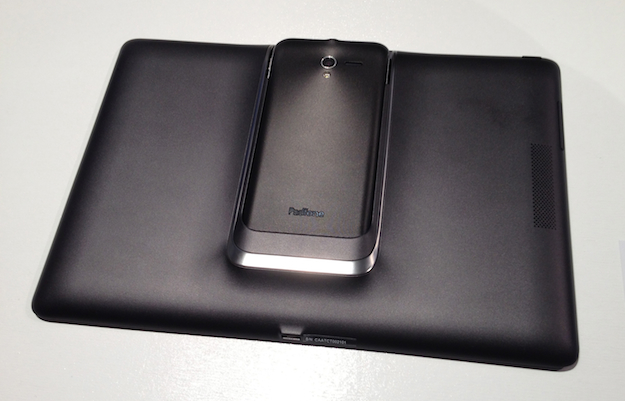
Padfone 2 Hands-on Front and Back

Padfone 2 Hands-on Dock

Quad-core power

The Snapdragon S4 Pro quad-core processor gives the smartphone incredible performance. Even without Jelly Bean’s “Project Butter,” scrolling was smooth and precise, and video was expertly handled. Scrolling could still be “sticky” in the browser though. A 1.5GB HD video file could be scrubbed back and forth with no delays in playback, and when the Adreno 320 GPU was put to work on a Need for Speed game, it looked stunning.

Grasping the tapered body of the PadFone 2’s phone section, it’s simple to slot it into the tablet and in fact, you don’t even need to look at what you’re doing. This makes perfect sense when you consider the sharing aspect of the PadFone 2, as you can be looking at a photo on the phone, which then appears on the tablet’s screen almost instantly when you dock them together. Fiddling around on the back of the tablet would spoil this experience completely.

Slotting the phone into the tablet station is precise and satisfying, and ends with a positive push to lock it into place, feeling not unlike docking an iPhone into a well-made audio dock. It’s not going anywhere either, as even turning it upside down and shaking it about failed to see the phone slip out and clatter onto the floor.

Padfone 2 Hands-on Back

Instant sharing, with a catch

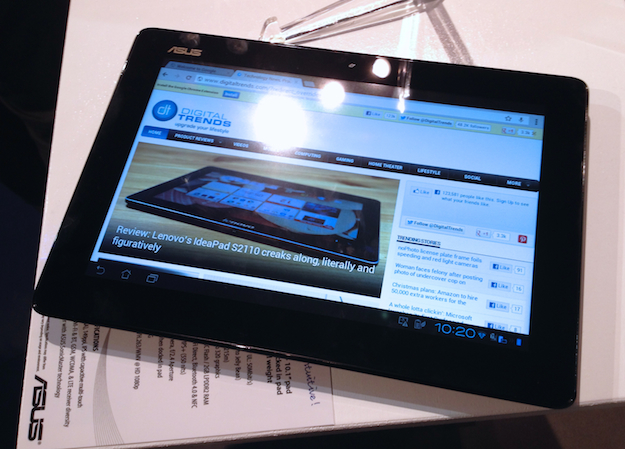
Using the tablet is a very similar experience to using the phone as it’s the same OS, but with this comes a slight drawback — the browser wants to open mobile websites. Visiting DigitalTrends.com, the BBC and YouTube on the tablet resulted in exactly that happening, but a better YouTube experience could be had using the standalone app. This is a problem on most Android tablets.

The instant sharing is also flawed at the moment, as it only works with certain applications. Say you’re reading a website using Chrome on the smartphone, but decide you want to read it on the larger screen, so you plug it into the tablet station. Sadly, it doesn’t just appear and you need to open Chrome as usual. Sure, your content is there straight away, but it adds a step or two to the process. The answer is to use the standard browser instead, which does instantly start when you dock the two devices, as does the gallery, the camera app, Google Play and the standard email app too. But generally, if you’re doing something on your phone before you plug it in, prepare to have to re-open that task.

Asus says that many apps are undergoing a certification process, so by the time the PadFone 2 goes on sale, this could all change. Hopefully it will, as it’s one of the standout features of the device.

Padfone 2 Hands-on Tablet

Intuitive and pleasantly surprising

Using the PadFone 2 for only a short time confirms that Asus is right to call it intuitive, primarily because of the instant sharing feature and the easy docking, but learning the ins-and-outs of the lightly skinned Android OS was a breeze too. This, along with the all-in-one nature of the PadFone 2, makes it a good choice for anyone new to smartphones and tablets.

Such simplicity, design innovation and power doesn’t come cheap though, with the 32GB model priced at 800 euros ($1,042) for the smartphone and the tablet station. Before you snort derisively at this figure, think about this: A 32GB iPhone 5 costs 790 euros on its own, and you’re stuck with that battery and that screen size. Add a 32GB Wi-Fi and Cellular iPad and you’ll need another 700 euros, giving a total of 1,488 euros ($1,940) for the pair. Pop over to Amazon for a SIM-free Galaxy S3 and a Galaxy Note 10.1 and you’ll still need the best part of 1,100 euros.

So, although the initial outlay sounds like a lot, that’s quite a savings when you consider how much buying two separate devices to emulate the PadFone 2’s abilities costs. It is, however, still a big price for a relative newcomer to ask for an quirky product. It could also be saved if U.S. wireless carriers decide to subsidize the phone and tablet combo deeply enough, it could be quite affordable. But with how badly the Motorola Atrix + Laptop Dock were priced, it’s difficult to be hopeful.

In the short time I had with the PadFone 2, it was certainly winning me over, and it’s impossible not to be impressed by the Snapdragon S4 Pro’s performance. I have the feeling a lot of people are going to be surprised by the PadFone 2, it just takes an open mind, a calculator and good, solid test run.

Video playing on the PadFone 2

The PadFone 2 camera


Source : http://www.digitaltrends.com/mobile/asus-padfone-2-hands-on/

Friday, September 21, 2012

Previewing Mozilla Firefox OS, an HTML5-based interface

Mozilla Firefox OS

The upcoming Mozilla Firefox OS is slated for a Q1 of 2013 release, but how is the development coming along? Here's our hands-on preview.

In attendance at the Pepcom Holiday Spectacular in New York City last night was Mozilla Firefox, and we got some hands-on time with the operating system the open-source web browser is currently developing. The Firefox OS (working name, as far as we know) is still in a heavy beta mode, and is built entirely on HTML5. The rep we spoke to demoed the OS using an unbranded ZTE phone, noting that Firefox has stripped the Android out of the phone and created its own operating system from the ground up.

Mozilla Firefox OS 3DWhat what we can see, the OS is fully web-based in that every app and functionality runs off the web browser. Making phone calls is equivalent to calling on Skype, taking pictures is akin to snapping flicks with Apple’s Photo Booth, searching straight from the homepage is like having a shortcut to the Firefox search tool bar. There’s also a cartoony game built into the phone that uses a tap to perform actions interface, and it’s clear that the OS still has a bit of a way to go before its scheduled release date early next year.

Mozilla even tried to build a glasses-less 3D rendering that you can see, touch, and move… but this feature was still a bit buggy and did not respond too well to touchscreen interface just yet. We’ll cut it some slack considering it has several months to go, but web developers should definitely gear up for some fun programming time once the open source OS becomes available for your modding pleasures.

Firefox OS screencap

The Firefox OS is all part of a collaboration between ZTE and Mozilla to roll out its own system that doesn’t rely on Windows or Android. The finished OS is slated to arrive overseas first, with mobile network operators Deutsche Telekom, Sprint, Smart, Telecom Italia, Telenor, and Etisalat backing the experimental platform, reports Reuters. We hope to catch up with the development team in a few months and see how their work comes along, and whether it’s got something entirely different to offer that truly distinguishes it from the rest.


Source : http://www.digitaltrends.com/mobile/previewing-mozilla-firefox-os-an-html5-based-interface/