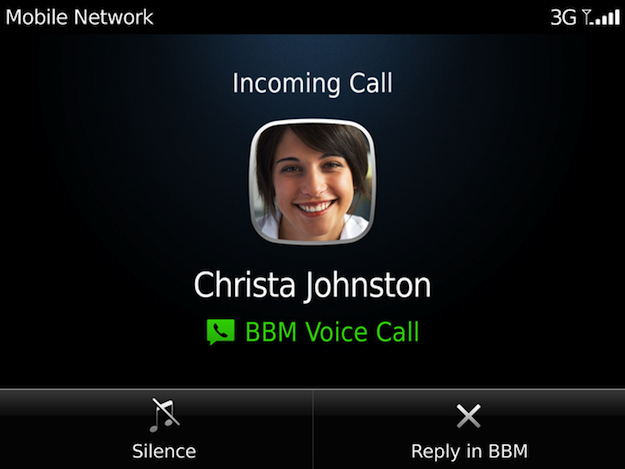
Research in Motion has added an interesting new feature to BlackBerry Messenger named BBM Voice, which lets you call fellow BBM users for free provided your phone is connected to a Wi-Fi network. It's a great idea, provided your friends also use BlackBerry phones.
Research in Motion knows it needs to win back the general public’s support, and it also knows that one way to do so is by coming up with a feature that will save someone money. BlackBerry Messenger was that feature several years ago, as it made use of the BlackBerry network plan you had to pay for anyway, and provided “free” text message conversation with fellow BlackBerry owners.
Now though, a high percentage of the dedicated BlackBerry owner’s friends use iPhones and Androids, rendering BBM a relic from better days past. Now RIM has come up with BBM Voice, which it claims is “for the times when you want to hear a friend’s laughter instead of reading LOL.”
That’s right, BBM has become Skype, as it now offers the chance to call your BBM friends through version 7 of the software, using only a Wi-Fi connection. There are no geographical borders and no time limits, and as it doesn’t count towards your monthly bill, no extra charges either.
RIM makes no mention of whether BBM Voice will break free from a Wi-Fi connection and use a 3G/4G data connection in the future. It’s hardly a surprise, as networks – particularly in the U.S. – are rarely enamored by features that lose them money.
BlackBerry Messenger will show who in your contact list is available to call using BBM Voice, and a split screen display lets you send text messages or files at the same time, plus the service is compatible with Bluetooth headsets too; setting it up perfectly as a way to work collaboratively while away from the office. Those not using a BlackBerry for business will appreciate the chance to avoid massive international roaming bills too.
So, free messages and free calls, all through a single app. Sounds great, right? It is, but – and here’s the problem – to take advantage of BBM Voice, your friends and colleagues all have to have BlackBerry phones too, and as we’ve established already, they’re now using iPhones and Androids.
BBM Voice is a beta program at the moment, but you can bet it will have been perfected by the time BlackBerry 10 arrives after January 30 next year, as being able to say “free calls and messages with BlackBerry 10” should help people take notice of the new OS. All RIM needs is for those people to convince their friends/family/acquaintances/dog it’s a good idea too.
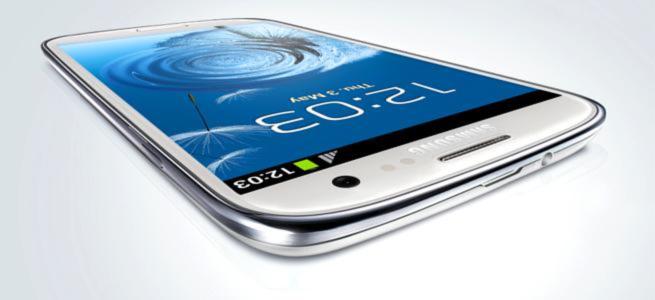
According to the latest research, the Samsung Galaxy S3 has become the world's most popular smartphone, after it outsold the Apple iPhone 4S and the iPhone 5 between July and September 2012.
Research into global smartphone sales for the July to September period of 2012 has revealed that the world’s number one smartphone was the Samsung Galaxy S3, knocking the Apple iPhone 4S into second position.
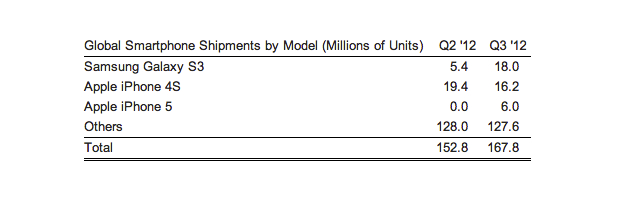
The report comes from research firm Strategy Analytics, and it puts the Galaxy S3 in first place with 18 million devices sold globally, and the iPhone 4S trailing with 16.2 million sold. In third place it’s the iPhone 5 with 6 million sales.
So, its a fanfare for Samsung, a company well on its way to beating Apple in the battle for smartphone supremacy. But is it? Well, as a headline, it is indeed good news for Samsung, but the sales from the third quarter of 2012 tell only a percentage of the story.
Samsung released the Galaxy S3 at the beginning of May 2012, spreading it to as many networks and countries as possible. In the slightly truncated second quarter results, it shifted 5.4 million phones.
But take a look at the iPhone 4S’s performance. The 4S went on sale in October 2011, and still sold 19.4 million in the second quarter, and then 16.2 this quarter. Not bad for a phone that was a fairly unremarkable evolution of the previous model, that has been on sale for, now at least, more than a year.
These past couple of months have also been filled with anticipation over the iPhone 5, which then arrived at the tail end of September, and it still managed to sell more than the Galaxy S3 did in its opening weeks, and in a shorter time too.
Many potential iPhone 4S buyers decided to wait for the iPhone 5 in the run up to its release, which explains the drop off in 4S sales, and in effect, allowed Samsung to swoop in and grab the “world’s best selling smartphone” crown.
The question is, can it retain its crown in the all-important Christmas period between October and December? Strategy Analytics doesn’t think so, and expects Apple to “soon reclaim the title.”
The Galaxy S3 unquestionably deserves to top the charts, but the figures also highlight the struggle it faces to maintain that position over a longer period of time.
Research In Motion's upcoming BlackBerry 10 platform has received US security clearance that will allow it to be used by goverment agencies – provided they don't all desert the Canadian company before the new platform launches.
As Research In Motion (RIM) executives count down the days to the launch of its next-generation BlackBerry 10 platform (though one wonders if they really know precisely how many days are left), the company has been pushing out a number of positive press releases recently in an effort to create a silver lining on the gray cloud that has been hanging over the firm for some time.
Last week it announced that development of BB10 had passed what it described as a “critical milestone” with news that it had entered lab testing with more than 50 carriers worldwide.
And on Wednesday evening it issued a statement saying its new BB10 smartphones and its Enterprise Service 10 management console had both received important Federal Information Processing Standard (FIPS) 140-2 security certification from the National Institute of Standards and Technology. This is the first time BlackBerry products have been FIPS certified ahead of launch, the Ontario-based company said, and paves the way for US and Canadian government agencies to use the devices in their work.
Commenting on the news, Michael K. Brown, vice president of security product management and research at RIM, said, “Achieving FIPS 140-2 certification means that BlackBerry 10 is ready to meet the strict security requirements of government agencies and enterprises at launch.”
Talking up the security features of BB10, he added, “What differentiates BlackBerry is that it integrates end-to-end security, and includes certified encryption algorithms for data at rest and data in transit. No other mobile solution has achieved the level of security accreditation that the BlackBerry solution has.”
The certification is undoubtedly good news for the mobile company, though with several agencies in recent months announcing their intention to turn away from BlackBerry handsets in favor of iOS and Android-powered devices, RIM will have its work cut out to get them back on board. It must also work to hold on to those who have so far stuck with its devices.
Happily for RIM, last week the Pentagon said it would continue to support “large numbers” of BlackBerry smartphones even though it’ll also be allowing many of its employees to use the iPhone and other devices.
BlackBerry’s reputation for strong security was what until recently made RIM’s handsets stand out for those who required such features. But for many IT administrators working today, iOS and Android phones now offer more secure and manageable platforms.
RIM has been able to offer a few bits of positive news of late, but the real test will of course come when its new, long-awaited BB10 OS and handsets finally make an appearance.
Gartner, a leading IT research and advisory company, has compiled estimates on the growth of smart devices and the effect they will have on the consumer electronics market. According to the report some 70 percent of total devices sold this year were either tablets or smartphones.
Android is expected to continue to dominate the mobile market even in the business sector, with 56% of devices expected to run on Google's OS by 2016 (up from 34 percent this year).
Tablets are expected to achieve a three-fold growth for business within the next four years, with 53 million units predicted to be sold in 2016.
Finally, Gartner predicts that Windows 8 tablets and smartphones will move to third place behind Apple and Android by 2016, with many businesses choosing smart devices rather than upgrading Windows on desktop PCs like in the past.
A new report by research firm IDC says that tablet sales are growing immensely, but most of that growth is by devices running Google's Android operating system.
The market research firm International Data Group (IDC) today announced its latest findings in the market trends and performance for worldwide tablet sales, and while it’s looking good for all of the top manufacturers, Apple’s beginning to show some slip in its market share control.
The firm released data showing, after a strong Q2 performance in the tablet realm, that the iPad manufacturer was beginning to slip in market share, falling to about 50 percent of all tablet sales for Q3, down from an impressive nearly 66 percent market share in Q2. Despite this apparent loss in market share, Apple still sold 14 million tablets in Q3, while its nearest competition (Samsung) sold just 5 million. In the bigger picture, Apple is actually selling more tablets, the problem is that it’s selling these tablets up against a roaring amount of competition composed of Samsung, Amazon, HTC, and now Microsoft — which spells trouble for its Q4 market share.
The IDC also drew a comparison in Q3 performance this year with that of 2011, and that’s where the numbers get startling. While Apple’s sales have grown by about 26 percent, Samsung’s have grown by an impressive 325 percent, and Asus by 242 percent. Apple’s top dog position won’t remain if it can’t slow down competitors’ momentum. In one such attempt to stop this momentum, Apple launched the iPad Mini and iPad 4, which sold 3 million in their first weekend alone.
Despite the momentum of the Apple iPad Mini, it seems that Apple cannot change the fact it’s competing against dozens of other companies who continue to refine and build upon their own mobile user experiences. They will do everything in their power to nibble away at the iPad market share. While lawsuits have been one route to settle this, the fact remains that Apple couldn’t have certainly expected its huge, 60-70 percent market share to last much longer.
At the end of the day, we’ve seen this coming. The introduction of two more tablets today alone only confirms it. The tablet market is exploding. That means that there will be plenty of competitors coming over the next few years, and they’ll all be doing whatever they can to have a piece of the multi-billion dollar pie. While Apple is far from hurting now, the IDC’s reports are just a taste of what’s to come.
Research In Motion boss Thorsten Heins has announced that devices running the firm's next-generation OS, BlackBerry 10, are now being tested by carriers around the world, keeping it on course for release early next year. Meanwhile, the Pentagon has said it will continue to use BlackBerry devices in its work.
It’s encouraging. It’s a step in the right direction. It might mean Research In Motion (RIM) really will fulfill its promise of a first-quarter 2013 launch of its next-generation BlackBerry 10 OS and handsets.
RIM CEO Thorsten Heins announced in a statement on Wednesday that handsets running the new OS were now being tested by more than 50 carriers worldwide.
Heins said reaching the testing phase meant the company had “passed a critical milestone” in the development of its new mobile computing platform.
“The hard work will not stop here as we build towards launch,” Heins said in the statement, adding, “Our developer teams are continuing to generate momentum to bring a wealth of applications to BlackBerry 10, our enterprise teams have started to present BlackBerry 10 devices and services to our business customers, and our engineers are fully mobilized to ensure that BlackBerry 10 launches flawlessly in the first quarter of 2013.”
In an interview with the BBC last week, Heins urged consumers not to underestimate “the dynamic [BlackBerry 10] is going to create in the market.”
In other news involving the mobile company, the Pentagon made clear this week that it would carry on supporting “large numbers” of BlackBerry handsets despite going ahead with plans to allow the US military to use other devices such as the iPhone.
“The Defense Information Systems Agency is managing an enterprise email capability that continues to support large numbers of RIM devices,” a spokesman told Reuters this week. A number of government agencies and businesses have said in the last year they would be issuing staff with iOS or Android devices, ending long-standing contracts with BlackBerry. While the Pentagon also appears to be relaxing its association with RIM, things are so serious at the Canadian company that the defense agency’s announcement that it’s not switching entirely to rival devices will actually be perceived as good news by many.
The BlackBerry was once the phone of choice for many agencies and firms thanks largely to its strong security features. However, security on rival handsets such as Apple’s iPhone and a number of Android-powered devices has improved over time, offering an alternative to the BlackBerry.
The launch of RIM’s next-generation OS and handsets is its make-or-break moment. Perhaps the Canadian mobile maker – once the country’s most valuable company – can still turn things around, remain a viable player in the mobile game and consequently help to keep competitors on their toes.
Research published by market analysts IDC has put Samsung way out in front of its rivals in the global smartphone market share charts, where Nokia has disappeared from the top five for the first time, and HTC has dropped several spots too.
Market analyst company IDC has released the latest version of its Mobile Phone Tracker information chart, showing where it places the world’s major phone manufacturers regarding smartphone market share and sales. Samsung is the star of the show, a fact reflected in its own quarterly results, while Nokia, HTC and Research in Motion all show signs of suffering at both its, and Apple’s hands.
Samsung has retained its position at the top of the charts, with a 31.3-percent market share, up from 22.7-percent last year. It’s estimated to have shipped 56 million smartphones between July and September, a huge improvement over the already impressive 28 million from the same period last year.
The Korean company has also announced its financial report for the same period, posting $7.4 billion in profits, beating its previous record for the fourth consecutive time. A Reuters piece on the subject puts its smartphone shipments at 58 million, slightly higher than IDC’s figure, and says that between 18 and 20 million of that amount were Galaxy S3 handsets.
HTC drops behind RIM and ZTE
Apple comes second in IDC’s ranking, with 15-percent of the smartphone market, up from 13.8-percent this time last year, and we all know how it has been performing recently. Research in Motion is gamely holding on to third position with a market share of 4.3-percent, down from 9.6-percent last year, but ZTE is a mere 0.1-percent behind — making a position change likely in IDC’s next report.
Finally, the top five is rounded out by HTC. This time last year, it had a 10.3-percent market share, and was ahead of both RIM and ZTE, but now, with a dismal 4-percent, it trails both of them. It’s shown to have sold 7.3 million smartphones this quarter, highlighting the gulf that has opened up between it, Apple and particularly Samsung.
To try to drum up some business in Europe, HTC has today launched Best Deals, a variation on the popular daily deal system, where HTC owners can enter their own deal preferences and, based on location, the app will return relevant offers. There are 12 providers signed up to Best Deals, including iVoucher, Daily Deal, Qype and LivingSocial, but perhaps crucially, not Groupon. The Best Deals app looks to be part of HTC Sense, is compatible with the One X, One S, One X+, the 8X and 8S, and will be available in the UK, Italy, Germany, France and Spain in November.
Nokia leaves the top five for the first time
Finally, we come to Nokia, a company absent from IDC’s top five smartphone companies for the first time since it first began keeping records in 2004. It does still appear in the overall list of general phone manufacturers though, and in second position. It has shipped a massive 82 million phones during the third quarter, down from the 106 million it shipped during the same period last year, and it retains an 18.7-percent market share.
Samsung again tops this list, with a 23-percent market share and a grand total of 105.4 million phones leaving its warehouse.
There’s no sign of the global smartphone market slowing down either, as the 179 million smartphones sold this summer is 45.3-percent more than this time last year.
Research indicates Lenovo has become the world's number one PC manufacturer, as the company announces plans to expand its smartphone range.
Lenovo is riding a wave of success at the moment, after announcing some exciting Windows 8 tablets, and now it appears the company has become the world’s number one PC manufacturer, and is preparing to release its smartphone range internationally too.
Research firm Gartner has released data that shows Lenovo has pushed past Hewlett-Packard to take the number one spot, and the figures read like this: HP can claim a 15.5-percent global market share, with 13.55 million units shipped, while Lenovo has a 15.7-percent market share with 13.77 million units heading out the door this quarter.
Perhaps more importantly, Gartner shows HP’s sales as down 16.4-percent on last year, while Lenovo is up by just under 10-percent. If you had to choose a direction as a company, you’d want to be the one going up.
According to Reuters, researchers from IDC still put Lenovo ahead of HP, with market shares of 15.7 and 15.9-percent respectively. HP told them that IDC’s report was “more expansive,” but then, they would say that. Almost regardless of who’s right today, the trend certainly indicates the position swap will happen soon.
HP’s CEO Meg Whitman has been quoted as saying the company is in the first year of a five-year restructuring plan, but despite the much-publicized downturn in PC sales — IDC says global sales have dropped by 8.6-percent since July — it still hasn’t made up its mind about re-entering the smartphone and tablet market. Recent reports seem to indicate confusion regarding this market segment within HP.
Lenovo to enter international smartphone market
Lenovo feels rather differently. It already produces smartphones for a variety of Eastern markets and in June this year, overtook both Nokia and Huawei to take second place in the Chinese market. Perhaps most tellingly — and a point HP needs to hear — is that its phone sales surpassed that of its PC sales for the first time there too.
It’s not just low-end hardware the company produces either, as it introduced the LePhone K860 in August, which has a 5-inch display with a 720p resolution, a quad-core processor (actually Samsung’s Exynos 4 Quad, also seen in the Galaxy S3), Android 4.0 and an 8-megapixel camera. It’s destined for Japan sometime later this year.
The momentum is there for Lenovo, and it’s already producing some interesting hardware, so it’s no surprise to see the following message posted on its Facebook page: “We won’t stop at laptops and tablets. For the first time, Lenovo is making plans to sell smartphones outside China.”
Introducing new hardware into the already massively competitive US and European markets isn’t going to be easy, but Lenovo knows it has little choice. Besides, it can always look at the lucrative African, Russian and South American markets initially, before hitting the rest of Europe and the US with devices such as the K860.
Lenovo hasn’t provided any further details, and we’d be surprised to see any releases this year, but it’s still a very positive step from a highly motivated company. Whether HP will respond remains to be seen.
BlackBerry 10 is a brand new operating system from RIM, which has been built to run on both smartphones and tablets, much like Android and iOS, and will be absolutely key in deciding the company's future.
Get it wrong and BlackBerry 10 could well sink the Canadian firm, so here's hoping that BB10 (and not BBX after a lawsuit was filed) will be the blockbuster revelation which RIM so desperately needs it to be.
Update: Research in Motion is pretty bullish about the chances of BlackBerry 10, with CEO Thorsten Heins saying: "We have a clear shot at being the number three platform on the market. We're not just another open platform on the market, we are BlackBerry." - powerful stuff.
BlackBerry 10 release date
Initially RIM was planning to launch BB10 before the end of 2012, with at least one flagship device running the operating system arriving in time for Christmas.
However CEO Thorsten Heins confirmed in July that BlackBerry 10 will be delayed until early 2013, as the company continues to fine tune the software, to ensure it launches in the best possible state.
Heins said: "We expect a successful launch of BB10 in the first calendar quarter 2013 – this is our number one priority.
"The timeline has shifted to [this date] and is related to the large volume of software code to work through over last few months.
"This is taking more time than anticipated. To be clear, the change in timeline is not related to architecture, but the integration challenge of bringing all this code our diligent R&D teams have created and get it ready for use globally."
BB10 sees the implementation of a whole new user interface, with RIM doing away with the familiar BlackBerry system we're all used to, in favour of something which resembles the likes of Android and iOS, although with its own unique features.
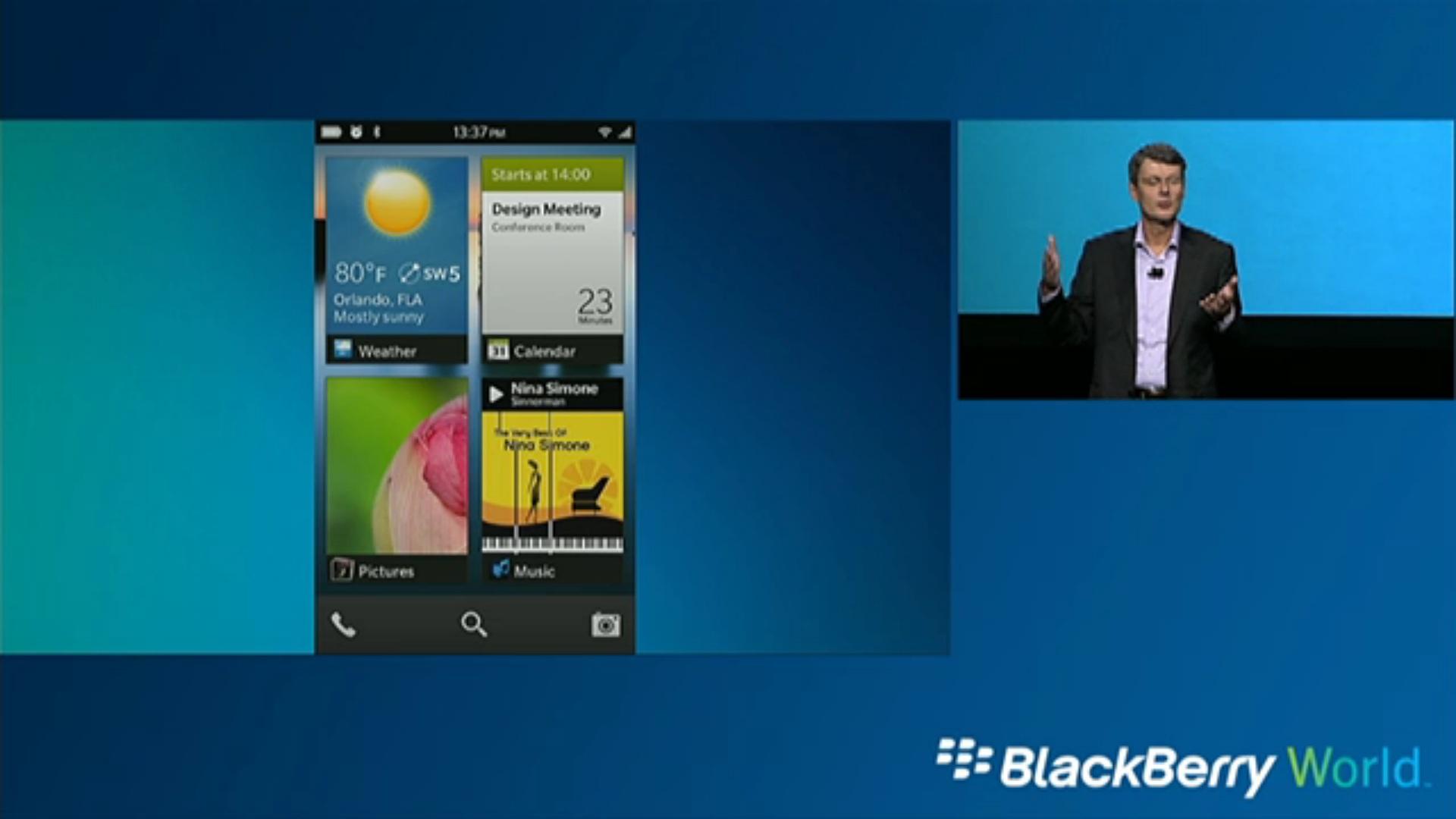
With BlackBerry 10, RIM has merged homescreens, widgets, app lists and a unified inbox into one slick interface, offering up an easy to navigate user experience.
Although the operating system is still very much in early stages of its development we must say that we were impressed with how smooth and slick the interface felt under out fingers – seamlessly zipping around without fuss.
BlackBerry assured us that this smooth experience would still be present in the final product, thanks to the clever integration of the HTML 5 system, which optimises the performance of the software. We certainly hope they're right.
To find out more about the initial features make sure you read out hands on: BlackBerry 10 review.
Update: A particularly enticing new feature is BlackBerry Peek, which allows users to glimpse their hub screen from any application without exiting the program.
It's a one-finger feature, meaning all it takes is a thumb swipe to see what emails, texts, and other messages are waiting on a phone.
Update:BlackBerry Balance draws a line between professional and personal use, so company phones have a set of rules laid out by the boss on one part of the device while allowing workers more freedom elsewhere.
Update: If you need any more convincing RIM CEO Thorsten Heins has said: "we believe BB10 will advance the OS environment to the next level" - so yeah, watch out Android/iOS/Windows Phone.
BlackBerry 10 keyboard
BlackBerry handsets are famous for their physical boards and RIM is keen to bring this typing experience to its BB10 touchscreen smartphones with its own offering.
RIM has developed its own keyboard, with a design which reflects the physical offerings on its Bold range and a new next-word prediction system which sees suggestions appearing above characters on the board itself.
It's critical that RIM nails the keyboard in BB10, as BlackBerry handsets are synonymous with typing on the go, and if dedicated fans can't easily transfer from physical boards then touchscreen BB 10 handsets may be hard to shift.
To find out more about the BB10 keyboard make sure you read our hands on: BB10 review.
BlackBerry 10 - BlackBerry Hub
The BlackBerry Hub will be the brain center of all BB10 devices, a one-stop shop to access email, Gmail, Twitter, Facebook, BlackBerry messenger, text messages, and other time-sensitive information.
BlackBerry 10 camera
A brand new camera application has been developed for BB10, bringing the operating system inline with the camera functions found on Android, iOS and Windows Phone handsets.
The new app allows for photographs to be "rewound" in case you've mucked up the image.
Say for instance your friend is blinking in a shot, with the new app you would be able to "rewind" the image to the point where they weren't and save it.
With the launch of Blackberry 10, RIM has also revealed a developer toolkit for the platform, which could mean that more photography and image-editing apps are in the pipeline.
BlackBerry 10 apps
Your current BlackBerry apps won't run on BB10, so you'll need to download/purchase a new set of applications onto your new device when they eventually roll out.
Apps are big business in the smartphone and tablet world and RIM is very aware of this, as it's guaranteed developers $10,000 of revenue in the first year of an app's life on BB 10.
The current PlayBook, and to an extent BlackBerry handsets, suffer from a lacklustre offering in the App World store – with the likes of Google's Play Store and Apple's App Store dwarfing RIM's offering and thus putting some consumers off.
As well as the revenue incentive for developers, RIM has also made it easy to port Android applications on the BB10 platform, with an easy to use API helping devs to do this - and hopefully boasting the portfolio of apps available at launch.
BlackBerry 10 devices
The first BlackBerry 10 devices are now expected to arrive in January 2013, and RIM has confirmed that it will offer both full-touchscreen and QWERTY keyboard handset options.
According to leaked BB10 roadmaps, the first touchscreen phone will be called the BlackBerry London, while the first to sport a full keyboard and the new OS will be called the BlackBerry Nevada – both pegged for a first quarter release next year.
The same roadmap also shows RIM isn't going to be giving up on the tablet market after the poor performce of its PlayBook, with another slate, codenamed Blackforest, scheduled for release in the middle of 2013.
It's thought that the Blackforest will also sport a larger screen than the 7-inch PlayBook – possibly putting it in contention to challenge the new iPad and 10-inch Android crowd.
Update: Heins said BB 10 phones will use the same HDMI and USB connectors as past BlackBerry devices, noting, "We all can save some money" - a cheeky dig at Apple and the new port on the iPhone 5 right there.
Update: RIM CEO Thorsten Heins reckons the display on the new touchscreen BB10 device is going to be top notch: "The display in full touch will be beyond what iPhone 5 launched with, it will actually be true HD."
However RIM has also ruled out any chance of us seeing the BB10 handsets before the end of 2012, with the Canadian firm determined to make us wait until the new year.
Update: But wait, what's this? We may have got our first peek at the fully-touchscreen L Series and QWERTY keyboard touting N Series, thanks to a leaked video claiming to be an internal promo clip for RIM.
BlackBerry 10 on PlayBook
RIM has already confirmed that the BlackBerry PlayBook will receive the update to the BlackBerry 10 operating system, and while there's no firm date for this to be rolled out, we'd expect it to happen pretty soon into the new year.
BlackBerry 10 in cars
The current PlayBook OS is based on the version of QNX built for car makers and "the next generation of QNX for cars is going to be built from BB 10," Alec Saunders told us; car makers are keen to use HTML5 for in-car information and entertainment.
That makes it easier to treat your car as another device, he suggested, and to share information. "Ultimately you will be able to transition from your smartphone to your tablet to your TV to your car. Sync will be important. I think you'll start to see devices do things like Bridge today, where it mirrors [on the PlayBook] what's on the BlackBerry handset.
"You'll use one device to access what's on another. QNX is made for these kind of scenarios, projecting information from one device to another. You won't have five devices and have all your content on everything; it's going to have to grow seamlessly across them."
BlackBerry 7 devices
There's bad news for anyone who currently owns a BlackBerry though, as all BlackBerry 7 handsets will not receive the update to the new BB 10 operating system, as RIM has completely rebuilt the platform from the ground up, which means the current crop of phones will be unable to run it.
Canadian firm Research in Motion (RIM) is pretty bullish about the chances of its upcoming, and it hopes company-saving, operating system BlackBerry 10.
RIM CEO Thorsten Heins took to the stage at the firm's Jam Americas event in San Jose California yesterday to declare that the delayed BB10 can topple Windows Phone 8 and claim third place in the mobile OS rankings.
Heins said: "We have a clear shot at being the number three platform on the market. We're not just another open platform on the market, we are BlackBerry."
I am SpartaBerry!
During Heins' keynote presentation yesterday, the BlackBerry boss revealed more new features for the BB10 platform, with the first devices running the new software due to arrive in January 2013.
Heins was quizzed on why RIM wasn't aiming for top spot in the mobile market, instead settling for third, to which he responded: "you climb a mountain step by step."
However could it all be too late for RIM, as Windows Phone 8 will have a couple of months' head start with devices expected to land in early November, and customers may not want to wait until after Christmas before upgrading their phone.
Has Research In Motion finally lost the plot? Or is it merely showing everyone it has a sense of humor? A new music video starring company executives thanks BlackBerry developers for sticking with its mobile platform, promising better days ahead.
Research In Motion (RIM) may be experiencing the toughest time in its 28-year history, but it hasn’t forgotten how to have bit of fun.
At its BlackBerry Jam developer conference in San Jose on Tuesday, the mobile company decided to entertain its attendees – or possibly horrify a few of them – with a slickly-produced music video featuring three RIM executives singing a developer-focused version of the classic REO Speedwagon hit, Keep on Loving You.
The video is apparently RIM’s way of expressing its appreciation for developers that have stuck with the BlackBerry platform.
“This video is a thank you to all developers supporting the BlackBerry platform. Your Developer Relations, Alliance and Developer Tools teams appreciate your enthusiasm and loyalty! We’re Going To Keep On Loving You,” reads the accompanying blurb on YouTube.
The three-and-a-half-minute production kicks off with the lyrics:
We’ve all seen these are challenging times, baby,
‘Cuz we’re in transition.
A whole new mobile computing platform may be
one tough proposition.
So don’t be misled,
The launch is just ahead,
We’ll have BlackBerry 10 both in full touch and QWERTY editions.
In a message to BlackBerry developers, vocalist Alec Saunders – RIM’s VP of developer relations and ecosystem – sings, “We’re gonna keep on loving you,” at the same time reassuring them that “our updated SDK is really cool.”
Check it out at the end of this piece and let us know: epic fail or good laugh?
Besides serenading the developers, RIM is also hoping to hold on to existing ones, or even attract new ones, by offering $10,000 per BB10 app submitted to its app store, provided it meets certain quality requirements.
The video was screened on the same day that RIM boss Thorsten Heins announced some better news for the Ontario-based company. Against expectations, BlackBerry subscriber numbers rose to 80 million for the quarter ending September, an increase of two million from earlier this year.
RIM’s future rests heavily on its next mobile operating system, BB10, which is set to launch early next year, together with a number of new handsets. Hopefully the Keep On Loving You video released on Tuesday won’t have scared off too many developers, and the phones can come to market with plenty of BB10 apps to choose from.
We see QR codes everywhere, though research suggests they're rarely scanned. Tourism officials in the British outpost of Gibraltar are hoping that won't be the case when it launches 'Gibraltarpedia', an initiative that will equip the territory's landmarks and places of interest with their own QR codes linked to Wikipedia pages offering more information.
We see QR codes all over the place, from magazines to posters to business cards. There’s even a cemetery in Denmark that’s using them to tell the life story of the deceased. A giant one turned up in a Canadian cornfield the other day, too.
Gibraltar, a small overseas territory of the UK located at the entrance to the Mediterranean in southwestern Europe, is also getting in on the act with its soon-to-launch Gibraltarpedia project. The plan is to plaster the place with QR codes giving smartphone-equipped tourists quick access to information about various sites and points of interest.
With 11 million visitors a year coming to the British outpost, tourist officials there are keen to find new ways of enriching their experience, and Clive Finlayson of the Gibraltar Museum thinks QR codes can go some way to help.
“Gibraltar is a multi-layered cake of historical events, starting with the Neanderthals of 50,000 years ago through to modern humans,” Finlayson told the BBC. “Here we have another way of getting all this information across to the world.”
The codes will take users to a Wikipedia page explaining about the place of interest. Volunteers are currently working hard on creating the new pages in a multitude of languages.
Roger Bamkin of Wikimedia, the charity that owns Wikipedia, is planning for the QR codes to communicate with the user’s handset to determine the language of the uploaded webpage.
“By scanning QR codes around them, tourists will be to able to find out about the place they are visiting in their own language, with the description written by a volunteer speaking that language,” Bamkin said.
Of course, it could be that many visitors, fearful of pricey roaming charges, will simply stick with a traditional printed guidebook rather than scanning codes. To get around this, the authorities are considering introducing free Wi-Fi.
Despite the good intentions of Gibraltar’s tourism office, getting visitors to use the codes may be an uphill struggle. The results of a recent comScore study showed that in July this year only 11 percent of UK smartphone owners scanned a QR code. That’s pretty dismal for a technology that’s been around almost 20 years.
Either way, the codes will provide tourists visiting the territory with another option for pulling up information besides guidebooks, pamphlets and apps.
While QR codes have failed to really take off in other areas, do you think it could find its place in the tourism industry? Would you be tempted to whip out your smartphone if you saw a QR code beside a famous landmark?
According to new data from research firm Nielsen, smartphone ownership is growing fastest among those between 13 and 17 years of age, with more than half now owning such a device.
New research from Nielsen shows that 58 percent of 13 to 17 year olds living in the US now own a smartphone, a significant jump from 36 percent 12 months ago. Ownership is most prevalent, however, among those aged 25 to 34, standing at 74 percent, up from 59 percent a year ago.
As of July 2012, 55.5 percent of all mobile subscribers based in the US own a smartphone, Nielsen said. This marks an increase of 14.5 percent on a year earlier.
With teens clearly the fastest-growing group in smartphone take-up – and with plenty of growth still possible – we can expect to see mobile makers taking an even keener interest in the sector with marketing campaigns designed to win over the young consumers.
Among the various mobile operating systems, Android is still the market leader, with 51.9 percent of all US-based smartphone owners using an Android-powered device as of July 2012. When the figures are broken down to see who bought what during the last three months to July, the figure for Android is even higher – 58.6 percent.
Worryingly for Research In Motion, Android’s recent growth appears to have been at the expense of its BlackBerry devices. According to Nielsen’s research, BlackBerry smartphone ownership now stands at just 8 percent of all US-based smartphone owners, with the figure dropping to just 2.7 percent for those who purchased a smartphone in the last three months. The grim figures highlight the enormity of RIM’s task of rejuvenating its business with the launch of its next-generation OS, BlackBerry 10, although this won’t be happening until at least early 2013.
Of smartphone purchases made in the last three months, 58.6 percent opted for an Android-powered device, while 33 percent went for the iPhone. The figures for Apple’s iOS device may have been skewed by the fact that many of those keen on getting an iPhone are choosing to wait until the launch of the new model, expected to be unveiled by Tim Cook on Wednesday.
In its research, Nielsen questioned more than 20,000 US-based mobile subscribers aged 13 and over.