Android's market share increased significantly during the third quarter of 2012, with the Google OS powering 72.4% of all smartphones sold in the three months' period. Apple's iOS came a very distant second with a market share of 13.9%.
This is an impressive accomplishment for Google's mobile OS, considering Android's market share was 52.5% in Q3 of 2011.
Samsung saw its position as the leading mobile manufacturer increase to 22.9% after selling almost 100 million phones in the three month period ending in September. This was mostly at the expense of Nokia, which saw its market share slide almost 5 percent points year-over-year.
The holiday season should see Apple take back some of both of those pies, as many iOS-faithfuls held off on replacing their smartphones until the iPhone 5 came around. Apple's new smartphone top dog is expanding its availability to many new markets in Q4, which should help Apple arrest the fall in iOS market share.
Microsoft and Barnes & Noble have teamed up to offer Windows 8 users a free Nook app for books, magazines, newspapers, and comics.
Readers with Windows 8 PCs have a new free option for enjoying their literature. Barnes & Noble’s subsidiary Nook Media announced the release of a Nook app for the Microsoft operating system. The free app holds all of your books, magazines, newspapers, and comics within an easy-to-use new interface specifically for PCs or tablets running Windows 8.
Like most of the programs available through the official Windows Store, the Nook app capitalizes on the distinguishing features of the OS for a unique new experience. The Live Tiles allow you to jump right back to your spot or see when a new issue of a subscription is available. You also have the option to pin a specific title to your start screen, making it faster to hop back and forth between books. The app contains a Nook Store, so you can purchase additional books without needing to navigate in and out of the program. Between the 3 million titles in the store and the tailored recommendations of the Nook Channels service, you should never be hurting for reading material.
Another handy feature of the app is the new “paper” user interface, which is meant to offer an uncluttered, easy reading experience. The Nook app interface is also designed to make browsing among your titles easy with the touch capabilities of Windows 8 tablets. And of course, the Windows 8 app will sync with the Nook app across your other mobile devices through the Nook Cloud. That makes it easy to access your books from any computer at any time without missing a page.
It’s been a busy month for Barnes & Noble, which recently dropped prices on two Nook models as it rolls out the new Nook HD. The Windows 8 Nook app is the first digital property to emerge from the partnership between the bookseller and Microsoft. It shows an understanding of how developers will likely take advantage of the Windows 8 start page, especially in terms of Live Tiles and pinning apps. These types of extra perks will probably become commonplace among the companies that are able to collaborate with Microsoft to create special Windows 8 versions of their programs.
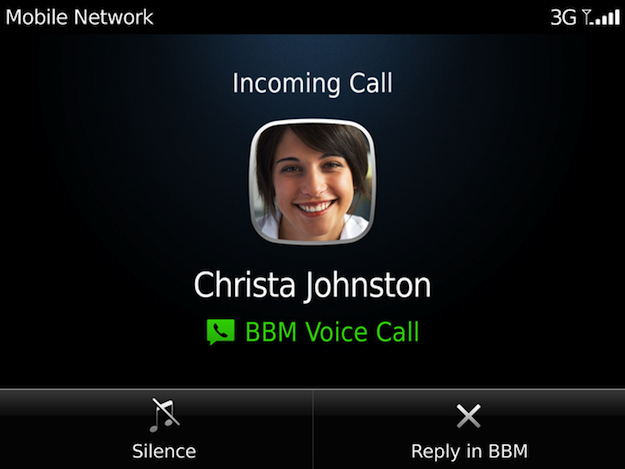
Research in Motion has added an interesting new feature to BlackBerry Messenger named BBM Voice, which lets you call fellow BBM users for free provided your phone is connected to a Wi-Fi network. It's a great idea, provided your friends also use BlackBerry phones.
Research in Motion knows it needs to win back the general public’s support, and it also knows that one way to do so is by coming up with a feature that will save someone money. BlackBerry Messenger was that feature several years ago, as it made use of the BlackBerry network plan you had to pay for anyway, and provided “free” text message conversation with fellow BlackBerry owners.
Now though, a high percentage of the dedicated BlackBerry owner’s friends use iPhones and Androids, rendering BBM a relic from better days past. Now RIM has come up with BBM Voice, which it claims is “for the times when you want to hear a friend’s laughter instead of reading LOL.”
That’s right, BBM has become Skype, as it now offers the chance to call your BBM friends through version 7 of the software, using only a Wi-Fi connection. There are no geographical borders and no time limits, and as it doesn’t count towards your monthly bill, no extra charges either.
RIM makes no mention of whether BBM Voice will break free from a Wi-Fi connection and use a 3G/4G data connection in the future. It’s hardly a surprise, as networks – particularly in the U.S. – are rarely enamored by features that lose them money.
BlackBerry Messenger will show who in your contact list is available to call using BBM Voice, and a split screen display lets you send text messages or files at the same time, plus the service is compatible with Bluetooth headsets too; setting it up perfectly as a way to work collaboratively while away from the office. Those not using a BlackBerry for business will appreciate the chance to avoid massive international roaming bills too.
So, free messages and free calls, all through a single app. Sounds great, right? It is, but – and here’s the problem – to take advantage of BBM Voice, your friends and colleagues all have to have BlackBerry phones too, and as we’ve established already, they’re now using iPhones and Androids.
BBM Voice is a beta program at the moment, but you can bet it will have been perfected by the time BlackBerry 10 arrives after January 30 next year, as being able to say “free calls and messages with BlackBerry 10” should help people take notice of the new OS. All RIM needs is for those people to convince their friends/family/acquaintances/dog it’s a good idea too.
T-Mobile is the second US carrier to unleash Android 4.1 Jelly Bean to its Galaxy S III customers. Last month Sprint started seeding the Jelly Bean update to the Galaxy S III units on its network.
The update is available OTA or from Samsung's Kies software. Users who are rooted and don't want to wait can download the update from here and then manually flash it on their devices.
The Galaxy S III will receive Project Butter for a smoother, more fluid UI performance, the improved notifications, "freestyle widgets" that automatically reorder your homescreen content before they are placed and more.
Here's a video by Samsung showcasing the various improvements. Below it is a video dedicated to the improvements and novelties in TouchWiz itself.
Now with T-Mobile on the bandwagon it seems AT&T and Verizon are lagging behind, something their customers are very vocal about in their respectful forums.
It certainly feels like Samsung is taking over the world right now – at least, the Android world. There's no doubt that last year's Galaxy S2 was arguably the phone of the year.
And not in recent times, discounting Apple of course, can we remember the anticipation and expectation of a phone as much as the Galaxy S3.
If you needed a barometer of this, just look at how it was unveiled. Not at MWC like lots of others, but its own event. Yep, the Galaxy line has reached the level where it can guarantee hoards will come just for an unveiling. Very Cupertino.
But despite the whooping masses and the queues on launch day, it wasn't the five star phone we hoped it would be... there's still very much room for improvement. So here's what we'd like to see for next year's SIV.
Samsung Galaxy S4 screen
This was the main source of criticism. The Galaxy S2 had an amazing Super AMOLED Plus display – and boy, was it vibrant. The S3 upped the screen size from 4.3-inches to 4.8-inches and the pixel density went from 217 to 306 to take a run at the iPhone's Retina Display.
But, Samsung also opted for a PenTile approach, to the chagrin of geeks. What does that mean for the end user?
Well, the screen looks great but you can make out pixels if you really, really strain. And some of the vivacity and colour saturation is lost. On the plus side, Samsung reckons the screen will last longer – but we'd rather see a much more S2-like screen with a sharper resolution - and given that's now appeared on the Samsung Galaxy Note 2, we're pretty hopeful we'll get it on the Samsung Galaxy S4 too.
It seems more than likely that Samsung will eschew MWC 2013 once more for the release of its top handset, instead focusing on the launch in May 2013, which we'd really like to see.
This makes sense for a number of reasons: time to allow the current customers to buy the S3, being able to scoop up all the customers about to come out of contract from the S2 and also not making its fans feel like its throwing out a new flagship phone every three seconds.
However, that didn't stop the rumour mill deciding that the Galaxy S4 launch was set for March 2013, based on something a Samsung 'representative' said to the media. The brand quickly took to Twitter to discredit the rumours, so it looks like the middle of the year launch is still firmly on the cards.
Beam and beam again
Samsung may be setting up its Galaxy Beam smartphone as an individual entity but we'd love the ability to be able to beam stuff straight from our S4 onto a wall and truly show off the eight-core and Super HD capabilities. Imagine the faces of iFans when it's a spec-off and you shine THAT (literally) in their faces.
The fact of the matter is that the S3 has the processing power to run graphically-intense offerings and the Google Play store lets you download movies. As long as there was some way of also booming out the sound, we think this would be a great addition
Samsung Galaxy S4 battery
Ok, we admit we always want more. The S2's 1,650mAh was manageable and the S3's 2,100mAh blows that out of the water. But it's still only OK.
You can get by on a day of moderate use but if you use this phone heavily (and we're talking watching TV shows on the morning and evening commute alongside your normal tinkering), this handset will still want a plug in at some point.
Motorola has proven it can be done by whacking a 3,300mAh power pack into the RAZR Maxx which can still be considered a skinny Minnie. Something of that size – along with ICS and Samsung's power management abilities – would really be the icing on the Ice Cream Sandwich.
Samsung Galaxy S4 design
We've lost count of the amount of people we've shown our device off to who've replied with the words: "Yeah, it's great but looks like a bit of a toy." It's a double-edged sword: the plastic is used to keep this handset nice and light, but does detract from what should be a premium device.
A bit of glass wouldn't go amiss. Android users, say what you like about the iPhone 4/4S (and we know you won't be short of words), but aside from being smash-tastic, the glass really adds that premium and expensive feel that the S3 just doesn't have.
Forget what your mum told you – it's what's on the outside that counts too, so the Samsung Galaxy S4 needs to step it up in the design stakes.
Better S-Voice
S-Voice just isn't there. At least Siri had the nous to call itself a BETA so that it could be excused for not getting things right at times. The problem we have with S-Voice is it just doesn't seem to be able to do much.
Sure, it can tell you what the weather is like if you really can't be bothered to look out the window. And it'll save you 10 seconds by setting an alarm.
But it's just not powerful enough - and is, frankly, awful for something that's supposed to be a headline feature on one of the world's best smartphones.
We've actually been using Speak To It Assistant far more often because it's superior. Samsung could do worse than buy a company like this to give the Galaxy S4 a real chance of being the best voice-controlled mobile out there.
Better Mac support
Yep, we know many consumers believe Mac users account for only 0.000001% of Android owners (why wouldn't they just buy an iPhone, right?)
But there are lots who like Apple computers as well as Android devices. And up until the S3, they got on famously.
But Android has changed the rules and how storage works so that it follows the MTP Protocol which plays along brilliantly with Windows but can't stand Macs.
Yes, we know this is a Google issue and not something that Samsung can be blamed for. But having said that, the HTC One X also runs Ice Cream Sandwich and it has managed to tweak the code enough for there to not be a problem.
Please Samsung – don't shut them out. Ice Cream Sandwich may be frozen – but we shouldn't be, so when you bring out the Jelly Bean or Key Lime Pie-powered Galaxy S4, let's get some support.
Samsung Galaxy S4 accessories
Samsung unveiled the SIII alongside a raft of accessories – the usual things like cases were complimented by the C-Pen (like the Note 2's S-Pen but smaller) and the dongle for connecting to your TV to stream stuff.
The problem is, they're all so expensive: £20 for the C-Pen and the best part of £70 for the AllShare Dongle. They're not mainstream accessories – and little wonder.
If Samsung made these cheaper – or even threw them into the box for the Galaxy S4 (highly unlikely, but we can dream) then it would make for a much happier customer.
Perhaps a premium package where you spend a little more but get the accessories at the same time would work... people like to get the most out of things when they get their shiny new device.
Better charging
Plug it in and charge until it's full. That's always been the way. But we'd love to see a more advanced version of charging - ditching the wires should be more prevalent.
Maybe something similar to the conductive methods used by Palm in the Pre which never really caught on. The idea being that you don't have to plug the phone in to charge, just place it on a particular mat or place and it does it automatically.The S3 has that functionality, but it's hardly been well-publicised since launch.
The likes of Nokia with the Lumia 920 have been banging on about the amazing world of wireless charging for ages now, with a range of accessories too. Given that it will all be based on the Qi wireless charging standard, we'll soon see reams of coffee shops and airports with these charging stations littered around - just don't forget to watch your phone.
Or how about something really radical – like a battery that can also charge kinetically on the S4. Sure, it would be slow but wouldn't it be great if you could go for a run and manage to gain an extra 10 or 20% just by doing so to get you through the day? Radical – yes. But Samsung is known for its innovation.
Improved speakers
As beautiful and wonderful as the S3 is, the speaker still sounds tinny. Ringtones sound cheap and when it is on its back, they're also muffled. At least the iPhone has a bit of bass.
But what about going a bit further? Have three or four powerful but small speakers around the rim so when you play music, it comes out loud and with a bit of bass.
Hell, even make it so strong that it negates the need for a travel dock so you can play music at a decent volume when you nip away for the weekend or are sitting on the beach. That'd be a real selling point.
Better media offerings
The range Samsung has in its various hubs is admirable - the Music Hub has a lot of functionality with streaming and radio recommendations, and the Video Hub... well, it has some videos. But it's bitty and on top of that you've got all of Google's media offerings too. This is one of Apple's strengths – it just all works as one ecosystem.
Maybe Samsung could look at teaming up with Google or even Amazon to create a 'super media store' that would really knock the socks off Apple when it launches the S4 - imagine a service where you got unlimited movie streaming each month as part of your contract.
But even if it's just incorporating a Samsung Galaxy Store, open to all, into Google Play, that would at least be an improvement. Some say Android is fragmented. Why not lead the way, Samsung, and end that by pushing to have it all in one place?
Samsung will not follow HTC's lead and come to a peaceful conclusion to its ongoing legal battle with Apple, vowing not to negotiate with the firm.
HTC and Apple shook hands earlier this week, having decided to put all their patent disputes behind them, and get on with building smartphones instead. This was good news for us, as it’s one less lawsuit to hear about, good news for HTC, as it avoids any costly court judgements and finally, good news for Apple as it will make money from each HTC Android phone sold.
Samsung however, will not be following HTC’s lead, and will instead continue to battle it out with Apple both in stores and in the courtroom. In an interview with Yonhap News in Korea, Samsung’s President of Telecoms and IT, Jong-Kyun Shin said “we don’t intend to negotiate at all” when asked if Samsung would settle any dispute in a similar way to HTC.
The various legal battles between Apple and Samsung have captured headlines throughout the year, particularly regarding Apple’s $1 billion win against the company, and Samsung’s controversial win in the UK. Shin’s comments indicate we’ll be seeing more of the same in the future.
HTC has signed a 10-year licensing contract with Apple, believed to include a payment of around $6 to $8 per HTC handset sold, which could total up to a figure of approximately $275 million per year, based on HTC’s current smartphone sales performance.
It’s an interesting turn of events too, as Apple has long been viewed as the aggressive one when it comes to litigation, but this shows Samsung is equally committed to continuing the patent war in a courtroom setting.
Samsung has filed an appeal against its $1 billion judgement, which is currently being assessed by the courts, while Apple has asked for more damages, saying Samsung has harmed the iPhone’s “distinctive product identity.” As Samsung won’t be signing an agreement with Apple anytime soon, expect more legal fireworks from the pair over the coming months.
Samsung has said that it is not looking to negotiate with its fierce rival Apple, with an HTC-style settlement looking increasingly unlikely.
Speaking to the Korean media, Samsung's mobile president Shin Jong-kyun revealed the firm was sticking to its guns in its continuing battle with its Cupertino-based rival.
Jong-kyun was quoted by Yonhap News saying: "It may be true that HTC may have agreed to pay 300 billion won (£173 million/$276 million) to Apple, but we don't intend to [negotiate] at all."
Say no to negotiation
At the start of the week Taiwanese manufacturer HTC announced that it had resolved its patent disputes with Apple, agreeing a 10 year licensing deal with the iPhone maker.
The ongoing game of one-up-manship between Apple and Samsung in the courts is well documented, and becoming ever more tedious, and this latest revelation will not help a resolution arrive any quicker.
We now lay in wait for Apple's sarcastic response, possibly in a similar fashion to the way it "apologised" for accusing Samsung of copying its products.




 S-Voice just isn't there. At least Siri had the nous to call itself a BETA so that it could be excused for not getting things right at times. The problem we have with S-Voice is it just doesn't seem to be able to do much.


