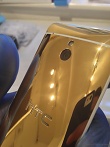
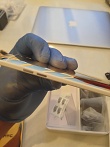
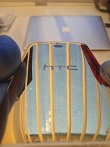
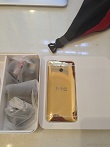
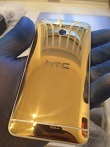
These were sent to us by an anonymous tipster, but we are quite certain that this Gold version of the HTC One mini is a custom gold plated edition, made by a third-party jeweler, and HTC won't be offering it officially.
Apple's gold color variant of the iPhone 5s made a real splash and we are hearing rumors that HTC will following down the same route to liven up the HTC One design.
Unfortunately, there is no word on the pricing and the availability of this gold HTC One Mini.
Thanks to our anonymous tipster for sending this in!
With Vodafone and O2 launching their 4G networks to take on the increasingly speedy LTE offering from EE, we picked up a handset from each carrier (along with an 'Ultrafast' HSPA+ phone from Three) and trawled around London to see what kind of speeds consumers can really expect if they fork out the extra money for the next-generation mobile speeds.
It's very hard to give definitive speed results in any given location, but as London is one of the only places in the UK with 4G from O2, EE and Vodafone at the moment (plus one of the highest densities of masts broadcasting the signal) we considered it adequate for getting a feel for what was on offer when it came to next generation speeds.
How did we test?
We decided to go with a variety of phones all capable of connecting to the 4G signal – in the case of 3 this wasn't necessary, so we stuck with the tried and tested Samsung Galaxy S4.
(We'll be re-testing this with our double-speed 4G-enabled LG G2 in the near future, so stay tuned!)
We used the Speedtest.net app to determine ping rates and download speeds in each location, ensuring there was a 4G connection (or HSPA+ in the case of Three) wherever possible – although no matter how hard we tried, there were occasions where an LTE signal just wasn't happening.
Ping test: to determine latency (the delay) between your phone / tablet and the server. The lower the rate, the faster the connection, and the less time waiting for your data to start arriving.
And in the interests of fairness, we ran the test at least three times on each phone, giving an average score at the end to ensure we didn't get caught out with an anomalous result during the testing.
We gave each network a score out of four for each test to help us determine TechRadar's utterly unofficial Best 4G network.
So how did each network get on? Does Three's claim that its Ultrafast network can be a good stopgap before it brings 4G later in the year hold water? Does EE's double-speed 4G network actually allow users to get much faster speeds (which would be unlikely, given no phones on the market can actually use the connection as yet)?
And can one man walk around London holding nearly £2000-worth of telephony and not get mugged several times?
TechRadar Towers – Balcombe St – 15.54 (indoors)
To kick off our test, we decided to start at home – right in TechRadar's offices. Checking the coverage maps showed that we were supposed to get good indoor coverage with O2, Three and EE, while Vodafone was outdoors only.
Colour us as surprised as a leopard that realises it looks better in pinstripes to find that not only did O2 and EE not manage to get anywhere near the expected speeds (O2 not even finding a 4G signal) but Vodafone defied its own maps to provide blistering speeds time and time again.
Vodafone – 4pts
EE – 3
O2 – 2
Three - 1
London Bridge – 20.15
Next up, a stop at the Shard later in the evening provided a great chance to test connection speeds. With loads of people milling around and a number of offices and homes within reach, this would surely test the signal in a new way, with all networks promising good coverage – and achieving it too for the most part.
EE fans will be pleased to note that once the indoor shackles were off, it leapt to the top of the leaderboard. Vodafone did not fare as well with a 4G signal hard to come by, while O2 and Three sailed through the test.
EE – 4pts
O2 – 3
Three - 2
Vodafone - 1
St Albans – 07.50
Now here's an odd one: while neither O2 nor Vodafone confirmed the outlying parts of London as towns or cities imbued with 4G, several of them were actually able to connect to the service, according to the coverage trackers.
St Albans station was apparently covered with good outdoor 4G signal according to the coverage maps, but only EE managed to get such a thing while waiting for the train, with many other commuters playing with their smartphones at the same time (although few were likely running 4G speeds).
Sadly, Vodafone didn't even manage to connect to the Speedtest.net app, despite multiple attempts, so scored nil points in this test. Three was once again a creditable distance behind the 4G rivals.
EE – 4pts
O2 – 3
Three – 2
Vodafone - 0
St Pancras – 08.25
Now we hit the big leagues – outside one of the busiest stations in London at rush hour. With all networks promising good indoor and outdoor coverage, which would leap to the top of the leaderboard?
Vodafone and O2 were the front runners in this test, with EE a close third and Three some way behind. The latency was a little slower than expected, but it seems the congestion from thousands of phones emerging blinking into signal all at once wasn't helping things.
Fresh from its previous two disasters, Vodafone narrowly missed out on top spot – another excellent showing from the new boy O2.
O2 – 4pts
Vodafone – 3
EE – 2
Three - 1
South Kensington – 10.25
So to quieter locations: in a more affluent area of London, would 4G speeds be slower?
It seems not, as all four networks raised their game in this location. EE really began to flex its muscle in this more open space, while O2 kicked it up a gear once more. Three suddenly remembered that it could pump some pretty whizzy speeds over HSPA+, and even managed to beat the 4G-connected Vodafone into fourth place.
EE – 4pts
O2 – 3
Three – 2
Vodafone - 1
Buckingham Palace – 10.55
For our final test, we wanted to ask the question everyone has been dying to know since the launch of the 4G networks: can the Queen get a 4G signal in Buckingham Palace?
With 4G signals promised once more – and this time delivered promptly and powerfully – this was going to be the test that sorted the 4G men from the GPRS boys.
Three bowed out early on, with a meagre result given its fine showing in Kensington. However, with many tourists thronging around and a number of businesses close by, its 3G networks may have been taxed rather heavily, while its unlikely foreign visitors would be paying up for 4G signal.
Vodafone managed to finally get another one over on its launch rival, boasting speeds just faster than O2, which will please some lovers of the Big Red Network.
However, EE showed that it knows what it's doing with 4G, bringing nearly double the download speed with the lowest ping rate. So if you can't decide whether you want to download an HD movie or watch guards changing at the Queen's London digs, then it looks like EE may be your best bet.
EE – 4 pts
Vodafone – 3
O2 – 2
Three - 1
The results
There's no doubt there's a large gap between Three's 3G Ultrafast network and the next generation speeds on offer. However, there were times when the distance was narrower, so if you're able to hold on until December with speeds hovering around 4-5Mbps on average, then you might just be in for a 4G treat.
EE has definitely got the most robust network on offer, with the fastest speeds shown in most locations, and more often than not far exceeding the competition.
EE – 21 pts
O2 – 17 pts
Vodafone – 11 pts
Three – 9 pts
O2, with less spectrum on offer than its rivals, surprised us in this test by often providing fast and impressive results – however, with a high price plan it will be interesting to see if consumers pay up.
Vodafone looks like it needs to do some more work, but with the red network promising to turn on a mast every 30 minutes in London, perhaps it won't be too long before its coverage map actually mimics real life usage.
We'll be running the same tests again in two weeks' time to see if anything has improved, so stay tuned to see if EE can hold on to its impressive lead.
Want to know if you should really care about 4G? Well, luckily we've spent ages putting together everything you need to know.
It looks like Nestle Germany has let the chocolate out the wrapper after it appeared to confirm that Android KitKat would be launched in October this year.
Replying to a user on its German KitKat Facebook wall, the translated message reads: "Hi Tim, Android 4.4 KIT KAT is available in October".
There have been rumours circulating that Google is planning an event on October 14, at which the search giant is expected to announce details on the next iteration of its mobile platform.
Nexus 5?
We could see KitKat arrive alongside the new Nexus 5, which is also be touted for the event and it could be the flagship smartphone for Android 4.4.
If Android KitKat does arrive in October you can expect Google's Nexus devices to be first in line for the free software upgrade, including the new Nexus 7, Nexus 4 and Nexus 10.
Of course Nestle might just be messing with us - could it instead be referring to the launch of a KitKat in the shape of an Android? We'll wait and see...
Nokia's upcoming phablet, the Lumia 1520 has been doing its rounds in the rumorland for quite some time now. We've only had rumors to rely on when it comes to the topic of what's packed under the hood of the 6-inch beast.
Now, it's all but certain that the Lumia 1520 will be powered by a Qualcomm Snapdragon 800 SoC, according to a tweet from Qualcomm. It looks like the chipset manufacturer (accidentally) revealed the details while responding to a tweet.
As one can expect, the company has since retracted its statement, but not before we all got to know what's powering the upcoming Lumia 1520 phablet.
Nokia Lumia 1520, which was formerly known as Bandit will feature a 20 megapixel PureView camera with Carl Zeiss lens. The newest addition to the phablet club is expected to make its formal entry on October 21.
US ratings service Nielsen has announced that it will be adding watching live TV on a mobile device to its show ratings, bringing it kicking and screaming into the 21st century.
The television monitoring service has slowly but surely been playing catch up with the modern age. Earlier in the year it announced that it would be throwing streaming services such as Netflix and Xbox into its statistical mix and now it has revealed that TV watching on a phone and tablet will also be counted.
There are a number of caveats, though. At the moment it will only be linear television that is counted. So, if you are in the US and are watching live content through apps such as the WatchABC service, then your view counts.
If you are watching through catch-up then this still won't be noted by Nielsen's system.
According to Variety, which broke the story, this new way to analyse TV viewing has been the culmination of three years' work and will help advertisers figure out where people are watching what.
App viewing
It's certainly not a perfect system, though. If a network wants to be part of the Digital Program Ratings system then their app will have to have a special code embedded that will track data for Nielsen.
So far, a pilot of the scheme, has seen ABC, CBS, Fox, NBC, A&E, CW, Discovery, Univision and AOL all sign up.
Given the changing ways the world is watching television, giving advertisers the best knowledge on how shows are watched is essential. Netflix and Lovefilm have always kept their numbers a secret but there are some areas of the TV world where mobile watching is known.
In the UK, iPlayer offers up a monthly update on how many people are watching on tablets and smartphones but this is because it is a publicly funded service.
Nielsen's Digital Programs Ratings system is set to launch in 2014, but it already has a rival. ESPN has been pushing its own ratings service called Project Blueprint.
For those who don't 'get' the whole concept of being a tech addict, the thought of queuing up outside an Apple store on launch day is alien.
I get that. I don't understand why people queue up for the January sales. They're crazy. Total oddballs!
But I can't quite apply that logic to my own behaviour. And so, on a rather chilly morning in late September 2013, I found myself standing in the middle of Cambridge, having gotten up at the kind of time that would make reasonable people wince, just to buy an iPhone 5S.
I was in the city the night before for work – and being from the big smoke, I did that whole 'London' thing of thinking I'd be stealing the march by getting my iPhone from a smaller city.
"No-one's gonna queue in Cambridge! They're all either in bed (students) or in work (rich folk)," I laughed to myself.
I'm not laughing now. And yet I can't stop wanting one.
It just doesn't work
6am, I arrived. Two hours prior to opening. That is late, late, LATE by Apple launch standards. I was practically being chased along by a white rabbit in a dinner jacket, waving a stopwatch.
And what a waste of time it was. More than 1500 people stood outside chatting – and 1400 of them turned away at 8am because stock was sold out.
I didn't get it – in fact, I don't get several things.
Firstly, what is Apple playing at? How can you globally launch a product with such a rubbish amount of stock? There is NO justification. The company was not ready for the launch. Pure and iSimple.
But the other thing I don't get is my own behaviour. My own determination to get one. That need, that hunger.
Soft launch
The launch wasn't that spectacular. I've spent the last week waving my Galaxy S4 around, telling iSheep to just bore off. But the sad fact is, I really want a 5S. I've not been true to myself. I'm a fraud.
The sad thing is – I don't know why. I mean, it's not as if the iPhone 5S is ultra amazing. It has a smaller screen than my S4, the processor may be enough to power a hydraulic dam, but really – do we need one that powerful in a phone?
I suppose there is the fingerprint scanner. Actually, that bit is cool. Really cool. I'm gonna be wearing that out from day one! When I get my hands on the flaming thing.
Apple has a mean marketing machine. The worrying thing is that I KNOW I've been brainwashed. Even going into a shop and playing with one after the launch, mentally torturing my empty hand, I was lusting. It's the capability of genius – make that desire come alive.
I wouldn't mind but I love Android. I love its openness, its customisation abilities and all the rest of it. Sometimes, it can be a little rough around the edges and I hate the adverts you are stuck with on some apps, but it's a trade off.
Yet all I can think of now is getting my face firmly nestled once again in Mother Apple's warm eco-busom. And I dread to think when that's going to happen.
So far, I've looked at eBay (what do you mean "wait ten days?" That just isn't an option!) and the one I want (Gold 64GB) is going for around £1400! It's the old story of supply and demand. And the fact is that loads of these beauties went to people who queued up for hours, days even, not because they wanted one. But because they wanted to sell them for a profit to mugs like me!
It'll probably be months before I get one. But that hasn't diminished my lust for an iPhone 5S. I still long for the days when I can finger the Touch ID sensor, pressing down to enter. And every time I do, the Android-lover in me will shudder.
But I can't help it. Damn you, Apple.
I've reviewed dozens of phones and tablets for TechRadar over the years – each time putting them through their paces in the most unbiased, rigorous way possible.
But as well as being a professional, I have a love/hate relationship with tech, and that's what these columns are all about: the passionate howlings of a true fanboy. Tell me why I'm right, wrong or a hopeless idiot in the comments below or by tweeting @techradar or @phillavelle.
Soon to be ex-Microsoft CEO Steve Ballmer has admitted that his greatest regret while in charge of the Redmond firm was missing out on the early days of the smartphone.
Speaking at an analyst meeting in Washington, Ballmer opened up about his time in charge of Microsoft and what happened when smartphones first entered the fray.
"I regret that there was a period in the early 2000s when we were so focused on what we had to do around Windows that we weren't able to redeploy talent to the new device form factor called the phone," he explained.
As iOS and Android begun to take off, Microsoft was still focussing on its PC business. It did have its Windows Mobile platform, but that was never capable of challenging the new offerings from Apple and Google.
Better for Windows
"That is the thing I'd tell you I regret the most, because the time we missed was about the time we were working away on Vista and I now wish we had our resources slightly differently deployed during that time.
"It would have been better for Windows and better for our success in other form factors."
Windows Phone wasn't launched until late 2010, several years after its rivals, putting Microsoft on the back foot immediately and since then we've witnessed it struggle to get a solid foot hold in the market.
The recent takeover of Nokia by Microsoft signals intent from the firm that it's taking mobile seriously and it will look to cement its third place in the mobile market - although it's still some way off the top two.