Tuesday, November 13, 2012

T-Mobile to sell unsubsidized 16GB Nexus 4 for $499 in US

T-Mobile has announced that they would be selling the 16GB Nexus 4 for $499 in the US, unsubsidized. That's rather high, as the phone costs only $349 on Google Play.


The other option they offer you is the ability to purchase the phone for $199 but with a two-year contract, so any money saved on the phone's purchase will be spent through the monthly bills and you will certainly end up paying more than $349.

It seems purchasing the phone through Google Play is still the best option. Unfortunately, the phone quickly went out of stock on Google's store, so if you want it urgently for some reason, T-Mobile would be your only choice.

Fortunately, as The Verge reports, the handsets sold by T-Mobile are identical to the ones sold directly by Google, which means they have no carrier bloatware and will get updates at the same time.

Source


Source : http://www.gsmarena.com/tmobile_to_sell_unsubsidized_16gb_nexus_4_for_499_in_us-news-5079.php

Nokia rebrands mapping service to Nokia HERE

In a San Francisco event, Nokia CEO Stephen Elop announced that the company will be rebranding their mapping service and will be calling it Nokia HERE. While the service will mostly remain the same, Nokia has added some cool new features.


First is a feature called Collections, which lets you save locations to your Nokia account so you can quickly jump to them without having to search for them every time. The locations sync across devices after you log into your Nokia account. Collections is similar to the starring feature in Google Maps.

Another new feature is 3D maps, where you get a 3D view of several key locations around the world. This feature is identical to the Flyover feature in the new Apple Maps and the data is actually provided by the same company, C3 Technologies.

Nokia has also added a maps editor, so users can now update street names and traffic information and the information will be added to the maps for others to see.

Nokia also acquired street view mapping company Earthmine, which brings street view functionality to Nokia's maps.

Now here's the best part. Nokia will be bringing their HERE maps to iOS and Android as well. The iOS and Android apps will be released soon and Nokia will also be providing the maps SDK to Android OEMs so they can integrate it within their apps. The iOS version includes turn by turn directions and public transportation information and is currently pending Apple's approval. A web version for Mozilla's upcoming Firefox OS will be released next year.

You can also check out Nokia HERE on your web browser by clicking, well, HERE.

Source 1 • Source 2 • Source 3


Source : http://www.gsmarena.com/nokia_rebrands_mapping_service_to_nokia_here-news-5078.php

BB10 phones to ship ‘within 30 days’ of Jan 30 unveiling event

research-in-motion

Research In Motion's promise that its next-generation BB10 OS and handsets will launch in the first quarter of 2013 appears to be holding steady, with the company announcing on Tuesday that its new handsets are set to ship "within 30 days" of the January 30 unveiling event.

– Next-gen handsets sent to carriers for testing? Check.

– Important security certification for next-gen handsets received? Check.

– Unveiling date of next-gen handsets set? Check.

– Launch date for next-gent handsets set? Er, well, kind of. Y’know. Yes….broadly speaking. Um…

On Monday, Research In Motion announced that its long-awaited next-generation BB10 operating system and handsets will be unveiled on January 30. Unveiling is all well and good, but many were left wondering when the actual launch date will be. Well, now we know. Sort of.

In an interview with Bloomberg on Tuesday, RIM’s chief operating officer Kristian Tear said the company wanted to launch the devices “as quickly as possible”, with the first BB10 devices hitting stores on multiple continents “within 30 days” of the January 30 unveiling event.

Technically, this means consumers interested in getting their hands on a new BB10 device might have to wait till the beginning of March, but let’s hope – for RIM’s sake – it means early February.

The Ontario-based mobile company had hoped to launch BB10 last year but was left red-faced when it was forced to admit its new OS and handsets weren’t ready. Its latest promise, which has been holding firm for a while now, is that it’ll launch during the first quarter of 2013.

RIM has been doing its best to stay in the headlines recently, pushing out a number of news releases keeping consumers up to date with what’s happening with BB10. Last month the company announced the devices had been sent for testing to more than 50 carriers worldwide. And just last week BB10 received important security clearance that will allow the new handsets to be used by government agencies in the US and Canada.

“The hard work will not stop here as we build towards launch,” RIM boss Thorsten Heins said in October. “Our developer teams are continuing to generate momentum to bring a wealth of applications to BlackBerry 10, our enterprise teams have started to present BlackBerry 10 devices and services to our business customers, and our engineers are fully mobilized to ensure that BlackBerry 10 launches flawlessly in the first quarter of 2013.”

It sounds like everything is going to plan. Now let’s just hope those new phones really do see the light of day “within 30 days” of the unveiling event at the end of January.


Source : http://www.digitaltrends.com/mobile/bb10-phones-to-ship-within-30-days-of-jan-30-unveiling-event/

Would you use an e-book version of Netflix?

Is the only thing standing between you and literary indulgence a lack of time and material to read? A new start-up that aims to put an entire library at your fingertips through your smartphone aims to change that.

By now, we’re used to the subscription streaming model for both visual and audio entertainment, with Netflix, Amazon Prime, Spotify, Pandora et al having convinced us that we don’t really need to own media anymore as long as we have a strong wifi connection and the right kind of device in order to enjoy it wherever and whenever we want. But how far will this thinking stretch, exactly? Could you see yourself signing up for a monthly subscription to an ebook library?

It’s an interesting question. After all, prose books aren’t exactly the same kind of “passive” media as music, or even movies or television; you rarely (if ever) hear of someone reading a book in the background while engaged in other activities in the same way that they might listen to music or even half-pay attention to whatever’s on the television in the room, for example. Reading a book requires a commitment that changes our relationship with the media, and may mean that readers are more likely to purchase their ebooks rather than rent them. Not that there’s not a long history of “renting” books, which is another potential bump in the road for the paid subscription model for ebooks: There’s such a thing as your local library, which does much the same thing, but for free (There is also Amazon’s Kindle Lending Library, which is free for Amazon Prime subscribers, of course).

None of this has scared off the Oyster start-up, however.

The New York-based company is the brainchild of Eric Stromberg, Andrew Brown and Willem Van Lancker, who collectively wrote in a debut blog post that the company was “inspired by the belief that the transformation from the print book to digital is still in its earliest phase,” and the result of thinking “deeply about the future of long-form narrative.” Aimed at, in their words, “an audience that aspires to read more,” the app will allow users to read as much as they want from “an ever-growing library of books” for a single monthly price.

The focus on smartphones means a reformatting of the books themselves, it seems. “Today’s book reading products were never envisioned with phones in mind – they are incomplete and shrunken copies of their tablet counterparts,” explains the blog post, adding that Oyster will be “an end-to-end product created specifically for mobile.” But that won’t be the only differentiator from print books or digital copies from other sources; Stromberg, Brown and Van Lancker explain that what may truly appeal to hardcore readers is Oyster’s superior discovery process. “Currently, people buy books online in the exact same way that they buy lamps, blenders and kitchen knives,” they explain. “The process of finding your next book is very different from purchasing a knife, and it should be treated that way.”

Oyster is currently in the process of signing up new investors as well as publishers and authors interested in adding their books to the company’s library. No launch date nor subscription cost has been revealed as yet.


Source : http://www.digitaltrends.com/mobile/would-you-use-an-ebook-version-of-netflix/

New Motorola program lets users 'Test Drive' Android 4.2

New Motorola program lets users 'Test Drive' Android 4.2
Upgrade away

Motorola is introducing a new program that lets its customers give the latest Android operating systems a go before the OSes hit their phones.

Called Test Drive, the program is a two-way street: users get to take the software for a trial run while providing Motorola feedback before the upgrades go public.

Motorola is wasting now time putting the most premium of upgrades into Test Drive's fuselage as Android 4.2, the latest flavor of Jelly Bean, will be the first preview out of the blocks.

The preview is only open to a few hundred customer who sign-up for Test Drive, though Motorola hasn't released sign-up or participation details yet.

Not all in

The Test Drive announcement, made through the Inside Motorola blog, contained another kernel of information some customers might raise an eyebrow at.

According to the post, in an effort to deliver a consistently high quality experience, not all phones will receive upgrades moving forward.

Motorola is offering a trade up program for the left-out phones, offering customers $100 (UK£63, AUD$95) back on a new Motorola smartphone when they trade in an old one.

"[S]o you don't have to miss out on Jelly Bean," the company assured.

Phones eligible for trade up include the Atrix 2, Xprt, Titanium and Triumph.

While it's a bit of a bummer to have to put down an old phone, customers can upgrade to devices like the Droid Razr Maxx HD, Droid Razr M and Droid Razr HD, phones that might lessen the separation blues.


Source : http://www.techradar.com/news/phone-and-communications/mobile-phones/new-motorola-program-lets-users-test-drive-android-4-2-1112377

Facebook, iMessage, Gtalk apps prompt first decline in text messaging

Facebook, iMessage, Gtalk apps prompt first decline in text messaging
IM taking a chunk out of SMS revenue

Free instant messaging apps like iMessage and Facebook Messenger have caused the first ever decline in texts sent in the U.S., according to new research.

The report from mobile analyst Chetan Sharma, claimed the average mobile user sent 678 texts a month in the last quarter. That represents a slight drop from 696 sent per-user in the previous quarter.

Sharma attributes the fall, which has already been evidenced in other countries, to users relying on internet-based alternatives like Apple's iMessage app and the Gtalk equivalent for Android devices.

There's also cross-platform solutions like Facebook Messenger, Twitter, Skype and What's App, all of which make it exponentially easier for smartphone owners to chat for free without spending text allowances.

Data saviour

"Most western markets have seen the net revenue in the messaging segment decline. The US market has resisted the decline thus far," wrote Sharma in his independent report.

"In Q3 2012, for the first time, there was a decline in both the total number of messages as well as the total messaging revenue in the market."

The slight fall in text message revenue would be bad news for mobile operators had they not shifted the weighting of price plans in order to account for the massive growth of mobile data use.


Source : http://www.techradar.com/news/phone-and-communications/mobile-phones/facebook-imessage-gtalk-apps-prompt-first-decline-in-text-messaging-1112375

HTC Droid DNA hands on: A 1080p dream come true

We get our hands on the HTC Droid DNA, the newest flagship phone on Verizon. Does it have what it takes to compete against the litany of powerful smartphones available this holiday season?

If you thought choosing between the Samsung Galaxy S3, Galaxy Note 2, iPhone 5, HTC 8X, Motorola Droid HD, LG Optimus G, Sony Xperia TL, Nokia Lumia 920, and Google Nexus 4 was tough, brace yourself: Things are only getting worse. (Or better, depending on your outlook.) Today, HTC and Verizon unveiled the Droid DNA, another flagship phone that desperately wants to make friends with your hand, and wallet. After the announcement, we were able to get some hands-on time with the new Droid DNA. Here’s what we think.

Best. Screen. Ever.

This is a bold statement to make, but we cannot recall a phone screen that looks as good as HTC’s new Droid DNA. Like the first time we set our eyes on the ‘Retina,’ high-resolution iPad 3, looking at the Droid DNA’s 5-inch 1080p (1920 x 1080 pixel) Super LCD 3 screen is a jaw-dropping experience. It’s pixel density is 440 pixels per inch, which is significantly denser than even the iPhone 5′s screen. After staring at the DNA’s screen for a while, going back to a 720p screen was not fun.

More impressive is the speed and fluidity of the Android operating system on this phone. For the first time, Android’s animation and fluidity appear on par with the iPhone 5. We don’t know if it’s entirely Android 4.1 (Jelly Bean) or if HTC’s Sense 4.0+ user interface actually speeds up the OS, but everything moves fast on the DNA. Google talked about ‘Project Butter’ when it unveiled Jelly Bean in the summer, but the Droid DNA is the first Android phone we’ve seen where the jump in speed is noticeable. Of course, the quad-core Snapdragon S4 processor and 2GB of RAM may also contribute to the Droid’s prowess.

There’s nothing quite like watching a 1080p video on a 1080p screen this small. It’s gorgeous. Unfortunately, due to the limited 16GB of internal memory and lack of microSD support, you won’t be able to download many movies to your Droid DNA. 

Stylish design

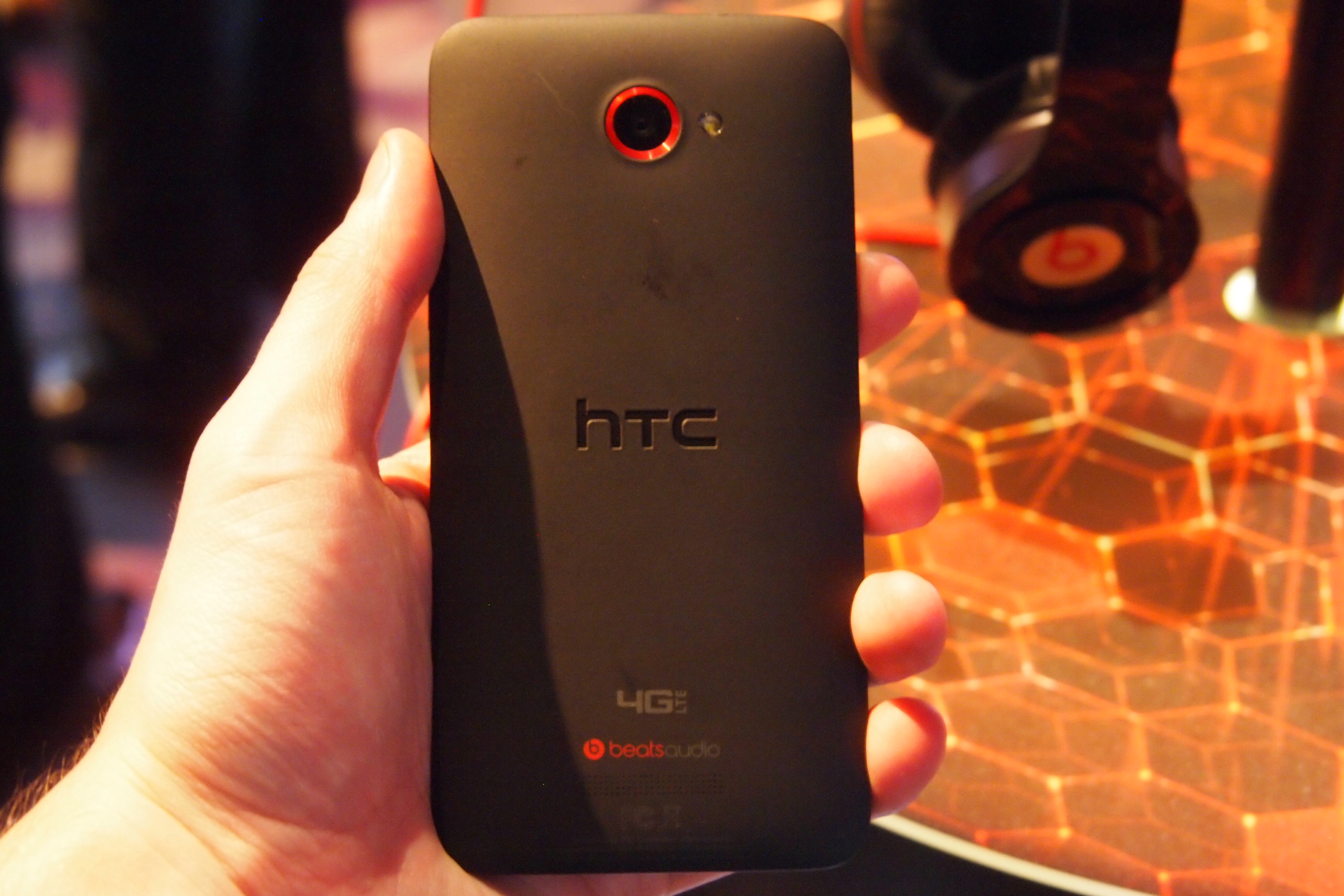
HTC has had a rough year. It’s top Android handsets have been handily outsold by Samsung. Things got bad enough that it was posting losses. But instead of wallowing and waiting, HTC continues to push forward, kicking its designs and performance up a notch with every phone unveiling. We recently labeled the HTC 8X as our favorite Windows Phone 8 device, and the Droid DNA may take the top spot for Android. Everything about the look and feel of the DNA, aside from its Verizon black and red color scheme, appears top notch. The device is thin: only 4mm at its edges, and is designed with the hand in mind. HTC has built a gradual hump into the back of the phone, which your hand cradles as you hold it. Though conventional wisdom argues that thinner is better, Having a rounded back is surprisingly comfortable.

On the edges of the phone, HTC has included a grill of sorts, as well. We don’t think this adds a lot to the experience, but it definitely doesn’t hurt. Did we mention that it can charge wirelessly?

All the conveniences of a modern HTC phone

HTC hasn’t gained much attention this year, but its hardware and Android user interface is more consistent than what a lot of manufacturers are pumping out. The Droid DNA has all of the good features we’ve come to like in phones like the One X. The Music app, for example, still aggregates all of the music on your device, regardless of its source; it’s a single place where you can find music from all your different apps, like Pandora, Spotify, Amazon MP3, etc. Like all HTC devices, the DNA also appears to have an excellent 8-megapixel camera, complete with the fancy ‘ImageSense’ chip that HTC includes in its top phones. The front-facing camera from the 8X is also included, which has a wide-angle lens so you can fit more of your friends in a photo.

Destined for greatness?

We don’t know if the Droid DNA will be a hit phone this holiday season or just another crashing wave on the smartphone shores. It has some hefty competition, and the fact that it’s a Verizon exclusive will work against its potential to compete with the Galaxy S3 and iPhone 5. But after using the Droid DNA, we think it would be dumb to count HTC out. The DNA builds on all of the forward strides HTC has made in 2012 and may be its best phone yet. We can’t wait to try it again.

The HTC Droid DNA will be released on November 21 for $200, with a two-year contract. Check out our spec comparisons to learn more: HTC Droid DNA vs. iPhone 5 vs. Galaxy S3 and Droid DNA vs. Galaxy Note 2 vs. LG Intuition.


Source : http://www.digitaltrends.com/mobile/htc-droid-dna-hands-on/